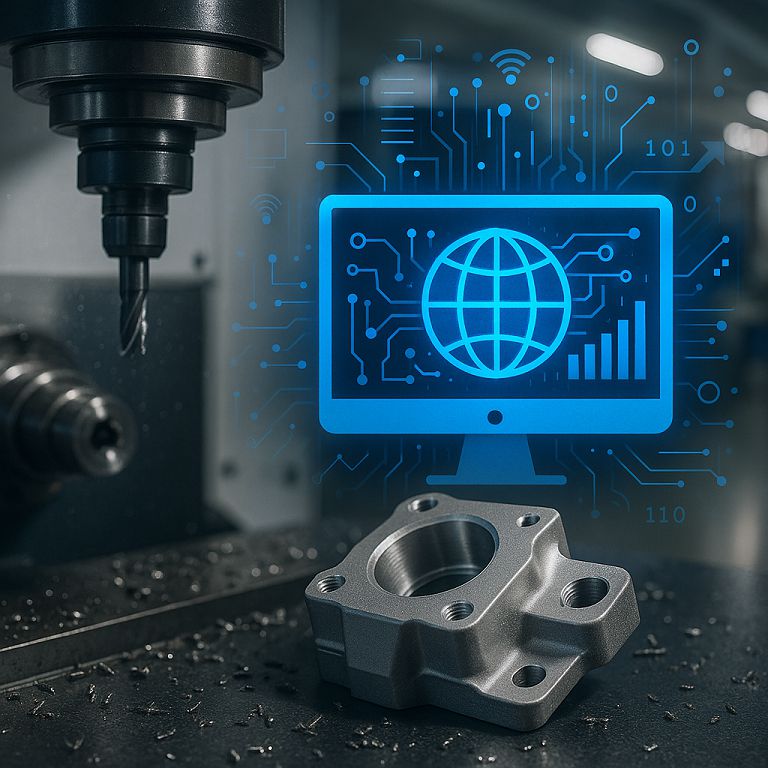
The Driving Forces Behind Digital Transformation
Several key factors are pushing precision machining companies toward digitalization:
Customer expectations: Clients now demand faster turnaround times, full traceability, and real-time updates on production progress.
Global competition: Manufacturers must improve efficiency and responsiveness to stay competitive in international markets.
Complex product designs: As industries like aerospace, medical, and semiconductors evolve, parts are becoming more intricate and require digital precision throughout production.
Data availability: Modern CNC machines and sensors generate vast amounts of data that can be analyzed for performance insights.
These forces are compelling precision machining companies to move beyond traditional production methods and embrace Industry 4.0 technologies.
Core Technologies in Digital Transformation
1. Smart CNC Machines and IoT Integration
Today’s CNC machines are equipped with sensors that monitor temperature, vibration, spindle speed, and cutting performance in real time.
Through the Industrial Internet of Things (IIoT), this data is transmitted to central platforms, allowing operators to track machine health, detect inefficiencies, and perform predictive maintenance before failures occur.
2. Data Analytics and Artificial Intelligence
AI-powered analytics tools process real-time production data to optimize cutting parameters, reduce downtime, and improve material utilization.
Machine learning algorithms can even predict tool wear and automatically adjust settings to maintain consistent quality—turning machining into a data-driven science.
3. Digital Twins and Virtual Simulation
A digital twin is a virtual replica of a physical process, machine, or system. In precision machining, digital twins enable manufacturers to simulate toolpaths, machining forces, and surface finishes before actual production.
This reduces trial-and-error cycles, shortens setup times, and improves first-pass yield.
4. Automation and Robotics
Automated tool changers, robotic arms, and pallet systems are now standard features in advanced machining workshops.
When connected to digital management systems, these technologies enable lights-out manufacturing, where production continues around the clock with minimal human supervision.
5. Cloud-Based Manufacturing Platforms
Cloud-based systems allow seamless collaboration between engineers, production teams, and clients.
Digital job tracking, remote monitoring, and instant reporting streamline communication and ensure transparency throughout the manufacturing process.
The Benefits of Digital Transformation
By adopting digital technologies, precision machining companies can achieve:
Higher efficiency: Real-time monitoring and analytics reduce waste and improve productivity.
Better quality control: Automated inspection and closed-loop feedback ensure consistent accuracy.
Faster delivery times: Smart scheduling and predictive planning shorten production cycles.
Greater flexibility: Digital systems allow quick reconfiguration for custom or small-batch orders.
Enhanced competitiveness: Digitalized manufacturers can respond faster to market and customer demands.
Challenges on the Road to Transformation
Despite its advantages, digital transformation poses challenges:
High initial investment in equipment, software, and training.
Workforce adaptation, as employees must learn digital tools and data analysis.
Cybersecurity risks associated with connected systems and data sharing.
Integration complexity between legacy machines and new digital systems.
Overcoming these obstacles requires strategic planning, cross-functional collaboration, and a long-term commitment to innovation.
The Future of Digital Precision Machining
The digital transformation of precision machining is ongoing, with AI, cloud computing, and automation leading the way toward fully intelligent manufacturing ecosystems.
In the near future, factories will operate as interconnected networks where machines communicate autonomously, data flows seamlessly, and decisions are made instantly based on predictive insights.
Summary
Digital transformation is redefining the precision machining industry from the ground up.
It is not merely a technological upgrade—it is a complete evolution of how manufacturers design, produce, and deliver value.
Companies that embrace this shift will not only achieve greater efficiency and precision but also position themselves as leaders in the next generation of smart manufacturing.
Get more info, please visit our CNC Turning Parts or Products. Contact us for your customized metal parts.