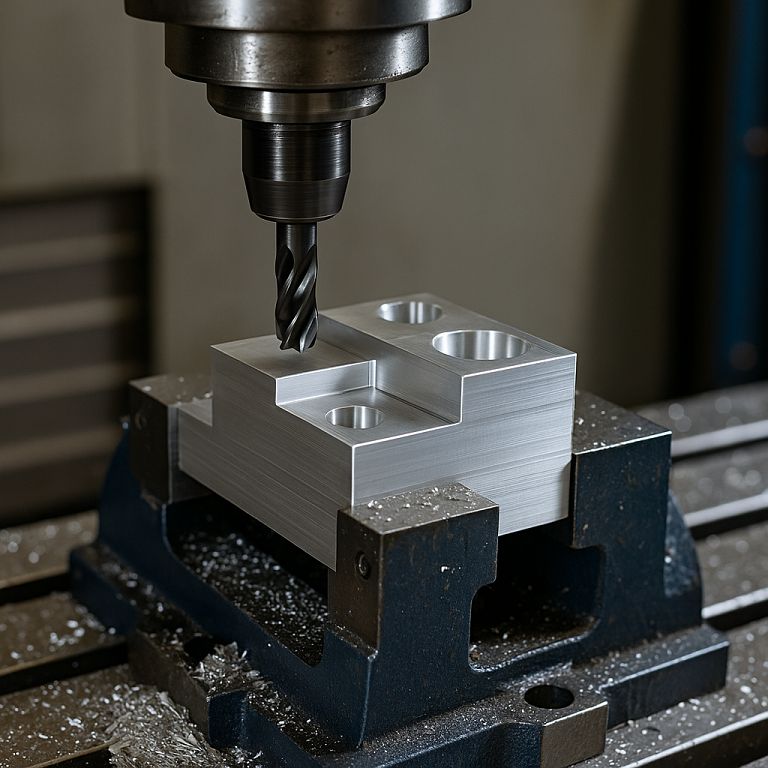
1. Focus on Cost Optimization at the Design Stage
The most effective cost optimization begins long before machining starts. Collaborating with engineers during the design phase allows for simplification of part geometry, standardization of dimensions, and smarter material selection.
Designing for manufacturability ensures that parts can be produced efficiently, with minimal setups and reduced waste. Even small design adjustments—like eliminating unnecessary features or optimizing tolerances—can have a large impact on overall machining costs.
2. Implement Automation to Reduce Labor Costs
Automation is one of the most powerful tools for reducing manufacturing expenses. Robotic arms, automatic tool changers, and pallet systems enable lights-out machining, allowing production to continue around the clock with minimal supervision.
By automating repetitive or low-value tasks, skilled operators can focus on programming, quality inspection, and process optimization. This not only improves machining efficiency but also helps stabilize production costs in the long term.
3. Extend Tool Life Through Proper Maintenance and Cutting Strategies
Tooling represents a significant portion of machining costs. Maximizing tool life requires careful attention to cutting parameters, tool coatings, and maintenance practices.
Using advanced cutting fluids, optimizing feed rates, and monitoring spindle loads can prevent premature wear. Implementing predictive maintenance—supported by AI or real-time monitoring—helps identify tool degradation before it affects part quality.
Longer tool life directly translates into fewer tool changes, less downtime, and better cost optimization.
4. Improve Machining Efficiency Through Process Optimization
High machining efficiency comes from eliminating waste and streamlining workflow. Multi-axis CNC machines can reduce setups, while optimized cutting paths shorten cycle times.
Using simulation software allows manufacturers to analyze and refine machining strategies before production, reducing trial-and-error costs. Integrating real-time monitoring and data analytics enables continuous improvement and higher throughput.
Additionally, adopting hybrid manufacturing—combining additive and subtractive processes—can further enhance machining efficiency for complex parts by reducing unnecessary material removal.
5. Increase Yield Rate Through Quality Control and Automation
A high yield rate ensures that more parts meet specifications the first time, reducing rework and scrap. Automated inspection systems, such as coordinate measuring machines (CMMs) and optical scanners, can detect deviations early in the process.
Closed-loop feedback between inspection data and CNC systems allows immediate corrections, improving consistency and repeatability.
When automation and data analytics are integrated into production, quality becomes predictable, and the yield rate rises significantly—enhancing profitability and customer satisfaction.
6. Optimize Material Utilization
Raw materials often represent one of the largest cost drivers in precision machining. Nesting strategies, near-net-shape machining, and recycling of metal chips all contribute to cost optimization.
Selecting materials with better machinability can also extend tool life and improve machining efficiency, further lowering overall costs.
Summary
Reducing machining costs without sacrificing quality requires a holistic approach built on cost optimization, automation, extended tool life, improved machining efficiency, and a higher yield rate.
By combining advanced technology with smart engineering and data-driven decision-making, manufacturers can achieve sustainable savings while maintaining superior precision and reliability.
The companies that successfully balance cost and quality will be the ones leading the future of precision manufacturing.
Get our Product Category To know Facilities of Unisontek.