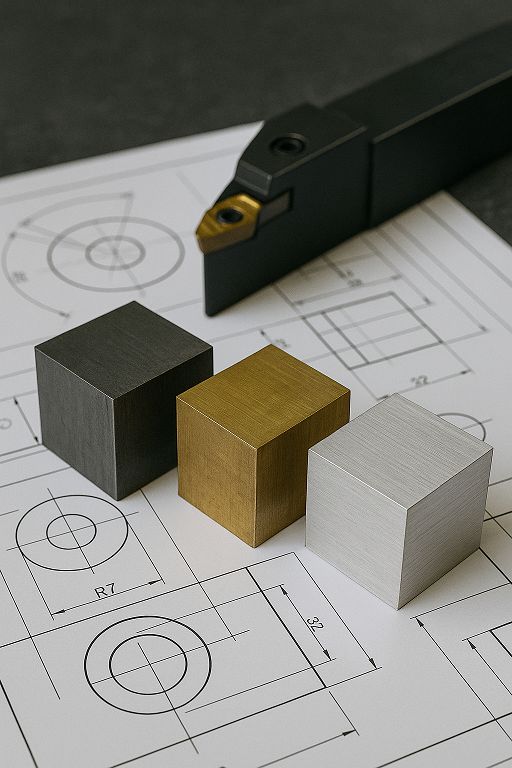
Understand Material Characteristics and Cutting Resistance
Different workpiece materials exhibit varying levels of cutting resistance, heat generation, and wear behavior.
Understanding how each material responds to cutting forces allows machinists to choose a tool material that can withstand stress without premature damage.
Soft materials like aluminum require sharp cutting edges and high chip evacuation efficiency.
Hardened or high-strength alloys demand tough, heat-resistant tool materials to withstand continuous stress.
Matching tool hardness and toughness to the material’s behavior is the foundation of achieving long tool life.
Choosing Tool Materials: Carbide, CBN, and PCD
While carbide tools are widely used for general machining, advanced applications often require premium tool materials such as CBN and PCD to handle specific cutting environments.
Carbide
Good balance of hardness and toughness
Suitable for most steels and general machining
Available in coated and uncoated forms to enhance tool life
CBN (Cubic Boron Nitride)
Extremely hard and heat-resistant
Ideal for hardened steels and cast irons
Maintains tool life even under heavy loads and high temperatures
PCD (Polycrystalline Diamond)
Ultra-hard, low-friction cutting material
Best for aluminum, copper, and abrasive non-ferrous materials
Provides superior surface finish and extended tool life when machining soft, gummy metals
Selecting CBN or PCD can significantly improve performance and reduce tool wear—especially in demanding or specialized applications.
Optimize Tool Geometry to Reduce Cutting Resistance
Tool geometry—including rake angle, clearance angle, and edge radius—has a major impact on cutting resistance and chip formation.
General guidelines:
Positive rake angles reduce cutting forces and heat, ideal for thin-walled or delicate parts.
Sharp cutting edges improve finish but can reduce tool life if cutting forces are high.
Stronger cutting edges with larger edge radius improve durability for roughing operations.
Selecting the right geometry depends on balancing load, strength, and precision.
Adjust Feed Rate for Stability and Finish
The feed rate plays a key role in tool performance and surface quality.
Too high a feed rate increases cutting resistance, causing edge chipping or deformation.
Too low a feed rate can cause tool rubbing, heat buildup, and shortened tool life.
The right feed rate ensures consistent chip formation, stable temperature control, and predictable tool wear.
Combine Material, Geometry, and Cutting Strategy
Optimal results come from selecting tool material and geometry together, rather than individually:
| Workpiece | Ideal Tool Material | Geometry Strategy | Feed Rate Advice |
|---|---|---|---|
| Hardened steel | CBN | Strong edge, moderate rake | Moderate feed to avoid chipping |
| Aluminum / copper alloys | PCD | Sharp edge, positive rake | Higher feed to avoid rubbing |
| Stainless steel | Coated carbide | Balanced edge prep | Steady feed to reduce heat buildup |
This integrated approach maximizes tool life and machining efficiency.
Summary
Selecting the right tool material and geometry directly influences tool life, machining stability, and cost efficiency.
Premium materials like CBN and PCD offer excellent performance for specialized applications, while careful control of cutting resistance, tool geometry, and feed rate ensures consistent results.
By understanding material behavior and adjusting tool strategy accordingly, manufacturers can achieve high-quality machining with longer-lasting tools and improved productivity.
Get more info, please visit our CNC Turning Parts or Products. Contact us for your customized metal parts.