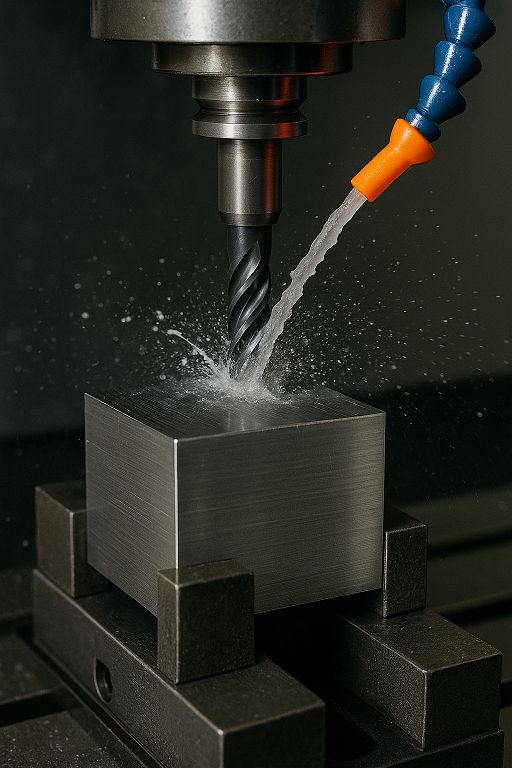
Understanding Thermal Deformation in Machining
Thermal deformation occurs when excessive heat causes a workpiece, tool, or machine structure to expand unevenly. Even microns of distortion can lead to dimensional inaccuracy—particularly in industries such as aerospace, optics, and semiconductors, where tolerances are extremely tight.
Heat accumulation can affect multiple components:
Workpiece expansion distorts the final geometry.
Tool elongation alters cutting depth and surface finish.
Machine structure drift shifts the relative position between tool and part, reducing accuracy stability.
Recognizing these heat-induced variations early is key to implementing effective thermal control strategies.
1. Optimize Coolant Application
Efficient coolant management is the most direct way to reduce heat buildup. The coolant not only removes heat from the cutting zone but also helps maintain machining stability by flushing chips and lubricating the interface.
Best practices for coolant use:
Apply coolant directly at the tool–workpiece contact area for maximum heat extraction.
Use high-pressure or through-spindle delivery to enhance cooling performance.
Maintain consistent coolant temperature; thermal shock from fluctuating coolant temperatures can worsen deformation.
For long cycles, consider using temperature-controlled chillers to maintain thermal control throughout production.
2. Adjust Cutting Parameters to Minimize Heat
Cutting speed, feed rate, and depth of cut significantly influence heat generation. Poorly optimized cutting parameters can cause excessive friction and thermal load.
Optimization guidelines:
Reduce cutting speed to control temperature, especially in tough materials.
Use a balanced feed rate—too high increases heat; too low can cause tool rubbing.
Employ multiple light passes instead of deep, heavy cuts to lower the thermal gradient.
Select tool coatings designed for heat resistance and friction reduction.
By refining cutting parameters, machinists can balance productivity with accuracy stability and tool longevity.
3. Enhance Machine and Process Thermal Control
Modern CNC machines are equipped with thermal control systems to maintain consistent temperature across critical components.
For long machining cycles, it’s essential to ensure these systems are calibrated and operating effectively.
Thermal control methods:
Preheat the machine to reach thermal equilibrium before production begins.
Implement spindle and coolant temperature monitoring systems.
Use temperature-compensation algorithms or sensors integrated into the CNC control.
Schedule regular thermal calibration to sustain accuracy stability over time.
Proper thermal control not only prevents dimensional drift but also improves machine reliability and long-term machining stability.
4. Design Processes to Balance Heat Distribution
Uneven heat accumulation across the workpiece can result in asymmetrical expansion. Strategic process design helps distribute thermal energy evenly.
Recommendations:
Alternate machining sides to balance internal stress and heat buildup.
Use adaptive toolpaths that minimize local friction concentration.
For large parts, allow short cooling intervals between machining stages.
Maintaining temperature uniformity across the workpiece is crucial for dimensional consistency and accuracy stability.
5. Continuous Monitoring for Thermal Accuracy
Real-time temperature and dimensional feedback systems allow operators to identify trends before they affect product quality.
Integration of sensors and predictive control systems helps anticipate potential deformation, ensuring machining stability during long runs.
By combining monitoring data with cutting parameter adjustments, manufacturers can proactively manage thermal control for superior part accuracy and reduced waste.
Summary
Reducing thermal deformation during long machining cycles requires a holistic approach—combining effective coolant management, optimized cutting parameters, and advanced thermal control systems.
These strategies not only protect accuracy stability but also improve machining stability, extend tool life, and reduce rework costs.
In today’s high-precision manufacturing world, mastering temperature management is essential to achieving consistent, reliable, and repeatable results—no matter how long the machining process runs.
Get more info, please visit our CNC Turning Parts or Products.
Contact us for your customized metal parts.