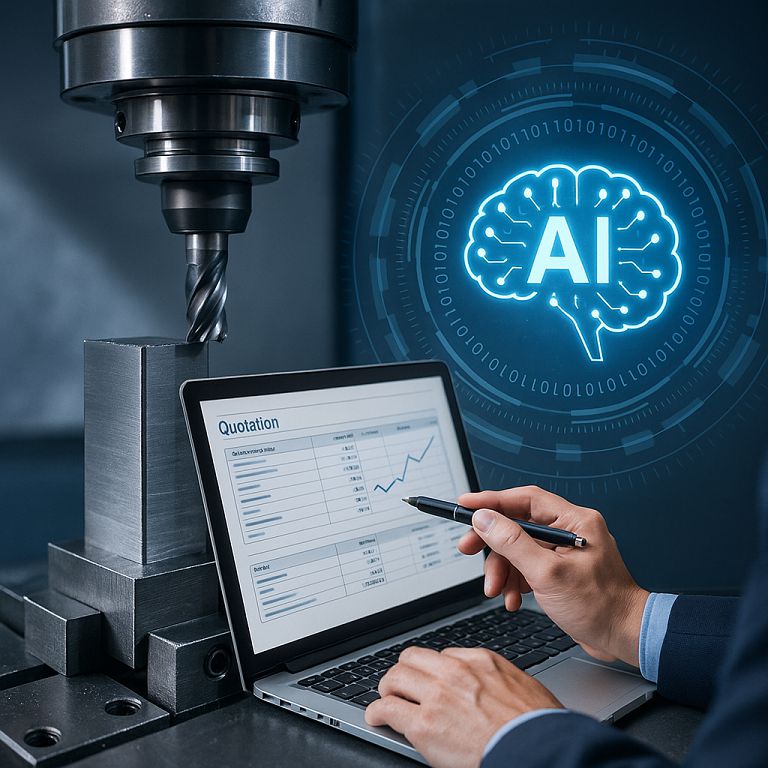
The Evolution of AI in Manufacturing
Traditionally, machining parameters and quotations relied heavily on human experience. Engineers determined feeds, speeds, and costs through trial, calculation, and reference charts.
While effective, this approach was limited by subjective judgment and time-consuming manual adjustments.
Today, AI quotation and machine learning algorithms leverage large datasets—from past jobs, tool wear data, and material properties—to generate predictive models that can simulate outcomes instantly.
These intelligent systems are transforming both production planning and business decision-making.
AI Quotation: From Estimation to Intelligent Costing
AI quotation systems go far beyond conventional cost estimation spreadsheets.
Using advanced data analysis, they can instantly calculate machining time, material usage, tool costs, and overhead based on part geometry and production complexity.
Benefits of AI quotation systems include:
Automated cost prediction: AI models assess machining time and tool paths to generate fast, accurate quotes.
Dynamic pricing: Adjusts automatically for changing material prices, labor rates, or production volume.
Data-driven accuracy: Uses historical job data to refine estimates over time.
Reduced manual input: Saves engineering time and shortens response cycles for customer requests.
By applying AI quotation, manufacturers can improve pricing precision, win more bids, and maintain profitability under competitive market conditions.
Machine Learning for Parameter Optimization
Machine learning algorithms play a key role in parameter optimization—analyzing thousands of machining records to determine the best cutting conditions for each material, tool, and setup.
How it works:
Sensors and CNC systems collect data on spindle speed, feed rate, torque, and vibration.
AI performs data analysis to identify patterns between parameters and part quality.
The system recommends or automatically adjusts cutting conditions to improve efficiency.
This continuous learning loop enables the system to refine machining performance in real time—reducing tool wear, improving surface finish, and maximizing cost prediction accuracy through direct process feedback.
Data Analysis for Process Insight
AI-driven data analysis converts raw machining data into actionable insights.
By correlating temperature, tool load, and surface quality, manufacturers can pinpoint inefficiencies and forecast process outcomes before they occur.
Applications of AI-based data analysis:
Predicting tool wear and maintenance schedules.
Detecting deviations in cycle time or machine behavior.
Estimating energy consumption and sustainability performance.
Improving traceability for quality assurance and compliance.
Accurate data analysis not only enhances parameter optimization but also supports strategic decision-making across engineering, production, and finance departments.
Cost Prediction for Smarter Business Decisions
Accurate cost prediction is essential for profitability in machining. AI tools integrate design geometry, material selection, and process parameters to estimate total costs with remarkable precision.
Key advantages:
Faster and more consistent quotations for customers.
Identification of cost drivers such as tool changes or non-cutting time.
Scenario analysis for “what-if” production planning.
Alignment of machining strategies with financial goals.
By integrating cost prediction with AI quotation, companies can balance productivity with pricing competitiveness while ensuring reliable margins.
The Future of AI in Precision Machining
The convergence of AI quotation, machine learning, and parameter optimization is reshaping the future of manufacturing.
As more data becomes available from IoT-enabled machines and digital twins, data analysis will continue to refine every stage—from quoting to final machining.
Future AI systems will autonomously adjust tool paths, recommend cutting tools, predict lead times, and instantly update quotations based on live shop-floor data—delivering unprecedented agility and accuracy.
Summary
AI is redefining precision machining through intelligent parameter optimization and automated AI quotation systems.
By combining machine learning, data analysis, and predictive cost prediction models, manufacturers can enhance efficiency, consistency, and profitability.
In an industry where speed and precision determine success, AI is not just a technological advantage—it’s becoming the core driver of smarter, data-driven manufacturing.
Get more info, please visit our CNC Turning Parts or Products. Contact us for your customized metal parts.