Have you ever looked at a sleek medical device, an aerospace instrument, or even your car’s engine and wondered: “How do they make these intricate metal components with such pinpoint accuracy?”
To the untrained eye, mechanical machining might seem like an intimidating world of codes and heavy industrial machinery. In reality, it is a masterclass in modern sculpture. At Unison Tek, we take raw blocks, rods, and sheets of metal or engineered plastics and craft them into high-performance components that power industries worldwide.
Let’s demystify the core machining processes and see how raw materials are transformed into everyday engineering marvels.
1. CNC Turning: The Art of the Industrial Pottery Wheel
If you have ever seen a potter throw clay on a spinning wheel, you already understand the basic concept of Turning.
- The Principle: Instead of spinning clay, a CNC lathe rotates a solid metal bar at high speeds. A stationary, razor-sharp cutting tool is then guided against the spinning material, shaving away excess layers to form cylindrical shapes, external threads, bores, and precise grooves.
- Common Applications: Bushings, shafts, threaded connectors, nozzles, pulleys, and precision pins.
Whether you need miniature brass fittings or complex stainless steel housings, our specialized CNC Turning Services deliver micron-level consistency across high-volume production runs.
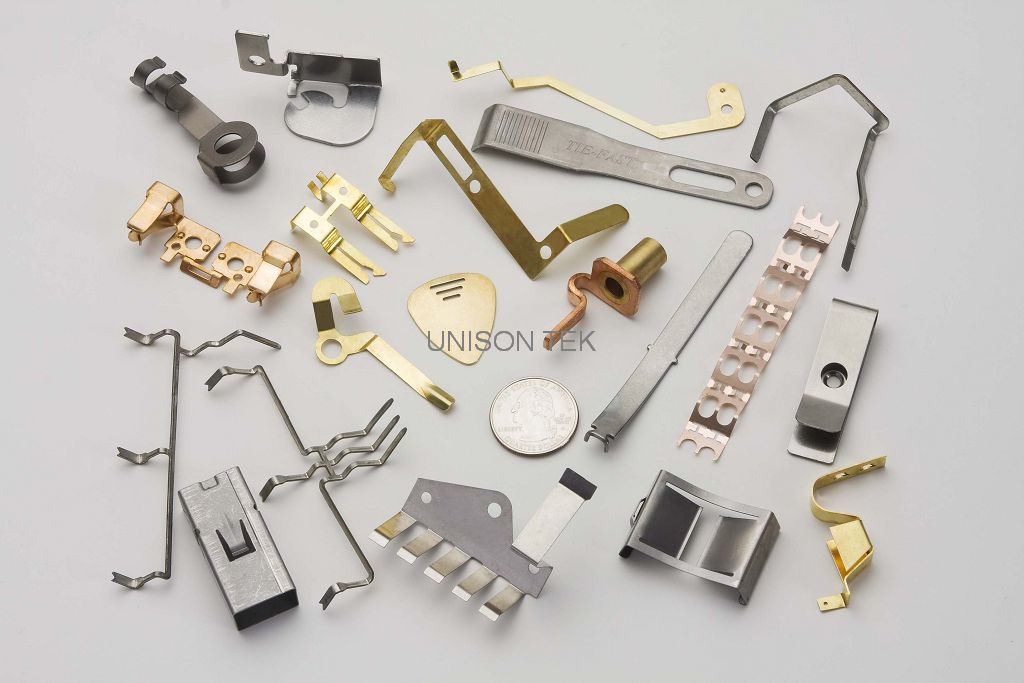
2. Metal Stamping: The High-Power Industrial Cookie Cutter
While turning sculpts round parts, what happens when you need thousands of flat, folded, or structural brackets quickly? That is where Metal Stamping shines.
- The Principle: Think of an ultra-heavy-duty cookie cutter. Flat metal strips or coils are fed into a stamping press. With tons of controlled mechanical or hydraulic force, custom precision dies punch, notch, bend, or draw the sheet metal into its final geometry in a split second.
- Common Applications: Mounting brackets, electronic shielding cans, automotive clips, chassis covers, and structural plates.
For cost-effective, high-speed production of durable metal components, explore our comprehensive Metal Stamping Solutions.
3. Beyond the Cut: Why Precision Inspection Defines Quality
Machining the shape is only half the journey. In critical applications like optical equipment, semiconductor manufacturing, and medical hardware, a variance smaller than the width of a human hair can cause a system failure.
How do we guarantee that every single part meets your exact engineering blueprints?
We don’t rely on guesswork—we rely on data. In our climate-controlled quality labs, our engineers utilize cutting-edge Quality Inspection Equipment, including:
- Coordinate Measuring Machines (CMM): 3D dimensional verification down to the micrometer ($\mu\text{m}$).
- Optical Comparators & Vision Systems: Rapid, non-contact profiling of complex contours and threads.
- Surface Roughness Testers & Height Gauges: Ensuring every critical surface meets functional friction and sealing tolerances.
Your Trusted Partner in Precision Manufacturing
From custom prototyping to mass production, Unison Tek bridges the gap between digital design and physical perfection. With decades of manufacturing expertise, we help global clients turn complex concepts into reliable hardware.
- Looking for a tailored solution for your next mechanical project? Browse our full portfolio on the Unison Tek Products Page or contact our engineering team today for a quote!