Selecting the right metal material is critical for the success of any engineering or manufacturing project.
Each metal has its own unique properties, advantages, and applications. In this article, we will compare aluminum, copper, steel, and stainless steel to help you make an informed decision.
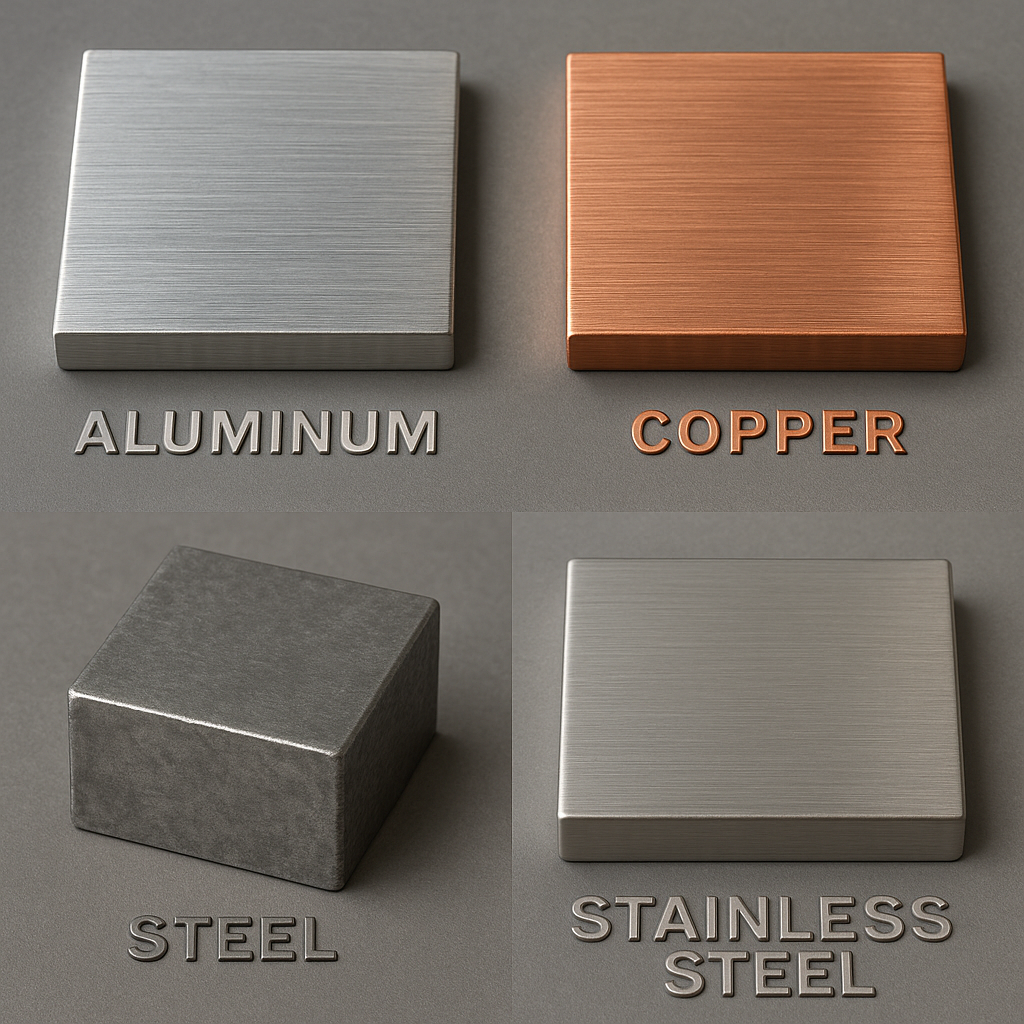
1. Aluminum
Aluminum is a lightweight, versatile metal widely used in industries such as aerospace, automotive, and construction.
Key Properties:
Lightweight: About one-third the density of steel, making it ideal for weight-sensitive applications.
Corrosion Resistance: Naturally forms an oxide layer that protects against corrosion.
High Thermal and Electrical Conductivity: Though not as conductive as copper, aluminum is still widely used for heat sinks and electrical applications.
Easy to Machine and Form: Excellent for CNC machining and extrusion.
Applications: Aircraft structures, automotive parts, consumer electronics, and packaging.
2. Copper
Copper is valued for its exceptional conductivity and corrosion resistance.
Key Properties:
Excellent Electrical Conductivity: The best among all commercial metals, making it ideal for electrical wiring.
High Thermal Conductivity: Used in heat exchangers and plumbing systems.
Corrosion Resistance: Particularly resistant to water and various chemicals.
Antimicrobial Properties: Useful in healthcare and food industries.
Applications: Electrical wires, plumbing, roofing, and industrial machinery components.
3. Steel
Steel, an alloy of iron and carbon, is known for its strength and affordability.
Key Properties:
High Strength: Suitable for heavy-duty structural applications.
Wide Range of Grades: From low-carbon mild steel to high-carbon tool steels.
Cost-Effective: Relatively inexpensive and widely available.
Susceptible to Corrosion: Requires protective coatings (e.g., paint or galvanization) unless alloyed with chromium (as in stainless steel).
Applications: Construction beams, automotive frames, tools, and machinery.
4. Stainless Steel
Stainless steel is a corrosion-resistant alloy of steel containing at least 10.5% chromium.
Key Properties:
Excellent Corrosion Resistance: Performs well in harsh environments.
High Strength and Durability: Suitable for high-stress applications.
Aesthetic Appearance: Attractive, shiny finish that is easy to clean.
Heat Resistance: Performs well at high temperatures.
Applications: Medical instruments, kitchen equipment, marine components, and architectural structures.
Summary Comparison Table
| Property | Aluminum | Copper | Steel | Stainless Steel |
|---|---|---|---|---|
| Density (g/cm³) | 2.7 | 8.9 | ~7.8 | ~8.0 |
| Corrosion Resistance | High | High | Low | Very High |
| Strength | Moderate | Moderate | High | High |
| Electrical Conductivity | Good | Excellent | Poor | Poor |
| Cost | Moderate | High | Low | Moderate-High |
| Machinability | Excellent | Fair | Good | Fair-Good |
Summary
The choice between aluminum, copper, steel, and stainless steel depends on your project requirements:
Aluminum for lightweight and corrosion-resistant parts.
Copper for superior electrical and thermal conductivity.
Steel for cost-effective strength in structural applications.
Stainless Steel for excellent corrosion resistance and aesthetics.
By understanding these materials’ properties and applications, you can select the best option for your specific needs and ensure optimal performance and cost-efficiency in your projects.
Get more information, please visit our CNC Turning Parts or Products. Contact us for your customized metal parts.