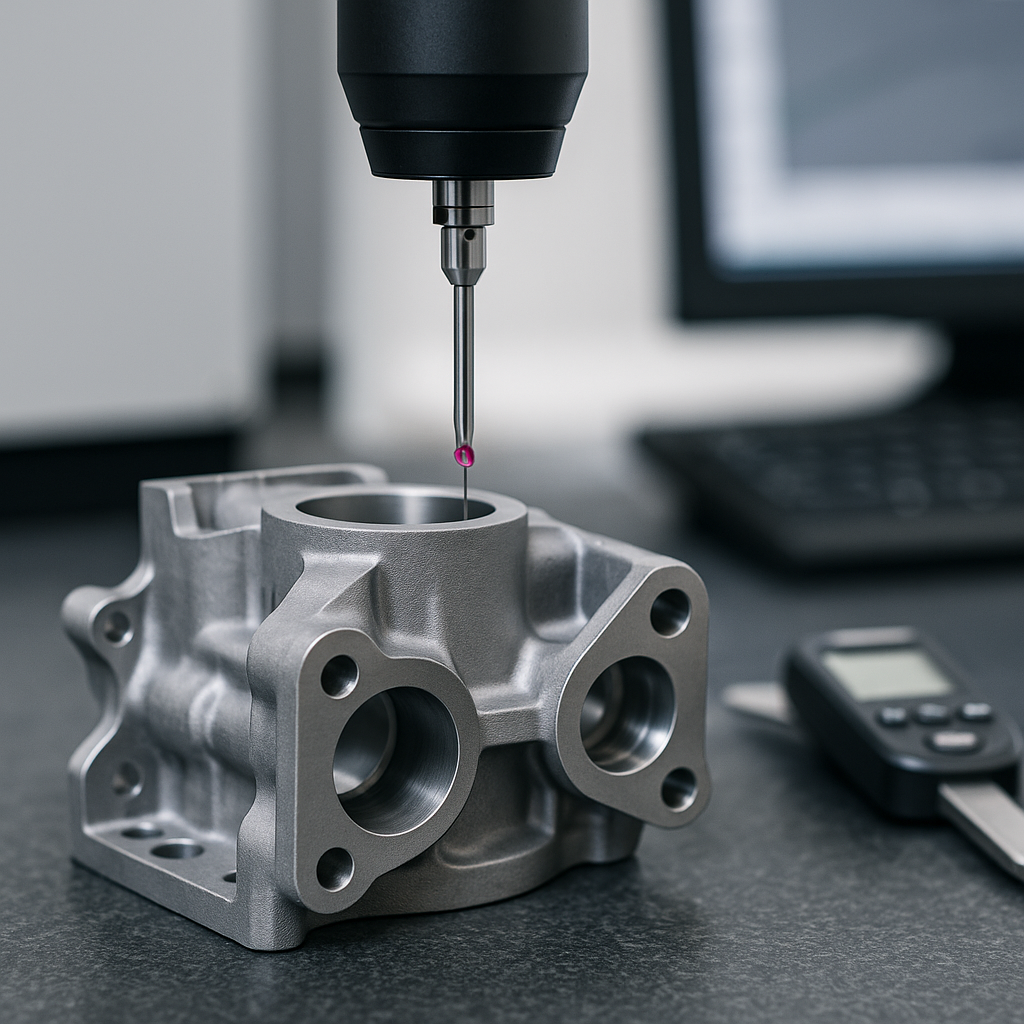
1. The Role of Quality Inspection
Quality inspection ensures that every product or component adheres to predefined requirements.
It prevents defective items from reaching customers, reduces rework costs, and supports continuous improvement. Effective inspection systems provide:
Verification: Confirming that dimensions and tolerances meet engineering drawings.
Validation: Ensuring performance and reliability under operating conditions.
Traceability: Documenting compliance for regulatory and customer requirements.
2. Common Measurement Techniques
Dimensional Measurement
Calipers and Micrometers: Simple but effective tools for basic dimensional checks.
Coordinate Measuring Machines (CMMs): Provide highly accurate 3D measurements for complex geometries.
Optical and Laser Scanning: Capture surface profiles and generate digital models for comparison with CAD data.
Surface and Material Analysis
Surface Roughness Testers: Measure micro-level surface textures that impact wear, lubrication, and sealing.
Hardness Testing: Determines material strength and durability.
Spectroscopy and Microscopy: Used to analyze composition and detect material inconsistencies.
Non-Destructive Testing (NDT)
Ultrasonic Testing: Identifies internal flaws without damaging the part.
X-Ray and CT Scanning: Reveal hidden cracks, voids, or assembly issues.
Dye Penetrant and Magnetic Particle Testing: Detect surface cracks and discontinuities.
3. Integration with Digital Technologies
With the rise of Industry 4.0, inspection systems are becoming smarter and more connected:
In-Process Monitoring: Sensors collect real-time data during machining to detect deviations instantly.
Statistical Process Control (SPC): Monitors production trends and prevents defects before they occur.
Digital Twins: Virtual models allow comparison between real and ideal parts for predictive quality management.
Automated Optical Inspection (AOI): High-speed vision systems check thousands of parts with minimal human input.
4. Benefits of Advanced Quality Inspection
Improved Accuracy: High-resolution tools ensure components meet tight tolerances.
Reduced Scrap and Rework: Early defect detection saves time and materials.
Faster Time-to-Market: Automated inspections streamline production and validation.
Enhanced Customer Confidence: Reliable quality builds stronger relationships with clients.
5. Challenges and Considerations
High Initial Costs: Advanced inspection technologies require significant investment.
Data Management: Large volumes of measurement data need to be stored and analyzed effectively.
Skilled Workforce: Operators and engineers must be trained to interpret results and maintain equipment.
Integration: Combining traditional QC methods with modern digital systems can be complex.
Summary
Quality inspection and measurement technologies are essential pillars of modern manufacturing.
By combining traditional metrology with advanced digital solutions, manufacturers can ensure precision, consistency, and compliance across every production stage.
As industries move toward smarter and more automated production environments, the role of quality assurance and measurement technologies will only grow in importance, shaping the future of manufacturing excellence.
Get more info, please visit our CNC Turning Parts or Products. Contact us for your customized metal parts.