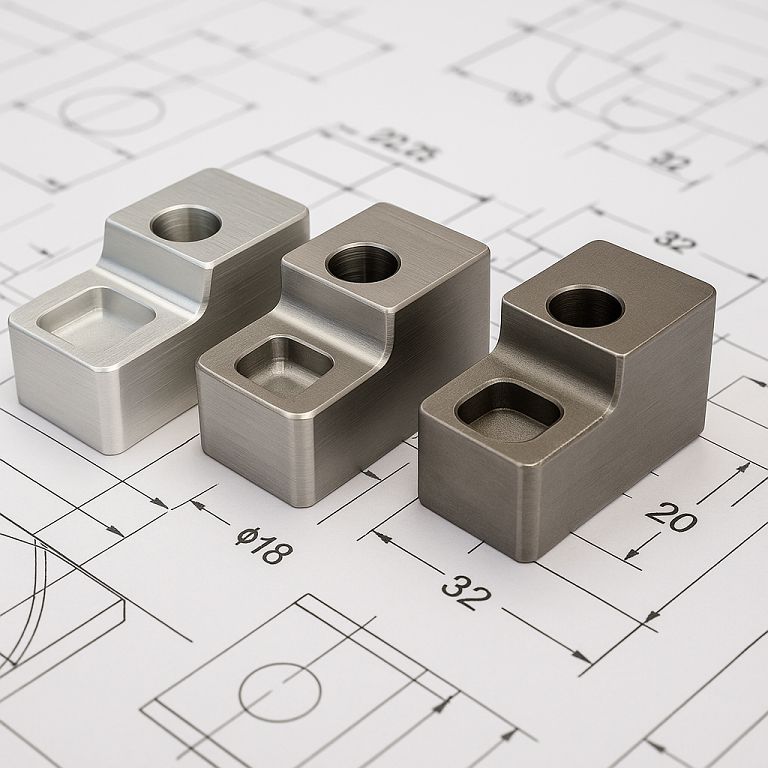
Aluminum: Lightweight, Fast-Cutting, but Sensitive to Burrs
Aluminum is known for its excellent machinability. Its low cutting resistance allows for high-speed milling and rapid removal rates.
However, because aluminum is softer and more ductile, it can adhere to cutting tools, forming built-up edge and compromising surface finish.
Key machining considerations:
Use sharp tooling with polished flutes to reduce material sticking.
Employ high spindle speeds with controlled feed rates for efficient cutting.
Maintain clean heat control, as aluminum dissipates heat quickly but may deform if overheated.
Apply coolant strategically to prevent tool loading and ensure smooth chip evacuation.
Best results: Smooth surfaces, fast machining cycles, and low machining stress when optimized.
Stainless Steel: Strong, Durable, and More Difficult to Cut
Stainless steel offers corrosion resistance and strength, but its material behavior creates challenges.
Higher cutting resistance generates heat quickly, leading to tool wear and work-hardening if parameters are not well controlled.
Key machining considerations:
Use rigid tooling and stable fixturing to prevent vibration and maintain accuracy.
Choose carbide tools with heat-resistant coatings to combat wear.
Apply high-pressure coolant for effective heat control and chip breaking.
Avoid light finishing passes that may cause work-hardening and reduce surface finish quality.
Best results: Consistent dimensions and polished surfaces when heat and tool wear are carefully managed.
Titanium: High-Strength, Low Thermal Conductivity, and Heat-Sensitive
Titanium provides excellent strength-to-weight performance, making it widely used in aerospace, medical, and high-performance components.
However, its unique material behavior—especially low thermal conductivity—causes heat to concentrate at the cutting edge, leading to rapid tool wear and potential deformation.
Key machining considerations:
Use rigid tooling with strong edge geometry to handle high cutting resistance.
Reduce cutting speed but maintain steady feed to minimize heat buildup.
Ensure aggressive heat control with coolant direction targeted at the tip-contact zone.
Optimize passes to avoid rubbing and thermal stress, which affect precision and surface finish.
Best results: Stable size and excellent functional accuracy when machining strategies emphasize heat management.
Summary Comparison
| Material | Cutting Resistance | Heat Control Needs | Tooling Requirements | Surface Finish Considerations |
|---|---|---|---|---|
| Aluminum | Low – easy to cut | Moderate | Sharp, polished tools | Prevent burrs and chip adhesion |
| Stainless Steel | Medium to high | High | Carbide tooling with coatings | Avoid work-hardening and maintain lubrication |
| Titanium | Very high | Critical | Rigid tooling and strong geometry | Control heat to prevent tool wear and deformation |
Summary
The key to machining aluminum, stainless steel, and titanium successfully lies in understanding each material’s material behavior, managing cutting resistance, selecting the right tooling, optimizing surface finish techniques, and implementing effective heat control strategies.
With proper planning and machining methods, manufacturers can achieve accuracy, efficiency, and repeatable quality across all three materials—ensuring reliable performance in applications ranging from precision medical implants to aerospace components and high-performance automotive parts.
Get more info, please visit our CNC Turning Parts or Products. Contact us for your customized metal parts.