Imagine this scenario: It’s a chilly winter morning. A skilled CNC machinist walks into the shop, turns on a high-precision machine, and dials in the settings to cut a critical aerospace component. The first part drops out of the machine, and the digital micrometer reads perfectly—exactly on the nominal dimension down to the micron.
Fast forward to 2:00 PM. The sun is blazing through the shop windows, the factory floor has warmed up by a few degrees, and the CNC machine has been running non-stop for hours. The operator measures a freshly finished part from the exact same batch, using the exact same program and tools.
Suddenly, the part is out of tolerance. It’s too big.
The operator hasn’t changed a single setting, the tools aren’t worn out, and the machine isn’t broken. So, what happened?
You’ve just been hit by the ultimate invisible saboteur of precision manufacturing: Thermal Expansion and Contraction . In the world of high-precision machining, where we fight for tolerances thinner than a strand of hair, temperature is a shape-shifter that quietly distorts everything it touches. Let’s look at how heat plays tricks on your shop floor in plain English, and how top shops fight back.
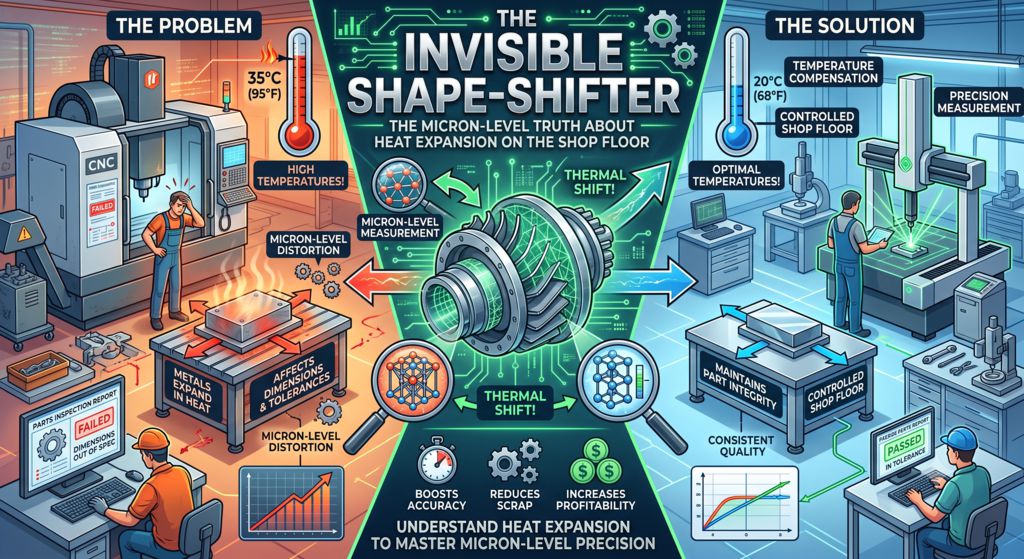
The Micron-Level Reality: Metal is a Sponge for Heat
We tend to look at materials like steel, aluminum, and granite as rock-solid and unmoving. But under a microscope, metal acts more like a rigid sponge that grows when it gets warm and shrinks when it cools.
When a material absorbs heat, its atoms start vibrating rapidly, pushing away from one another. This causes the entire object to expand in every direction. When it cools down, the atoms relax, pack tightly together, and the object shrinks.
In everyday life, you don’t notice this. A metal handrail on a bridge might expand by a fraction of a millimeter on a hot day, and no one cares. But in a CNC shop, we live in the world of the micron —which is one-thousandth of a millimeter. A human hair is about 70 microns wide. If your tolerance window is only 5 or 10 microns, a tiny shift in room temperature can completely ruin your part.
The Three Elements of Thermal Distortion
Thermal expansion doesn’t just happen in one place. On a shop floor, it attacks from three different angles simultaneously:
1. The Workpiece (The Part Itself)
Different metals react to heat at wildly different rates. Aluminum, for example, is incredibly sensitive to temperature—it expands and contracts roughly twice as fast as steel. If you rough out an aluminum part and it gets hot from the friction of cutting, measuring it immediately will give you a false reading. Once it sits on a bench and cools down to room temperature, it will shrink, and your final dimensions will be smaller than you thought.
2. The Machine Tool (The Spindle and Castings)
A CNC machine is an incredible heat generator. The spindle spins at thousands of RPMs, creating friction in the bearings. The linear motors and ball screws constantly move back and forth, generating heat. As the spindle head warms up, it physically expands downward—a phenomenon known as spindle growth. If the machine thinks the tool tip is at a certain height, but thermal expansion has pushed the spindle down by 15 microns, your cuts will be too deep.
3. The Measuring Equipment (The Gauges)
If you take a warm part out of a machine and measure it with a cold micrometer that just sat near an air conditioning vent, your reading will be wrong. Even holding a precision gauge in your warm bare hand for too long can transfer enough body heat to expand the gauge, throwing off your measurements.
How Smart Shops Fight Back Against Thermal Chaos
You can’t stop physics, but you can outsmart it. Precision machine shops use several brilliant strategies to keep heat under control:
The 24-Hour Soak (Thermal Stabilization)
If a delivery truck drops off a pallet of raw metal bars that have been sitting outside in the winter cold, a precision shop will never load them straight into a machine. They will let the material sit on the shop floor for up to 24 hours. This allows the metal to slowly adapt to the room’s ambient temperature so it doesn’t expand wildly inside the machine.
Constant-Climate Control
High-end aerospace and medical machine shops look less like factories and more like laboratories. They use massive, specialized HVAC systems to keep the air temperature locked at exactly 20°C (68°F)—the international standard for dimensional measurement—24 hours a day, 365 days a year.
Active Spindle Chillers and Software Compensation
Modern CNC machines come equipped with liquid-cooling jackets wrapped around the spindle and ball screws. These chillers constantly pump temperature-controlled fluid through the machine to pull heat away before it can cause expansion. Furthermore, smart machine controls use built-in sensors to monitor temperatures and automatically calculate how much the machine has grown, instantly shifting the toolpath by a few microns to compensate.
The Takeaway: Respect the Temperature
In precision machining, what you see isn’t always what you get. A part that is a perfect 25.000mm at 2:00 PM on a hot summer afternoon might become a rejected 24.985mm by the time it arrives at your customer’s climate-controlled inspection lab.
The secret to mastering micron-level accuracy isn’t just buying a more expensive machine; it’s respecting the laws of thermal dynamics. By letting your materials rest, keeping your shop temperatures stable, and remembering that everything expands when it gets hot, you can tame the invisible shape-shifter and keep your tolerances razor-sharp.
Get more info, please visit our CNC Turning Parts or Products.
Contact us for your customized metal parts.ㄢ
Have you ever been fooled by a part that changed size after it cooled down? What’s your shop’s golden rule for managing temperature changes? Let’s share some stories in the comments below!