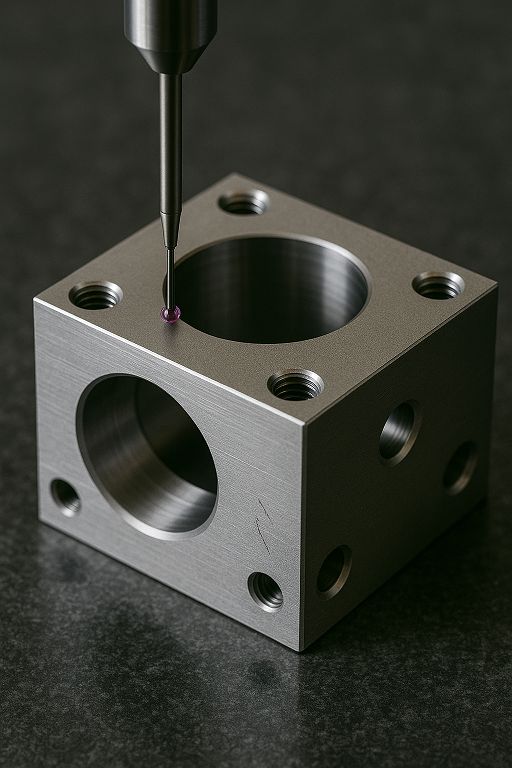
Understanding Surface Defects in Precision Components
A surface defect refers to any irregularity that deviates from the intended texture or geometry of a part’s surface.
In precision parts—especially those used in aerospace, medical, and semiconductor industries—even micron-level defects can have major performance consequences.
Common types of surface defects include:
Scratches and scoring from improper handling or tool wear.
Burrs or micro-cracks from excessive cutting forces.
Surface contamination or oxide discoloration.
Dimensional unevenness caused by unstable machining or vibration.
Recognizing the sources of defects early in the process helps prevent costly rework and ensures consistent product quality.
Quality Inspection: The First Line of Defense
Effective quality inspection is essential for identifying and categorizing surface defects before they affect downstream assembly or performance.
Advanced inspection systems allow manufacturers to detect anomalies that are invisible to the naked eye.
Modern quality inspection methods include:
Optical measurement systems using high-resolution cameras or laser scanning for 3D surface mapping.
Microscopic inspection to identify micro-defects on polished or coated surfaces.
Automated visual inspection (AVI) for detecting scratches, dents, or blemishes in high-volume production.
Non-destructive testing (NDT) for detecting subsurface cracks or stress points.
By integrating real-time quality inspection data into process feedback, manufacturers can act quickly to eliminate the root causes of defects.
Optical Measurement for Precision Verification
Optical measurement technologies provide non-contact, high-accuracy assessment of surface topography and dimensional uniformity.
Unlike traditional contact probes, optical systems prevent measurement-induced scratches and offer faster throughput.
Applications of optical measurement:
Confirming surface flatness and roughness at micron-level accuracy.
Detecting deviations in form and contour during tool wear monitoring.
Ensuring surface defect detection consistency across all production batches.
Verifying polishing and coating uniformity for reflective or critical surfaces.
Optical measurement plays a vital role in verifying not only part geometry but also the visual and functional integrity of the finished product.
Production Control and Process Stability
Preventing surface defects requires disciplined production control across all machining and finishing stages. Instability in tools, materials, or environmental conditions often leads to inconsistency in surface quality.
Key elements of production control:
Continuous monitoring of cutting parameters and tool wear.
Regular machine calibration to maintain dimensional repeatability.
Clean and controlled working environments to prevent contamination.
Statistical Process Control (SPC) to identify trends and predict potential defects.
Strong production control ensures every process—from cutting to finishing—operates within defined tolerances, reducing variability and rework.
The Role of Polishing in Defect Prevention
Proper polishing is one of the most effective ways to enhance surface integrity and remove microscopic imperfections.
Whether performed manually or with automated systems, polishing refines the final texture, reduces friction, and improves both visual and functional quality.
Benefits of polishing:
Eliminates fine scratches and tool marks.
Enhances reflective surfaces for optical components.
Reduces potential stress concentration points caused by machining.
Improves coating adhesion and long-term durability.
By integrating polishing with final quality inspection, manufacturers ensure that every precision part achieves the desired finish and performance.
Summary
In precision manufacturing, detecting and preventing surface defects is vital to ensuring long-term reliability and customer satisfaction.
Combining advanced quality inspection, high-resolution optical measurement, robust production control, and expert polishing practices enables manufacturers to achieve superior surface quality and dimensional precision.
By proactively managing each stage of the process, precision engineers can eliminate hidden flaws, reduce waste, and deliver products that meet the highest global standards of accuracy and perfection.
Get more info, please visit our CNC Turning Parts or Products.
Contact us for your customized metal parts.