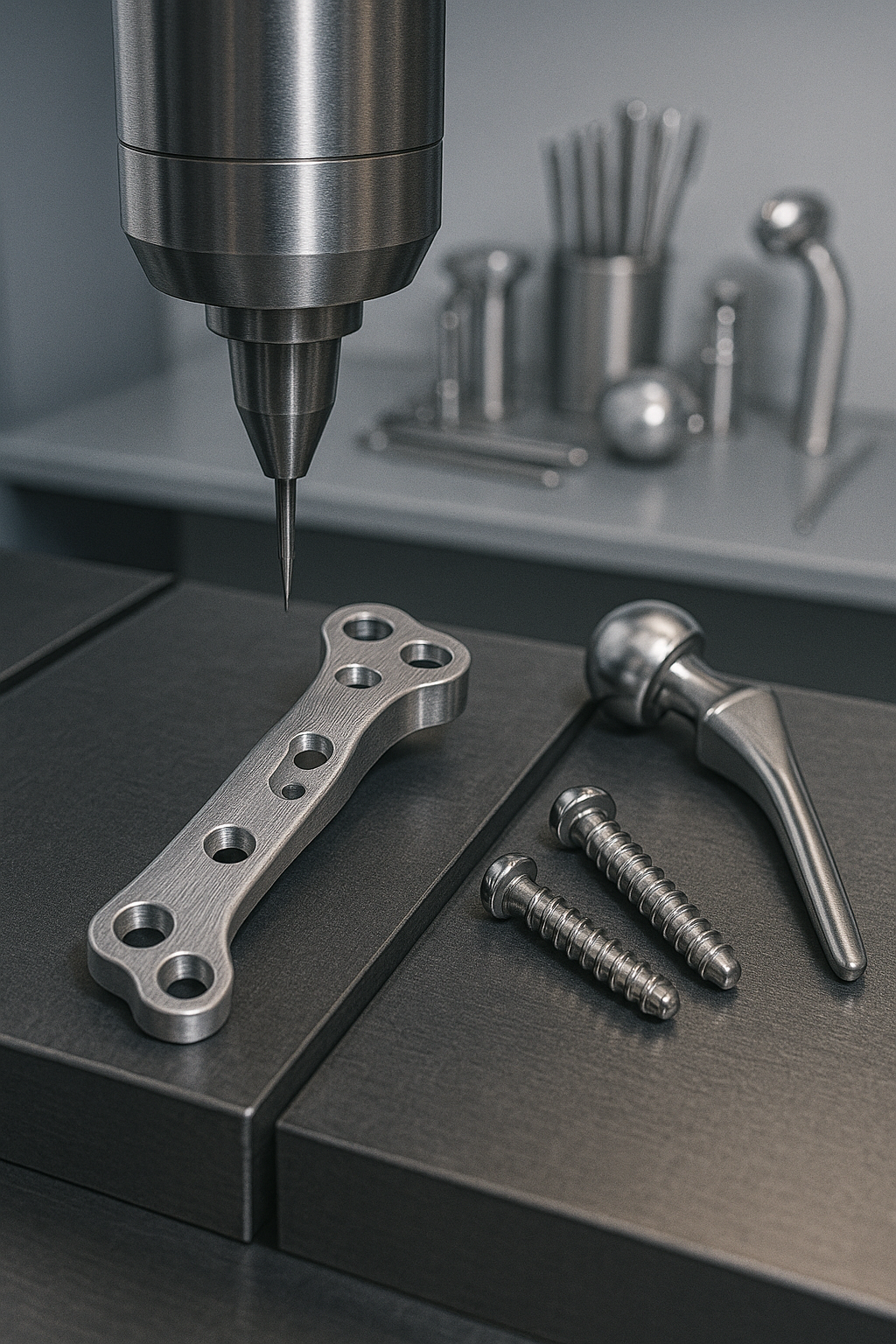
1. The Importance of Precision in Medical Machining
Medical devices and implants often function inside the human body or in direct contact with patients. This means tolerances are extremely tight, sometimes measured in microns.
For example, orthopedic implants, dental screws, and surgical instruments must fit perfectly to ensure both effectiveness and patient comfort.
Even the smallest dimensional error can compromise performance or cause complications.
2. Materials for Medical Devices and Implants
The choice of material is crucial in medical manufacturing:
Stainless Steel: Widely used for surgical instruments due to strength, corrosion resistance, and ease of sterilization.
Titanium and Titanium Alloys: Biocompatible, lightweight, and highly durable, making them ideal for implants such as hip joints, dental implants, and bone screws.
Cobalt-Chrome Alloys: Known for wear resistance and commonly used in orthopedic implants.
Medical-Grade Plastics: Materials such as PEEK and UHMWPE are applied in joint replacements and other devices where metal-to-metal contact must be minimized.
3. Challenges in Machining Medical Components
Producing medical devices and implants requires advanced capabilities:
Tight Tolerances: CNC machining must achieve micro-level accuracy.
Complex Geometries: Implants often require intricate shapes and porous structures for bone integration.
Surface Quality: Smooth finishes are vital for surgical tools, while specific textures are engineered on implants to improve biological compatibility.
Cleanliness and Sterility: Parts must be free of contamination, often requiring ultrasonic cleaning, passivation, or production in controlled environments.
4. Quality Control and Compliance
Medical device machining is governed by strict regulatory standards:
ISO 13485 certification ensures compliance with medical manufacturing requirements.
FDA Regulations in the U.S. set quality and safety benchmarks.
Full Traceability is required to ensure every component can be tracked from raw material to final product.
Shops must implement rigorous quality control systems, including in-process inspections, final validation, and detailed documentation.
5. Applications of Medical Machined Components
Orthopedic Implants: Hip and knee replacements, bone screws, and spinal implants.
Dental Devices: Crowns, bridges, and implant fixtures.
Surgical Instruments: Scalpels, forceps, clamps, and minimally invasive tools.
Diagnostic Equipment: Precision housings and components for imaging systems and laboratory devices.
Summary
Machining for medical devices and implants requires a unique combination of precision engineering, advanced materials, and strict quality control.
With patient safety on the line, there is no margin for error. As medical technology continues to evolve, machining will remain at the heart of producing devices that improve quality of life and enable better healthcare outcomes worldwide.