In the world of modern manufacturing, precision is not a luxury—it’s a necessity. Especially in industries like aerospace, medical devices, automotive, and electronics, even the smallest dimensional deviation can lead to product failure, performance issues, or safety concerns.
That’s why machining tolerances—the permissible limit of variation in a physical dimension—are critical to product quality, reliability, and functionality.
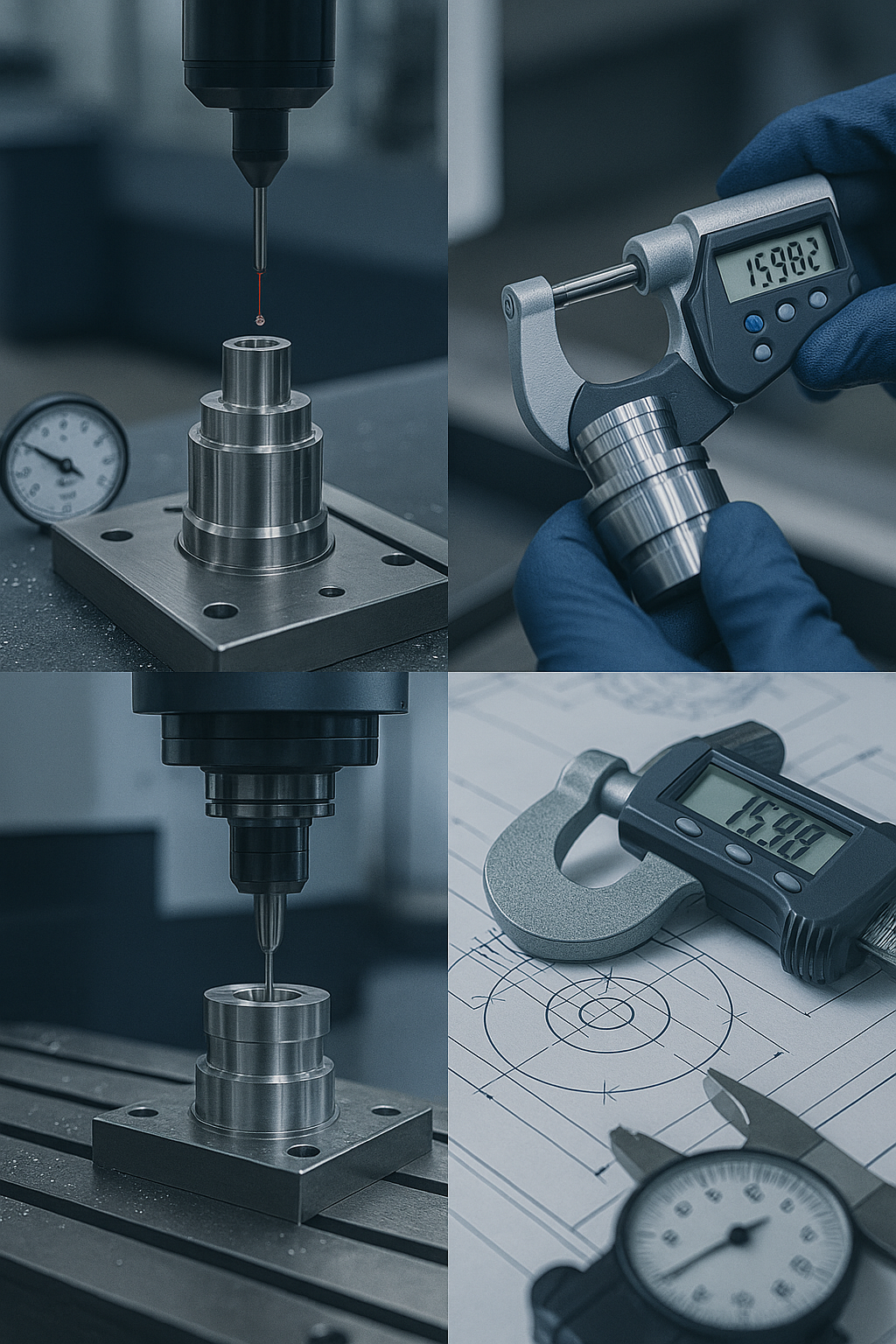
What Are Machining Tolerances?
Machining tolerances define how much a manufactured part can deviate from its specified dimension and still function properly. They are typically measured in thousandths of an inch (thou) or microns (μm).
For example:
A shaft with a diameter of 10.00 ±0.01 mm can be between 9.99 mm and 10.01 mm and still meet the design requirements.
Why Are Tight Tolerances Important?
1. Ensures Functional Fit
In mechanical assemblies, components must fit together precisely.
✅ Tight tolerances prevent looseness, misalignment, or binding in assemblies like gears, bearings, or valves.
2. Improves Product Performance
Precision tolerances ensure consistent performance in dynamic or high-stress environments.
✅ Example: In electric motors, tight tolerances in rotor-stator gaps help optimize efficiency and reduce energy loss.
3. Enhances Product Reliability
The closer a part is to its ideal specification, the more reliably it performs over time.
✅ This is especially critical in medical, aerospace, and semiconductor applications, where failure is not an option.
4. Reduces Wear and Failure Risk
Proper tolerances reduce friction and vibration, which translates into less wear, fewer breakdowns, and longer service life.
5. Minimizes Rework and Assembly Issues
Parts with poor tolerances can cause costly delays due to manual fitting, re-machining, or rejection during quality checks.
Challenges of Achieving Tight Tolerances
While tight tolerances offer clear advantages, they also present challenges:
📏 Increased Machining Time: More passes and finer tooling are often needed.
💰 Higher Costs: Precision machining requires advanced equipment, skilled labor, and strict quality control.
🧠 Material Sensitivity: Some metals expand, warp, or stress-relieve differently during cutting, affecting final dimensions.
✅ Balance is key: Not every part needs ultra-tight tolerances. Engineering teams must specify tolerances only where functionally necessary to optimize cost and performance.
Typical Tolerance Ranges (For Reference)
| Tolerance Class | Range | Applications |
|---|---|---|
| Standard Machining | ±0.1 mm to ±0.05 mm | General mechanical components |
| Precision Machining | ±0.025 mm to ±0.01 mm | Aerospace, automotive, tooling |
| High-Precision Machining | ±0.005 mm to ±0.001 mm | Medical devices, optical, semiconductor |
Summary
In precision machining, tolerances are not just numbers on a drawing—they are the foundation of product quality. Specifying and achieving the right tolerances ensures that components fit, function, and last as intended, while also controlling manufacturing costs.
At Unison Tek, we specialize in tight-tolerance CNC machining for industries that demand the highest level of precision. With over 36 years of experience, ISO 9001:2015 certification, and advanced metrology equipment, we ensure every part meets exact specifications—every time.
Get more info, please visit our CNC Turning Parts or Products. Contact us for your customized metal parts.