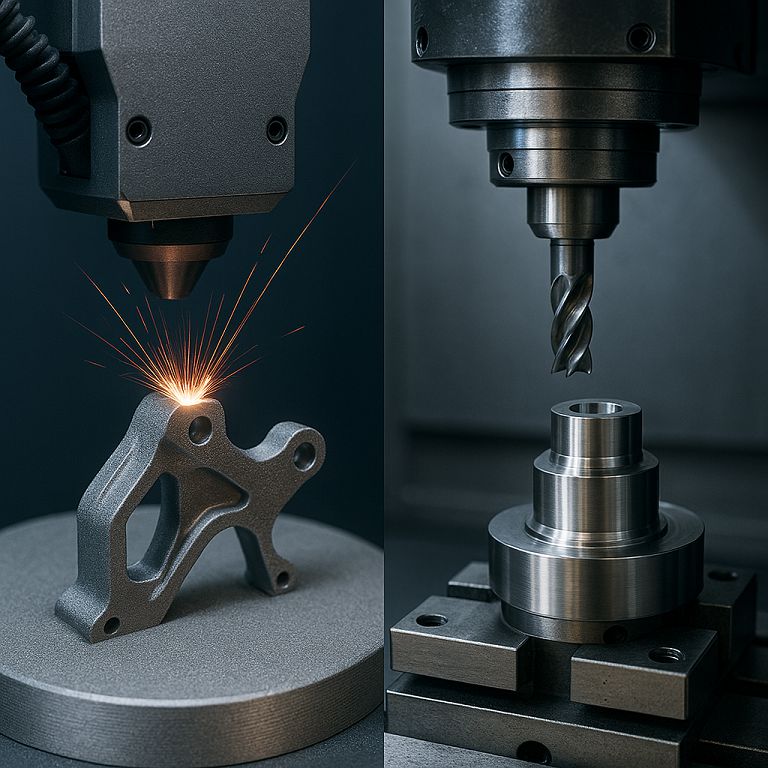
The Strengths of Metal 3D Printing
Metal 3D printing, also known as additive manufacturing (AM), allows designers to build parts layer by layer directly from digital models. This eliminates the need for complex molds or tooling in the early design stages.
Key advantages include:
Rapid prototyping: Functional metal prototypes can be produced within days instead of weeks.
Design freedom: Complex geometries, internal channels, and lightweight lattice structures can be created easily.
Material efficiency: Additive manufacturing minimizes waste by using only the necessary material.
Customization: Ideal for producing low-volume or one-off components with unique designs.
However, while metal 3D printing excels in flexibility and speed, it often lacks the precision surface finish and dimensional accuracy required for final parts—this is where CNC machining complements the process.
The Precision of CNC Machining
CNC machining is a subtractive process that removes material from a solid block to achieve tight tolerances and smooth surface finishes. It remains essential for refining 3D-printed parts, ensuring exact dimensions, proper fit, and mechanical performance.
When combined with 3D printing, CNC machining can:
Improve dimensional accuracy: Finishing critical surfaces and interfaces to micron-level tolerances.
Enhance strength and assembly compatibility: Machined threads, grooves, and fits ensure proper integration.
Reduce post-processing time: By selectively machining only critical areas, production becomes more efficient.
Hybrid Manufacturing: The Best of Both Worlds
The integration of metal 3D printing and CNC machining—often referred to as hybrid manufacturing—brings together the advantages of both additive and subtractive methods. This approach enables manufacturers to:
Prototype faster: Print complex shapes quickly and machine only the necessary surfaces for accuracy.
Reduce tooling lead times: Produce mold inserts or tooling components directly from printed near-net shapes.
Lower costs: Eliminate the need for expensive mold revisions and reduce material waste.
Accelerate product launch: Transition from design validation to full production more efficiently.
Applications Across Industries
Aerospace: Rapid production of lightweight turbine parts and structural brackets.
Medical: Custom surgical tools and implants tailored to patient anatomy.
Automotive: Quick development of prototype engine components and die-casting inserts.
Electronics: Heat sinks, housings, and fixtures with optimized thermal properties.
Summary
Combining CNC machining with metal 3D printing is transforming modern manufacturing by bridging the gap between rapid prototyping and precision production.
This hybrid approach enables faster development cycles, reduced tooling time, and greater design freedom—allowing companies to bring innovative products to market sooner.
As technology continues to advance, the synergy between additive and subtractive manufacturing will redefine how the world designs, prototypes, and produces metal components.
Get more info, please visit our CNC Turning Parts or Products.
Contact us for your customized metal parts.