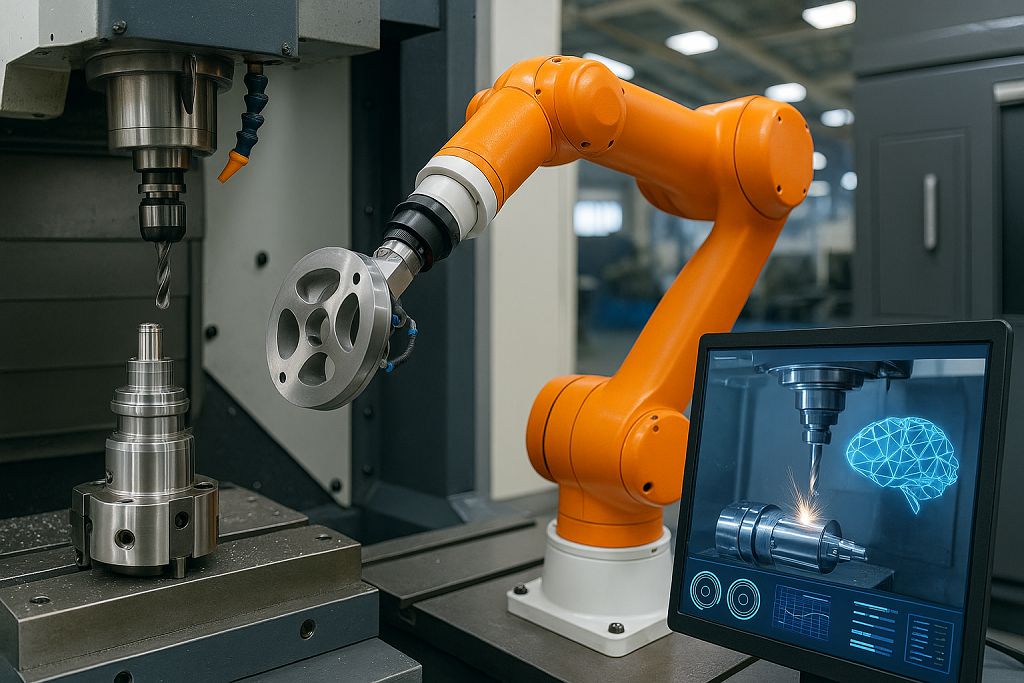
The Role of Robotic Arms in Machining Automation
Robotic arms have become an essential part of modern machining workshops. They handle repetitive and labor-intensive tasks such as loading raw materials, unloading finished parts, and transferring components between machines.
Key Benefits:
24/7 Operation: Robots enable continuous production without the need for manual supervision.
Consistency and Safety: Automated handling reduces human error and workplace injuries.
Workforce Optimization: Skilled workers can focus on programming, quality control, and process improvement instead of manual labor.
By replacing repetitive tasks with robotic automation, manufacturers can achieve higher throughput and lower per-part costs, even in high-mix, low-volume production environments.
Automatic Tool Changers for Efficiency and Precision
Automatic tool changers (ATCs) allow CNC machines to switch tools quickly and accurately during production without operator intervention. This innovation significantly enhances machining flexibility and efficiency.
Advantages of ATCs:
Reduced Downtime: Fast, automated tool changes minimize interruptions between machining operations.
Improved Accuracy: Tool changes are performed consistently, eliminating setup errors.
Multi-Operation Capability: Machines can perform milling, drilling, and tapping in a single setup, reducing cycle times.
By integrating ATCs, manufacturers can handle complex machining jobs with fewer operators, improving productivity and reducing labor dependency.
AI Monitoring for Predictive and Intelligent Production
Artificial intelligence (AI) is taking manufacturing automation to the next level. AI-powered monitoring systems analyze real-time data from machines to predict issues, optimize operations, and ensure consistent quality.
Key Functions of AI Monitoring:
Predictive Maintenance: Detects tool wear, vibration, or abnormal loads before they cause downtime.
Process Optimization: Adjusts cutting parameters automatically to improve surface finish and reduce material waste.
Energy and Resource Management: Monitors power consumption and suggests efficiency improvements.
Data-Driven Decision Making: Provides insights for production planning and continuous improvement.
By integrating AI with machine tools and automation systems, companies can create smart, self-optimizing production environments that require minimal human supervision.
Combining Technologies for Maximum Impact
When robotic arms, ATCs, and AI monitoring systems are used together, they create a highly automated and efficient production ecosystem. This combination allows for:
Unattended or “lights-out” manufacturing—machines operate continuously with minimal human oversight.
Lower labor costs—fewer operators are needed for the same or higher production output.
Higher quality and consistency—automated precision reduces human error.
Improved competitiveness—manufacturers can offer faster turnaround times and more cost-effective pricing.
Summary
The integration of robotic arms, automatic tool changers, and AI monitoring is reshaping the future of precision machining.
By automating repetitive processes, reducing downtime, and enabling data-driven decision-making, manufacturers can significantly lower labor costs while boosting productivity and quality.
As technology continues to evolve, fully automated and intelligent machining workshops will become the new standard for global manufacturing excellence.
Get more info, please visit our CNC Turning Parts or Products. Contact us for your customized metal parts.