Running a CNC machine shop is an exciting business, but it comes with a heavy burden: the electricity bill. Between the high-powered spindles, massive hydraulic systems, and constant air compressors, a machine shop eats up power like a hungry beast.
With rising energy costs, many shop owners look at their monthly bills with a sigh, assuming it’s just the unavoidable cost of doing business.
But here’s a dirty little secret: a huge chunk of that electricity bill isn’t going into cutting metal. It’s being wasted by silent, hidden habits on your shop floor.
By identifying and breaking just three common bad habits, you can stop the bleeding, protect your machines, and keep a massive amount of cash in your bank account. Let’s take an easy, plain-English look at where your power is leaking and how to fix it.
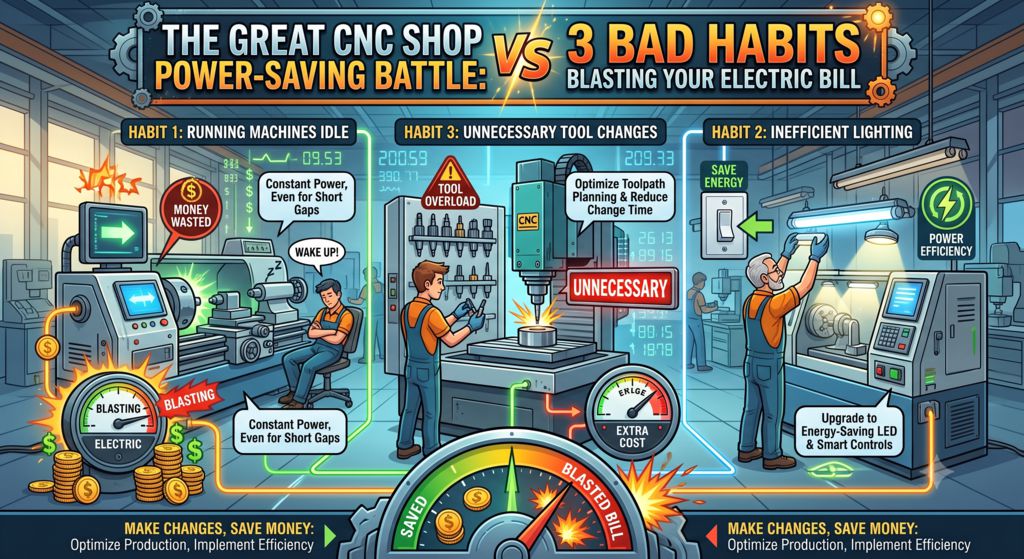
Habit 1: Leaving Machines Idling in “Zombie Mode”
Picture this: it’s lunch break. The operators head out for an hour, leaving the CNC machines sitting idle. The spindle isn’t spinning, and the tools aren’t cutting, so it’s fine, right?
Not exactly. Even when a CNC machine is just standing still, it is often in what engineers call a “ready state”—or what we like to call Zombie Mode.
While the machine looks asleep, its internal power-hungry systems are still running at full blast. The hydraulic pumps are maintaining pressure, the cooling fans are spinning, the control panel is lit up, and the chiller unit is actively working to keep the fluids cold. An idling machine can easily swallow up to a third of the electricity it uses when it’s actually cutting! Leaving machines idling during long breaks, setup periods, or overnight is like leaving your car running in the driveway while you go sleep.
The Fix: Use “Sleep Mode” and Smart Scheduling
Most modern CNC machines have built-in energy-saving modes or auto-shutdown timers. Work with your operators to program the machines to go into a deep sleep if they sit idle for more than 15 or 20 minutes. For older machines, make it a standard rule to shut down the hydraulics and main power during extended breaks.
Habit 2: Ignoring the Hiss of Leaky Compressed Air
Walk onto your shop floor when the machines are paused, stand perfectly still, and listen closely. Do you hear a faint, constant hissing sound?
If you do, you are listening to the sound of money evaporating into thin air.
CNC shops rely heavily on compressed air to blow chips away, actuate robot arms, and clean parts. Because air seems free, we rarely think about it. But generating compressed air requires massive, power-hogging air compressors.
When your air lines, hoses, or fittings have tiny leaks, your air compressor has to work overtime—turning on and cycling constantly even when no one is using air—just to maintain pressure in the pipes.
The Fix: The Saturday Morning “Soap Water” Hunt
Finding air leaks doesn’t require expensive high-tech gear. Grab a spray bottle filled with soapy water and spray it onto your hose connections, joints, and valves. If it bubbles up, you’ve found a leak. Fixing a few loose fittings or replacing a cracked rubber hose can instantly slash your compressor’s electricity usage.
Habit 3: Cranking the Coolant and Chillers to “Over-Freeze” Mode
In machining, heat is the enemy, so it’s natural to want everything as cool as possible. However, a very common habit is setting the machine’s industrial fluid chillers to an unnecessarily low temperature.
Chillers act like heavy-duty refrigerators for your machine’s spindle and coolant fluids. If the ambient shop temperature is comfortable, but your chiller is set to a freezing temperature, the compressor inside the chiller has to fight a brutal, non-stop battle against the room’s natural warmth.
Running a chiller too cold doesn’t make your parts any better; it just forces the cooling unit to run continuously at maximum power capacity.
The Fix: Match the Room, Don’t Fight It
The golden rule for industrial chillers is to set them to match the stable ambient temperature of your shop floor (or just a degree or two below it), rather than forcing them to create an arctic environment inside the machine. Keeping the temperature stable and aligned with the room gives the chiller’s compressor plenty of rest, cutting down its power draw dramatically.
The Takeaway: Energy Efficiency is Free Profit
Saving money on your CNC electricity bill doesn’t require buying multi-million dollar green machines or solar panels. It starts with a shift in shop floor culture.
By waking up from “Zombie Mode,” sealing up those sneaky air leaks, and letting your chillers breathe, you can run a leaner, meaner, and much more profitable shop. Best of all, the money you save on electricity goes straight to your bottom line.
Get more info, please visit our CNC Turning Parts or Products.
Contact us for your customized metal parts.
Have you noticed your machines drawing too much power when they aren’t working? What’s your shop’s favorite trick for keeping utility costs down? Let’s chat in the comments below!