Entering a modern precision workshop, you'll typically see two types of CNC lathes humming as they transform raw metal bars into complex components. To the untrained eye, they may look quite similar—both turn metal and use sharp cutting tools.
But inside, these two machines operate on completely different principles. They are Swiss-type lathes and conventional lathes.
Choosing the wrong machine for your product can lead to skyrocketing production costs, tool breakage, and defective parts. The right machine, on the other hand, enables lightning-fast production and flawless precision.
Let's clearly explain the differences between these two manufacturing giants so you can decide which machine is best suited for your product.
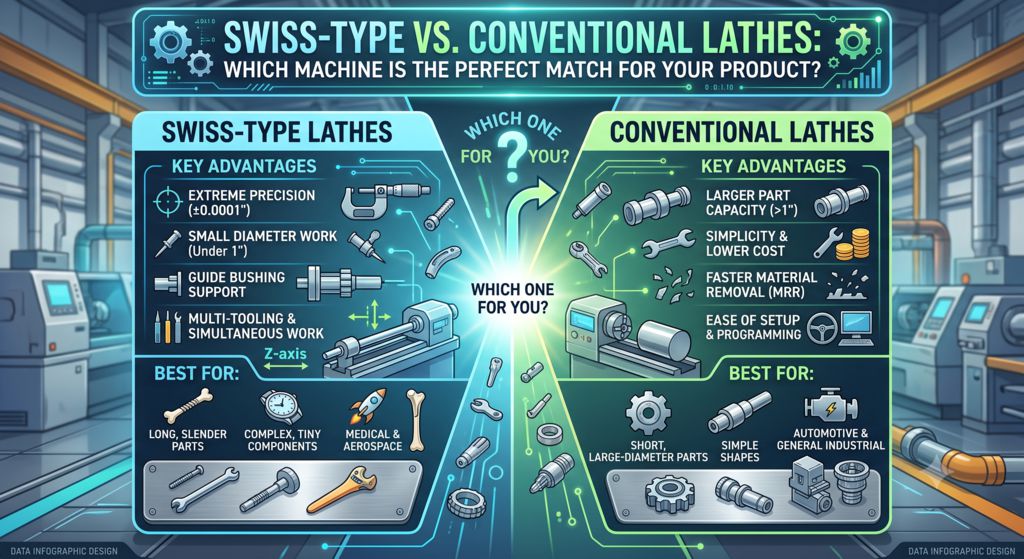
The crucial difference: Who moves, who stays in place?
To understand the difference, imagine trying to sharpen a very long pencil with a knife. If you hold the pencil far from the tip and try to sharpen it, it will bend, flex, and probably break. For a precise cut, you need to support the pencil directly at the cutting edge of the knife.
This simple principle is the crucial difference between the two types of lathes.
1. Conventional Lathes (“Moving Tool”)
On a conventional CNC lathe, the raw metal bar is clamped at one end in a chuck and rotates. The cutting tools move up and down along the bar to machine the desired shape.
Because the material is fixed at the back, the metal bar tends to deform or bent under the pressure of the tool as the cutting depth increases.
2. Swiss-type Lathes (“Moving Material”)
A Swiss-type lathe reverses this principle. The cutting tools remain relatively stationary, close to a support ring, the so-called guide bushing. Instead of moving along the metal bar, the machine guides the raw metal bar through the guide bushing directly to the tools.
Because the cut is made only a few millimeters away from the rigid support of the material, the metal cannot bend or deform. This enables breathtaking precision, even with extremely long and thin parts.
The comparison: Which system is superior in which area?
Now that we understand how it works, let's look at its performance in practice, using your product design as an example.
Choose a Swiss lathe if…
Your parts are long and thin: For example, if you are manufacturing a medical bone screw, a long drive shaft, or a miniature valve needle, the Swiss lathe is the only option. It can machine parts whose length is many times their diameter without any bending.
You need micro-precision: Swiss lathes were originally developed by Swiss watchmakers to produce tiny, microscopic gears and pins. With the tightest tolerances, the extreme rigidity of the guide bushing design ensures flawless precision.
You require complete manufacturing: Modern Swiss lathes are equipped with driven tools, counter spindles, and back-machining stations. They can turn, mill, drill, and slot complex parts, completing them entirely in a single operation, so they come out of the machine ready for shipment.
Choose a conventional lathe if…
Your parts are massive or large: Swiss lathes are typically fed with long bars and are limited to smaller diameters (usually under 32 mm or 38 mm). If your product is a robust automotive gear, a large flange, or a thick-walled metal cylinder, a conventional lathe offers the necessary power and space.
Your parts are short: If you are manufacturing simple, short parts such as a standard tubular nut or a thick spacer ring, you don't need the specialized capabilities of a Swiss lathe. A conventional lathe will do the job perfectly well and at a significantly lower cost.
Choose a conventional lathe if…
Your parts are large or heavy: If you are manufacturing simple, short parts such as a standard tubular nut or a thick spacer ring, you don't need the specialized capabilities of a Swiss lathe. Material preparation costs are crucial: Swiss lathes require highly precise, centerless ground bar stock to ensure smooth operation through the guide bushing. Conventional lathes are significantly simpler; they can easily handle coarser, less expensive raw materials.
At a Glance: The Quick Comparison
Features: Swiss Lathe – Conventional Lathe
Ideal for: Long, thin, high-precision parts – Short, thick, robust parts
Maximum Diameter: Typically small (under 38 mm) – Virtually unlimited (large capacity)
Deflection: Nearly zero; very rigid support – Higher; requires additional support for long parts
Setup Time: Longer, more complex – Shorter, simpler
Conclusion
Think of a Swiss lathe as a scalpel – highly specialized, incredibly precise, and unsurpassed at delicate, intricate work. Think of a conventional lathe as a rugged survival knife – versatile, powerful, and ideally suited for large, heavy-duty tasks.
Maximum diameter: Typically small (under 38 mm) – Conventional lathe. Before requesting quotes for your next project, consider the geometry of your component. If it's long, thin, and resembles a watch component, Swiss turning is recommended. If it's wide, short, and robust, conventional turning is the best choice. Finding the right machine philosophy for your product