In recent years, the manufacturing landscape has been reshaped by the emergence of 3D printing (additive manufacturing). While 3D printing alone has opened new possibilities for prototyping and low-volume production, its true potential is unlocked when combined with traditional machining techniques. This hybrid approach enables manufacturers to deliver parts that are both geometrically complex and dimensionally precise.
This article explores real-world application scenarios where 3D printing and conventional machining work together to create better-performing components, reduce costs, and accelerate product development.
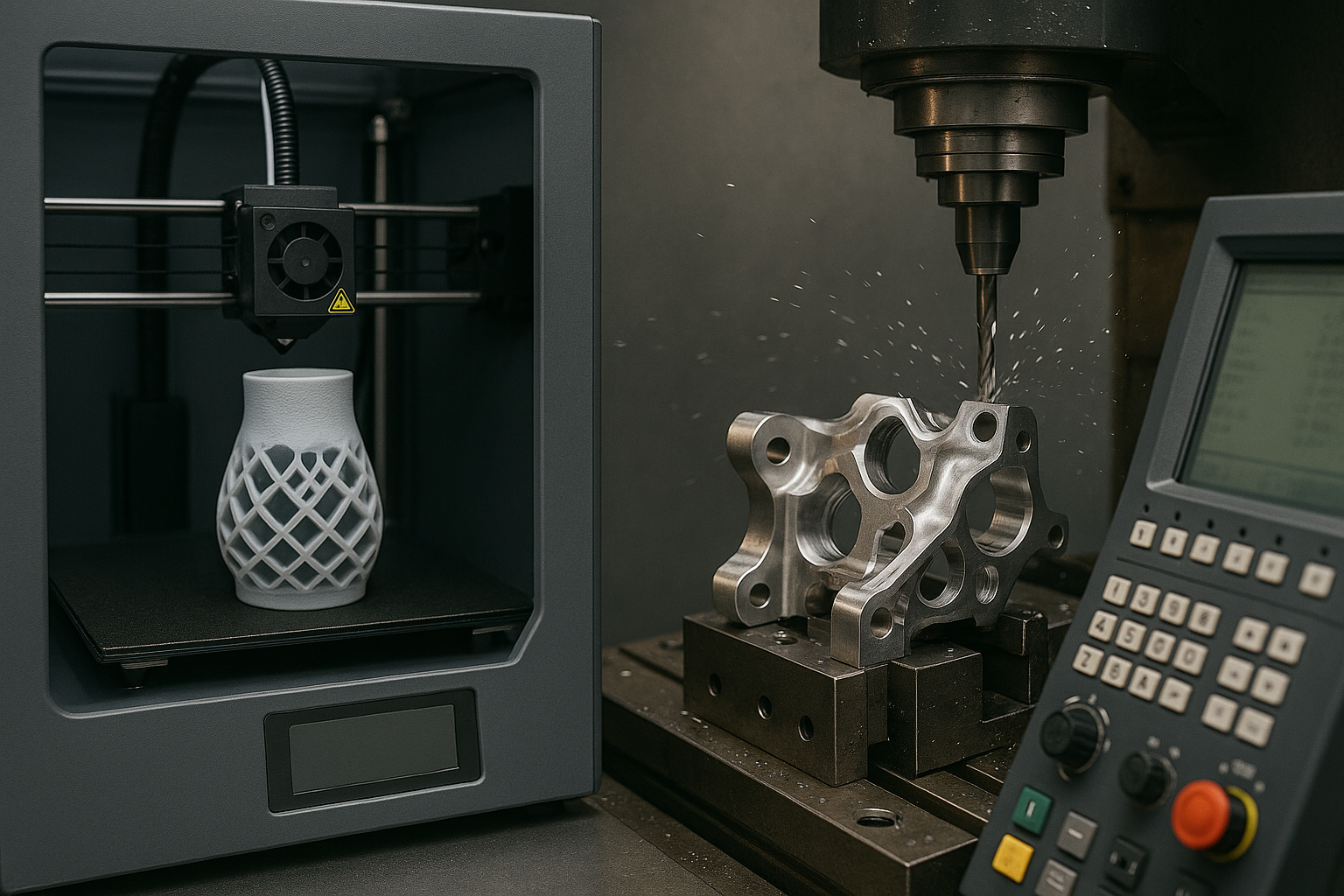
Why Combine 3D Printing and Traditional Machining?
3D printing excels at creating complex internal geometries, lattice structures, and lightweight designs that are difficult or impossible to produce with subtractive methods. However, it often lacks the tight tolerances, surface finish, and material consistency required for critical applications.
Traditional machining, on the other hand, provides superior dimensional control, surface precision, and mechanical reliability, but is limited when it comes to producing intricate or organic forms.
By combining both methods, manufacturers gain the design freedom of 3D printing and the precision of CNC machining—a powerful formula for high-value, functional parts.
Key Application Scenarios
1. Functional Prototypes with Precision Fit
A 3D-printed prototype can be post-machined to achieve tight tolerances on specific features, such as bearing seats, threads, or mating surfaces. This allows functional testing of assemblies without the need for full-scale tooling.
2. Lightweight Aerospace or Automotive Components
Complex brackets or housings are often 3D-printed in titanium or aluminum to reduce weight. After printing, machining ensures flatness, mounting holes, and interfaces meet strict aerospace or automotive standards.
3. Medical Implants and Custom Devices
Patient-specific implants (such as orthopedic plates or dental frameworks) are 3D-printed based on CT scans. Machining then refines contact surfaces or attachment points to meet surgical precision.
4. Conformal Cooling in Injection Molds
Tooling inserts with conformal cooling channels are 3D-printed to improve heat transfer. Traditional machining is used afterward to finish critical mold surfaces and tolerance zones.
5. Hybrid Tooling and Fixtures
3D-printed fixturing bases can be produced rapidly, while CNC-machined metal inserts are embedded for strength, wear resistance, or high-precision interfaces, creating flexible and cost-effective shop-floor tools.
6. Reverse Engineering and Low-Volume Spare Parts
Obsolete parts can be 3D-scanned and printed quickly. Traditional machining follows to refine functional areas and adapt the part for compatibility with modern systems.
Benefits of Hybrid Manufacturing
Faster Time-to-Market: Design iterations are accelerated when additive and subtractive processes are combined strategically.
Lower Tooling Costs: Complex geometries can be produced without specialized molds or dies.
Greater Design Flexibility: Engineers can optimize shape, weight, and function beyond the constraints of traditional methods.
Improved Functionality: Critical features benefit from high precision, while the rest of the part remains lightweight or organically shaped.
Material Efficiency: Material is added only where needed and machined only where necessary.
Considerations for Integration
Successfully combining 3D printing and machining requires:
Careful design for hybrid manufacturability, considering both additive and subtractive constraints
Alignment of materials, since not all 3D-printed materials machine well
Thoughtful fixturing and orientation to support precise machining after printing
Post-processing strategies to handle surface roughness, residual stress, or porosity in printed parts
A collaborative workflow between designers, machinists, and additive experts is key to maximizing results.
Conclusion
The integration of 3D printing and traditional machining is not a trend—it’s a practical evolution in modern manufacturing. It enables faster innovation, smarter part design, and more efficient use of resources across industries from aerospace and medical to automotive and tooling.
At Unison Tek, we recognize the value of hybrid manufacturing and work closely with our partners to deliver custom solutions that combine the best of both worlds—complex geometry with uncompromising precision.
Looking to bring your innovative part to life with hybrid manufacturing? Let’s build it together.