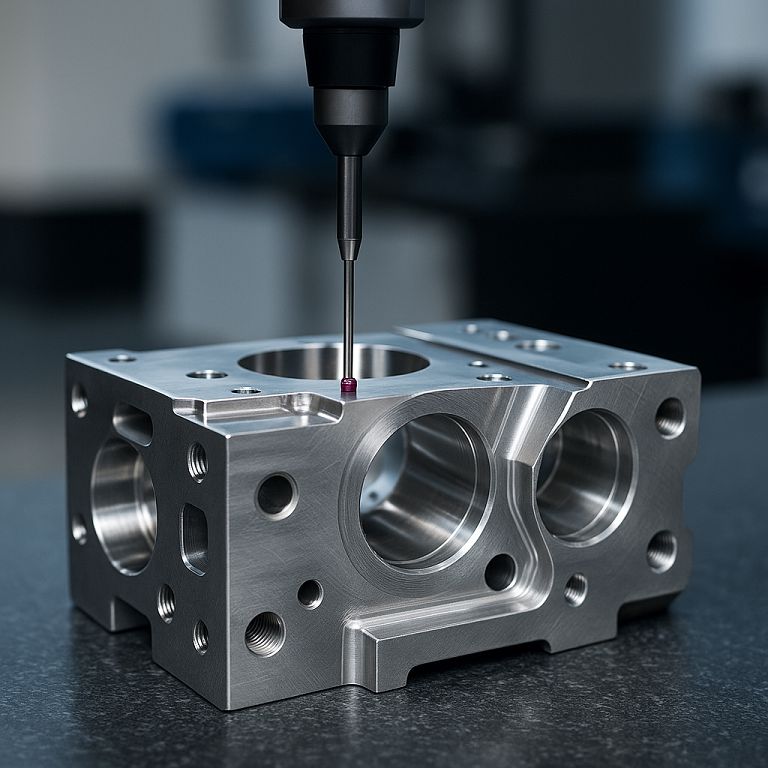
The Role of CMM Inspection in Precision Machining
CMM inspection is the backbone of dimensional control in precision machining. It uses a computer-controlled measuring probe to capture data points from a part’s surface and compare them to the CAD model or engineering drawing.
This process provides an accurate, three-dimensional analysis of the part’s geometry, confirming that it adheres to design intent.
CMMs are especially valuable for high-precision industries such as aerospace, medical devices, and automotive manufacturing, where reliability and repeatability are non-negotiable.
Key Benefits of CMM Inspection
Unmatched accuracy: Capable of detecting deviations within microns.
Comprehensive analysis: Measures size, position, and form features across complex geometries.
Efficiency: Reduces manual inspection time and human error.
Traceability: Digital reports provide documented quality verification for each part.
Understanding GD&T in CMM Measurement
GD&T (Geometric Dimensioning and Tolerancing) provides the universal language of dimensional control. It defines how part features relate to one another in terms of shape, orientation, and position.
When integrated with CMM inspection, GD&T ensures precise interpretation of design requirements. Instead of relying solely on traditional linear dimensions, GD&T symbols allow inspectors to measure functional characteristics—ensuring that parts will fit, move, and perform correctly when assembled.
Using CMMs with GD&T principles leads to more consistent quality verification, minimizing disputes between manufacturers and customers.
Measuring Equipment and Technology Advancements
Modern measuring equipment extends far beyond traditional touch-probe CMMs. Today’s systems incorporate:
Non-contact laser and optical sensors for delicate or flexible components.
Portable CMMs for on-site inspection and large workpieces.
Automated CMMs integrated with production lines for real-time quality monitoring.
Temperature compensation systems that maintain accuracy in variable environments.
These technologies make CMM inspection faster, more versatile, and more compatible with smart manufacturing systems.
ISO9001 and Quality Verification
For global manufacturers, achieving and maintaining ISO9001 certification demonstrates a strong commitment to quality management. Under ISO9001 guidelines, CMM inspection is an essential part of the quality verification process, ensuring full traceability from raw material to final delivery.
Consistent inspection routines and documented results provide customers with confidence that every part meets international standards.
In many industries, CMM inspection data is a mandatory requirement for supplier approval and ongoing quality audits.
Applications of CMM Inspection
CMM inspection is used across a variety of industries:
Aerospace: Verifying turbine blades, structural components, and landing gear assemblies.
Medical: Inspecting implants and surgical tools for geometric accuracy.
Automotive: Checking engine housings, transmission parts, and die-cast molds.
Electronics: Measuring housings, connectors, and micro-mechanical components.
In all these cases, CMMs ensure consistency, precision, and full quality verification at every production stage.
Summary
In precision machining, CMM inspection is far more than a measurement step—it’s the foundation of quality verification and customer trust.
By combining GD&T principles, advanced measuring equipment, and ISO9001 quality standards, manufacturers can guarantee that every component meets the most demanding tolerances.
As industries continue to advance toward digital and automated production, CMM technology will remain essential for maintaining precision, compliance, and excellence in manufacturing.
Get our Product Category To know Facilities of Unisontek.