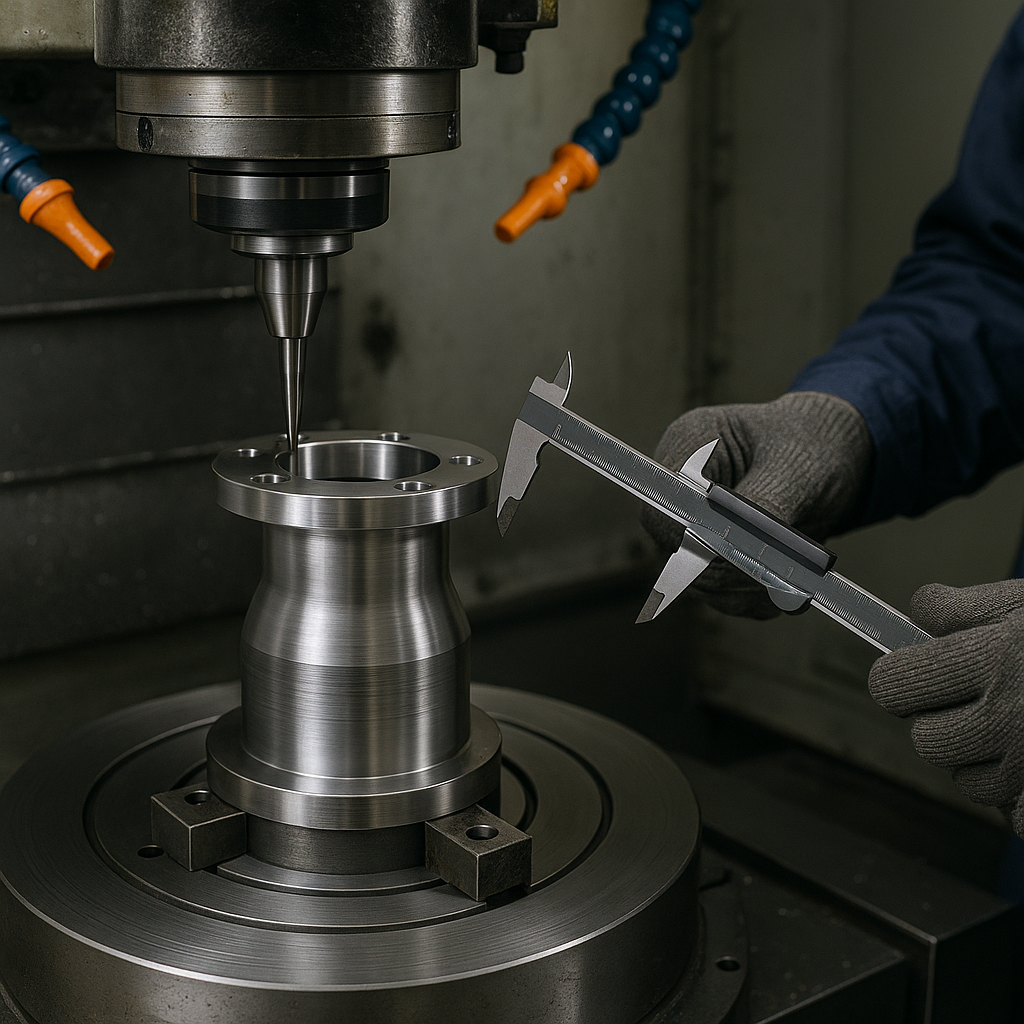
1. The Importance of Precision Machining
Precision machining involves producing components with extremely tight dimensional accuracy, often measured in microns.
Advanced CNC equipment, skilled operators, and strict process controls are necessary to achieve this level of accuracy. Without precision, even minor dimensional errors can lead to:
Misaligned assemblies
Reduced product performance
Premature wear or failure
Increased costs due to rework or scrap
2. What Is Tolerance Control?
Tolerance control refers to the management of acceptable dimensional variation in a part. Engineering drawings specify tolerances to ensure components fit together while balancing manufacturability and cost.
Tight tolerances improve performance and reliability but increase machining difficulty and cost.
Looser tolerances reduce machining time and cost but may compromise functionality.
Effective tolerance control ensures that the right level of precision is applied where it matters most.
3. Factors Affecting Tolerance Achievement
Several elements influence whether a machine shop can maintain tight tolerances:
Machine Capability: Multi-axis CNC machines with stable construction and advanced controls achieve finer precision.
Tooling and Fixtures: High-quality cutting tools and rigid fixturing reduce vibration and dimensional errors.
Material Properties: Some materials, such as titanium, are more challenging to machine within tight tolerances due to hardness or thermal expansion.
Environmental Conditions: Temperature fluctuations can cause material expansion or contraction, affecting accuracy.
Operator Skill: Skilled machinists and programmers play a critical role in ensuring tolerances are consistently achieved.
4. Measurement and Verification
To guarantee tolerance compliance, advanced metrology tools are employed:
Coordinate Measuring Machines (CMMs) for dimensional accuracy.
Laser Scanning and Optical Systems for surface profiles and complex geometries.
In-Process Probing integrated into CNC machines to detect deviations during machining.
Consistent measurement and verification reduce the risk of defects and ensure compliance with customer requirements.
5. Balancing Precision and Cost
One of the biggest challenges in tolerance control is finding the right balance between performance needs and production costs. Specifying unnecessarily tight tolerances increases machining time, tool wear, and inspection costs. On the other hand, overly loose tolerances may cause assembly failures. Effective engineering requires understanding where tight tolerances are essential and where standard ones are sufficient.
Summary
Precision machining and tolerance control are the foundation of high-quality manufacturing.
They ensure components meet functional, safety, and reliability standards across critical industries.
By combining advanced machinery, skilled personnel, and rigorous quality systems, manufacturers can achieve the delicate balance between precision, efficiency, and cost-effectiveness—a balance that defines success in today’s competitive market.
Get more info, please visit our CNC Turning Parts or Products. Contact us for your customized metal parts.