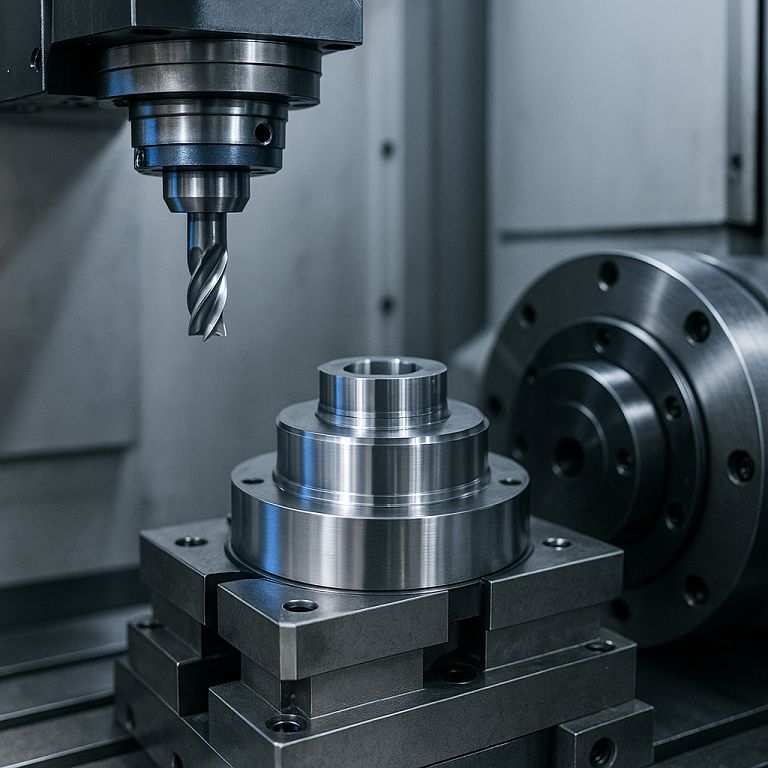
The Core of Precision Machining
At its foundation, precision machining involves removing material from a workpiece with exact control over dimensions, surface finish, and geometry.
Using advanced CNC (Computer Numerical Control) machines, engineers can produce parts measured in microns—achieving levels of accuracy impossible with traditional manufacturing methods.
These processes include turning, milling, drilling, grinding, and electrical discharge machining (EDM), often combined to create complex, high-performance components.
Materials and Process Innovations
Modern precision machining handles a wide range of materials, from aluminum and stainless steel to titanium, Inconel, and engineering plastics.
Each material presents unique challenges in cutting performance, thermal expansion, and tool wear. Innovations such as high-speed machining, multi-axis systems, and hybrid manufacturing (combining CNC with additive technologies) allow manufacturers to maintain accuracy while increasing productivity.
Surface finishing, coating, and heat treatment further enhance component performance, ensuring durability and resistance to wear, corrosion, and extreme environments.
Automation and Smart Manufacturing
The integration of automation and digital technologies is transforming precision machining into smart manufacturing.
Robotic arms handle repetitive tasks such as loading and unloading, while automatic tool changers and AI-driven monitoring systems optimize cutting conditions in real time.
These advancements not only reduce human error but also lower labor costs and improve efficiency.
Through the Industrial Internet of Things (IIoT), machines are now interconnected, capable of sharing performance data for predictive maintenance and process optimization.
This digital evolution enables “lights-out manufacturing,” where production continues around the clock with minimal human intervention.
Quality and Inspection Technologies
In precision machining, quality assurance is non-negotiable.
Coordinate Measuring Machines (CMMs), laser scanners, and optical inspection systems ensure that every part meets strict dimensional tolerances.
Advanced inspection data can be fed back into machining processes, creating a closed-loop system that continuously improves accuracy and consistency.
Sustainability and Green Manufacturing
Sustainability is becoming a core consideration in machining operations.
Energy-efficient CNC machines, recyclable cutting fluids, and waste reduction practices contribute to lower carbon emissions.
Lean manufacturing principles and digital optimization also help minimize resource consumption—aligning precision machining with global sustainability goals.
The Future of Precision Machining
As industries evolve, precision machining will continue to play a vital role in producing components for emerging technologies such as electric vehicles, renewable energy systems, and advanced semiconductors. The future will be defined by hybrid manufacturing, AI-driven process control, and ultra-precision machining capable of achieving nanometer-level accuracy.
Summary
Precision machining is more than a manufacturing process—it is the foundation of technological innovation.
Through continuous improvement, automation, and digital transformation, it empowers industries to create stronger, smarter, and more efficient products.
As global demand for high-performance components continues to rise, precision machining will remain the cornerstone of advanced manufacturing and industrial excellence.
Get more info, please visit our CNC Turning Parts or Products. Contact us for your customized metal parts.