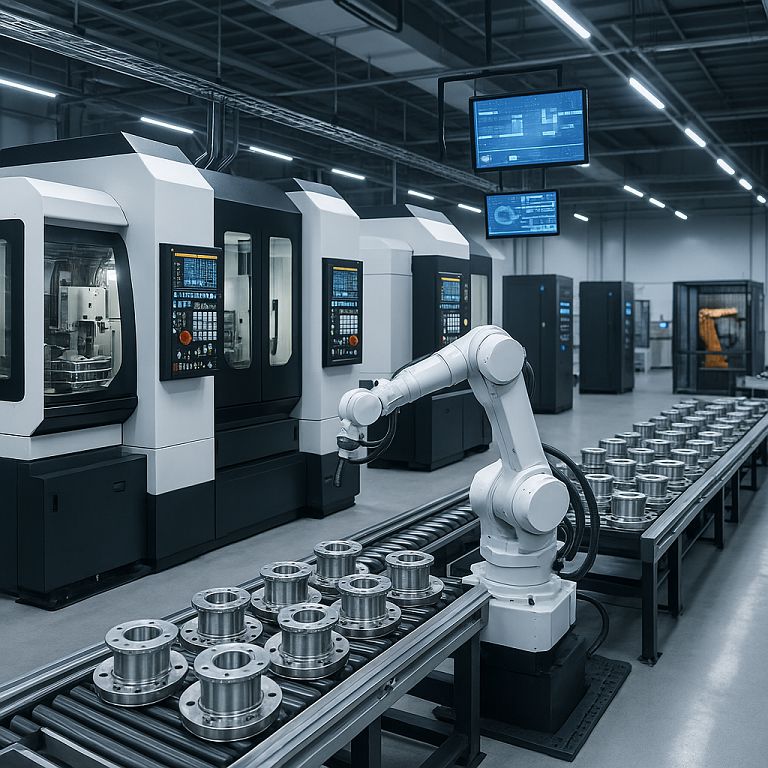
What Defines a Smart Factory?
A smart factory leverages technologies such as the Internet of Things (IoT), artificial intelligence (AI), robotics, and big data to create a connected and adaptive manufacturing ecosystem.
Machines, sensors, and software platforms communicate seamlessly, enabling real-time monitoring and predictive decision-making. This level of connectivity allows manufacturers to anticipate problems, optimize workflows, and maintain consistent product quality.
Smart Factories in Precision Metalworking
Precision metalworking requires strict adherence to tolerances, material integrity, and repeatability. Smart factory technologies enhance these capabilities by introducing:
Automated CNC systems: Machines equipped with sensors and adaptive controls can adjust parameters in real time to maintain accuracy.
Predictive maintenance: IoT-enabled monitoring detects wear or anomalies before failures occur, reducing downtime.
Data-driven quality assurance: Integrated inspection systems ensure each component meets specifications, while data logs provide traceability.
Flexible production: Automated scheduling and robotics enable quick adjustments to meet varying customer demands and shorter lead times.
Benefits of Smart Factories for Metalworking
Implementing smart factory principles in precision metalworking offers significant advantages:
Higher efficiency: Reduced waste, optimized cutting strategies, and faster cycle times.
Improved quality: Real-time feedback loops ensure consistent tolerances and surface finishes.
Cost savings: Lower downtime and energy use contribute to leaner, more sustainable operations.
Customization at scale: The ability to produce small-batch or complex parts without sacrificing efficiency.
Challenges and Considerations
While the benefits are compelling, transitioning to smart factories involves challenges. High initial investment, cybersecurity risks, and the need for workforce training are key concerns.
Companies must also ensure interoperability between legacy systems and new digital technologies. However, as adoption grows, costs are expected to decline, making smart manufacturing increasingly accessible.
The Road Ahead
The future of precision metalworking will be shaped by smart factories that embrace automation, digital integration, and sustainable practices.
Hybrid approaches combining CNC machining, additive manufacturing, and AI-driven analytics will unlock new levels of efficiency and innovation.
As industries such as aerospace, automotive, medical, and energy demand more complex and reliable components, smart factories will be central to meeting these requirements.
Summary
Smart factories represent the next evolution in precision metalworking.
By merging advanced machining technologies with digital intelligence, manufacturers can achieve unparalleled efficiency, flexibility, and quality.
As the global market moves toward smarter and greener production, precision metalworking companies that adopt smart factory strategies will gain a decisive competitive edge in the future of manufacturing.
Get our Product Category To know Facilities of Unisontek.