When the Cut is Smaller Than the Grain: Unraveling the “Size Effect” in Micro-Machining
If you take a standard piece of steel and cut it on a full-sized CNC milling machine, the physics feels straightforward and intuitive. You dial in your feeds and speeds, the cutting tool acts like a sharp knife, and metal chips peel off smoothly like curls of butter.
Now, imagine shrinking that cutting tool down until its tip is finer than a single strand of human hair. You are no longer removing chunks of metal you can see with the naked eye; you are shaving off layers measured in fractions of a single micron.
Welcome to the fascinating world of Micro-Machining—the ultra-precise manufacturing process used to craft microscopic medical implants, tiny semiconductor molds, and miniature aerospace sensors.
At this microscopic scale, something mind-bending happens. The comfortable rules of traditional machining completely break down. Metal no longer behaves like a predictable solid; instead, it starts acting tough, gummy, and unexpectedly stubborn.
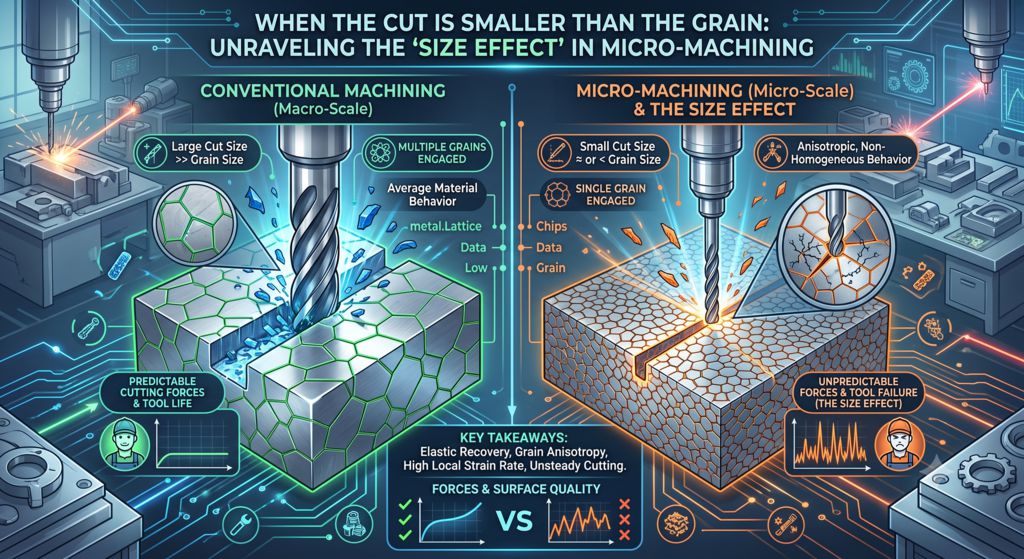
Why? Because when your chip thickness becomes smaller than the microscopic metal grains inside the material, you enter the realm of the Size Effect. Let’s take a friendly, plain-English journey into this tiny frontier to see what happens when the cut becomes smaller than the grain itself.
The Secret Architecture of Metal: Grains and Boundaries
To understand why micro-machining is so tricky, we first have to zoom in on what metal actually looks like at a microscopic level.
When we hold a solid steel rod or an aluminum block, it looks completely smooth and uniform. But if you put that metal under a powerful microscope, you’ll discover that it is actually composed of millions of tiny, interlocking crystal structures called grains.
Think of a piece of metal like a wall made of irregular cobblestones stuck together with strong mortar:
- The Grains: Individual crystal structures where all the atoms are lined up in neat, orderly rows.
- The Grain Boundaries: The lines where two different grains bump into each other.
In conventional, macro-scale machining, a cutting tool is huge compared to these grains. A standard 6mm endmill slices through millions of grains and grain boundaries in a single pass. Because it is cutting across an average of thousands of grains all at once, the metal feels uniform, predictable, and easy to slice.
What Happens When You Cut Inside a Single Grain?
Now, shrink your cutting depth down so far that the thickness of the metal you are removing is smaller than the size of a single grain.
Suddenly, your cutting tool isn’t slicing through a giant crowd of grains anymore. It is stuck fighting one individual grain at a time.
This is where the “Size Effect” rears its head, creating three strange phenomena that catch many machinists off guard:
1. Metal Suddenly Feels “Harder” (The Size Effect)
In traditional machining, cutting off a larger chunk of metal requires more total force, but the energy required per unit of material stays relatively constant.
In micro-machining, that rule flips on its head. As your cut gets thinner and thinner, the amount of energy required to remove a tiny speck of metal shoots up exponentially. Why? Because you are no longer hitting the natural microscopic defects and grain boundaries that help metal fracture easily. You are trying to shear through a pure, flawless crystal lattice. The metal effectively becomes much tougher to cut than it was on a larger scale.
2. The Tool “Pushes” Instead of “Cuts” (Plowing Effect)
Even the sharpest micro-tools made of fine-grained carbide have a slightly rounded tip at the microscopic level. When your programmed depth of cut is smaller than the radius of that tool tip, the knife edge can no longer get underneath the metal to slice it cleanly.
Instead of cutting, the tool tip acts like a blunt snowplow. It rubs against the metal, pushing and compressing it downward. Instead of creating a clean chip, the metal bulges up around the tool, creating intense friction, extreme heat, and heavy burrs around the edges of your tiny part.
3. The Metal Turns “Grainy” and Unpredictable
Imagine cutting a piece of wood. Slicing with the grain is easy, but slicing across the grain takes more effort.
When your tool is cutting inside individual metal crystals, it experiences this exact same problem. As the tool moves from Grain A (oriented in one direction) to Grain B (oriented in another direction), the cutting forces suddenly jump up and down. This causes microscopic vibrations, rapid tool wear, and inconsistent surface finishes that look uneven under a microscope.
How Ultra-Precision Shops Master the Micro-World
Overcoming the Size Effect requires rethinking everything about tools, machines, and material preparation. Here is how modern precision shops win the battle against microscopic grain resistance:
- Ultra-Fine Grain Materials: To make the material act predictably, manufacturers use specialized metals with ultra-fine or nanometer-sized grains. By making the grains microscopic, the tool can still hit multiple grain boundaries even during a tiny cut, making the material feel smooth again.
- Single-Crystal Diamond Tools: When carbide tools aren’t sharp enough, engineers use tools made of pure single-crystal diamond. These tools can be sharpened down to an atomic edge radius, allowing them to cleanly slice underneath microscopic chip layers without plowing.
- Blistering Spindle Speeds: To prevent micro-tools from snapping under variable grain forces, micro-milling machines use air-bearing spindles that spin at staggering speeds—often between 60,000 to 160,000 RPM—allowing tiny tools to whisper through the metal with minimal force.
The Takeaway: Scale Changes Everything
Micro-machining teaches us a valuable lesson about the physical world: when you change the scale, you change the rules.
What works on a 50mm steel block will fail on a 5-micron feature. By understanding that metal is an assembly of microscopic grains—and respecting the Size Effect that occurs when you cut inside those grains—engineers can design better tools, optimize toolpaths, and continue pushing the boundaries of what is humanly possible to manufacture.
Get more info, please visit our CNC Turning Parts or Products.
Contact us for your customized metal parts.
Have you ever worked with micro-tools or manufactured ultra-tiny features? What was the biggest challenge you faced when shrinking down your setup? Let’s share some insights in the comments below!