In the world of advanced manufacturing, titanium is treated like royalty. It is the golden child of aerospace engineering, medical implants, and high-performance military hardware. Among the various grades of this wonder metal, Ti-6Al-4V (often called Grade 5 Titanium) reigns supreme. Accounting for over half of all titanium used worldwide, this specific alloy of titanium, aluminum, and vanadium offers a mouth-watering combination of extreme strength, lightweight properties, and spectacular corrosion resistance.
But if you slide away from the design studio and step onto the noisy floor of a CNC machine shop, the mention of Ti-6Al-4V evokes a very different reaction: groans, sighs, and frustrated head-scratching.
To a machinist, Ti-6Al-4V is a notorious "nightmare material." It is an alloy that actively tries to destroy the tools meant to shape it. The difficulty of cutting Ti-6Al-4V boils down to a brutal double-whammy of physics: severe tool adhesion (gummy sticking) and a catastrophic thermal bottleneck. Here is an in-depth look at why titanium is so punishing to machine and how modern engineering is fighting back.
1. The Thermal Bottleneck: A Closed-Door to Heat Dissipation
When you machine standard steels or aluminum, friction generates an immense amount of heat at the cutting edge. However, these traditional metals possess high thermal conductivity. As the tool cuts, the metal behaves like a heat sink, absorbing the thermal energy and safely carrying it away inside the flying chips. The heat leaves the machine inside the waste bucket.
Titanium completely breaks this rule. Ti-6Al-4V has an incredibly low thermal conductivity—it acts more like a thermal insulator than a metal.
When a carbide end mill slices into Ti-6Al-4V, the heat generated by the intense friction has nowhere to go. It cannot escape into the workpiece, and it cannot escape into the chips. Instead, roughly 80% of the blistering heat remains trapped in one tiny, localized zone: the microscopic interface between the tool edge and the workpiece.
Temperatures at the tool tip can instantly rocket past 1000°C. This localized heat concentration acts like a thermal laser, rapidly softening the cutting tool material, accelerating chemical wear, and causing the sharp cutting edge to plastically deform and dull within minutes.
2. The Sticky Trap: Severe Tool Adhesion (Built-Up Edge)
As if dealing with a thousand-degree localized furnace wasn't enough, Ti-6Al-4V introduces a second, highly aggressive defense mechanism: chemical reactivity and adhesion.
Titanium is a highly reactive element, especially when exposed to elevated temperatures. When the cutting zone gets red-hot, the titanium alloy loses its stability and wants to chemically bond with other elements, including the tungsten carbide or cobalt inside the cutting tool.
As the tool moves through the cut, the gummy, softened titanium literally welds itself directly onto the tool’s rake face and cutting edge. This phenomenon is known as a Built-Up Edge (BUE).
This sticky adhesion creates a disastrous domino effect. The layer of welded titanium alters the sharp geometry of the tool, making it blunt. Instead of cleanly shearing the metal, the tool begins to plow and rub against the workpiece, creating even more friction and trapping even more heat.
Worse yet, as the machine forces the tool forward, these temporary titanium welds violently rip away from the tool tip. When the titanium breaks off, it takes microscopic chunks of the carbide tool edge with it, leading to rapid micro-chipping, flaking, and catastrophic tool failure.
3. Breaking the Bottleneck: Modern Machining Strategies
To successfully machine Ti-6Al-4V without going bankrupt over destroyed cutting tools, machine shops must throw out standard cutting handbooks and implement advanced, specialized strategies designed to bypass these thermal and adhesive barriers.
High-Pressure Coolant (HPC) Systems
Standard overhead coolant nozzles that gently splash fluid onto the machine bed are completely useless against titanium. The intense pressure of the cut creates a localized vapor barrier that prevents the fluid from ever reaching the actual hot spot.
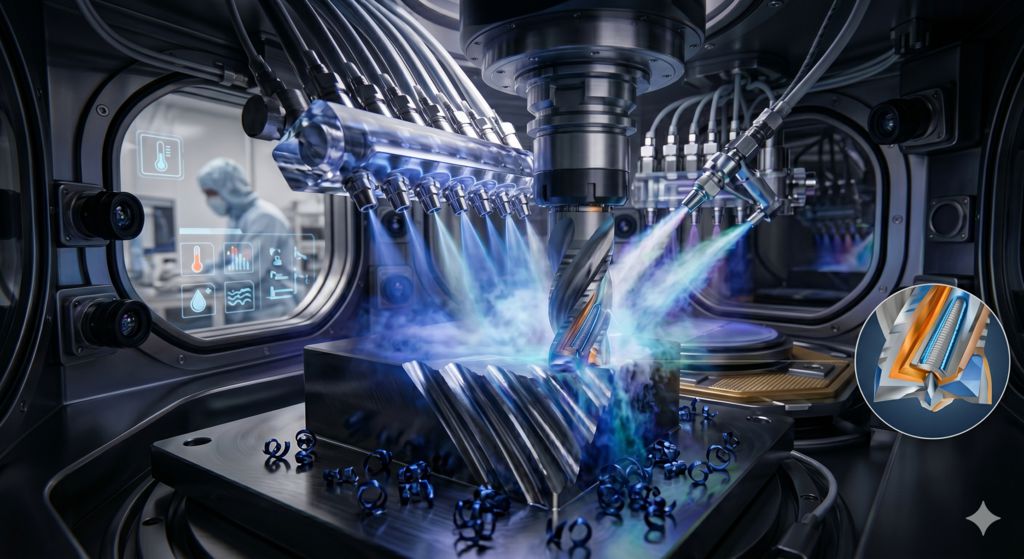
To smash through this barrier, modern CNC machines utilize High-Pressure Coolant (HPC) systems that blast specialized cutting fluid directly through the spindle and out of the tool tip at pressures exceeding 70 to 100 bars.
This supersonic jet of fluid forcefully penetrates the cutting zone, physically lifting the chip away from the tool face, instantly quenching the thermal bottleneck, and blasting away gummy titanium particles before they can weld to the edge.
Cryogenic Machining (Liquid Nitrogen)
The ultimate evolution in thermal control is cryogenic machining. Instead of traditional oils or water-based coolants, advanced aerospace facilities pump liquid nitrogen at a freezing -196°C directly onto the cutting zone through micro-nozzles. This extreme cold completely neutralizes the thermal bottleneck, keeping the cutting tool at a safe operating temperature and preventing the titanium from reaching the hot, chemically reactive state where it likes to stick to the tool.
Advanced Tool Coatings: PVD Barriers
To stop the chemical attraction between titanium and tungsten carbide, manufacturers apply specialized coatings to the tools using Physical Vapor Deposition (PVD).
Coatings like Titanium Aluminum Nitride (TiAlN) or specialized diamond-like carbon (DLC) layers act as a slippery, thermal-barrier shield. They prevent the titanium from making direct molecular contact with the tool core, lowering friction and stopping the sticking phenomenon dead in its tracks.
The Bottom Line
Machining Ti-6Al-4V is a delicate balancing act between speed, heat, and material science. You cannot tame titanium with brute force; if you try to push the machine too hard or cut too fast, the physics of the material will instantly destroy your tooling.
By understanding that the battle against titanium is primarily a thermodynamic war against trapped heat and atomic adhesion, modern manufacturers can deploy the right tools—high-pressure hydraulics, advanced PVD armor, and optimized tool paths.
Taming Ti-6Al-4V is expensive and requires flawless execution, but unlocking the full potential of this celestial metal makes the engineering struggle entirely worth it.
Get more info, please visit our CNC Turning Parts or Products. Contact us for your customized metal parts.