Outsmarting Metal’s Memory: Fighting Springback in Precision Stamping with Predictive Design
If you take a sheet of paper, fold it cleanly down the middle, and let go, it stays folded. The crease is sharp, predictable, and permanent.
Now, imagine trying to do the exact same thing with a sheet of high-strength steel. You place it into a massive industrial stamping press, drive a heavy steel punch down with tons of force, and bend it into a crisp 90-degree angle.
The press lifts up. You reach in to collect your part, expecting a perfect right angle.
Instead, the moment the heavy steel punch releases its grip, the metal quietly relaxes and unbends itself to 92 degrees.
Welcome to one of the most persistent, maddening headaches in sheet metal stamping: Springback. Metal, it turns out, has a memory. No matter how hard you hit it, it always wants to fight back and snap towards its original flat shape.
In the high-stakes world of automotive, aerospace, and consumer electronics manufacturing—where parts must fit together with microscopic precision—fighting metal’s memory is a daily battle.
Let’s take an easy, math-free look at why springback happens, why modern lightweight metals make it worse, and how tool engineers use “predictive design” to outsmart the metal every single time.
Why Does Metal Remember Its Past?
To understand springback, we have to look inside the metal when it gets bent.
Imagine bending a thick rubber eraser between your thumbs:
- The outer curve of the eraser gets stretched apart.
- The inner curve gets compressed and squished together.
- The very center layer barely stretches at all.
When you bend a piece of sheet metal, the exact same thing happens. The outer layers suffer tension (stretching), while the inner layers suffer compression (squishing).
When the stamping press hits the metal with maximum force, it pushes the metal past its yield point into what engineers call plastic deformation—meaning it takes on a new, permanent shape.
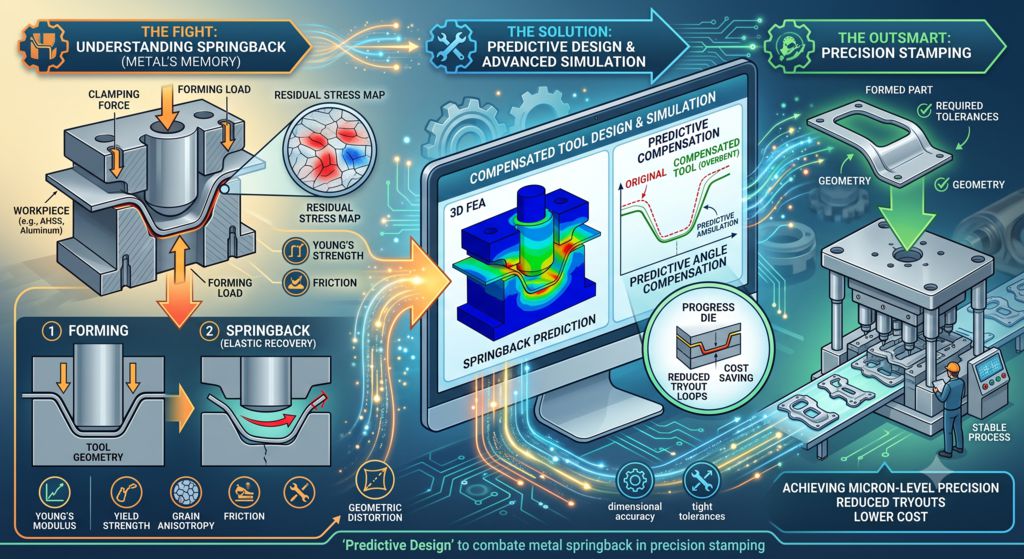
However, metal is also inherently elastic (like a very stiff spring). The outer stretched layers want to contract back to their original size, while the inner compressed layers want to push outward. The moment the stamping press retracts and releases its clamping pressure, these trapped internal forces release. The metal “springs back” toward its flat, relaxed state.
Why Is Springback Getting Worse in Modern Manufacturing?
If toolmakers have been dealing with springback for over a century, why is it such a hot topic right now?
The answer lies in our drive for stronger, lighter products.
To make electric vehicles travel further on a single charge and keep passengers safe in crashes, automakers have largely abandoned soft, easily-formed mild steels. Instead, they use Advanced High-Strength Steels (AHSS) and lightweight aluminum alloys.
While these materials are incredibly strong and lightweight, they possess extreme elasticity. They are much stiffer and act like high-powered springs. When stamped, high-strength alloys don’t just spring back by a fraction of a degree—they can warp, twist, and snap back dramatically out of shape.
If you try to stamp a modern automotive safety pillar using old-school traditional methods, the finished part won’t come close to fitting into the vehicle frame.
Outsmarting the Memory: 3 Ways Engineers Fight Springback
Since you can’t erase the laws of physics, how do precision stamping shops get parts to come out at the exact target dimensions?
Instead of fighting the metal’s memory with brute force, engineers use clever design strategies to outsmart it.
1. Over-Bending (The Intuitive Fix)
The simplest way to beat springback is to bend the material too much on purpose. If you want a finished part to settle at a true 90-degree angle, and you know the metal will spring back by 2 degrees, you design the die to bend it down to 88 degrees.
When the press lifts up, the metal snaps back right into the desired 90-degree sweet spot.
2. Stiffening Ribs (Geometry Over Strength)
Think about how easy it is to fold a flat piece of cardboard versus how hard it is to fold a corrugated cardboard box. Adding 3D geometric shapes—like tiny raised ridges, beads, or stiffening ribs—into the part design freezes the material in place.
These stamped ribs trap the internal stresses, making it physically impossible for the metal to flex back open.
3. Coining and Bottoming (Crushing the Memory)
At the very bottom of the press stroke, if the tool applies extreme, localized pressure directly to the bend line, it physically reshapes and breaks the atomic structure along that corner.
This technique—known as coining—literally squeezes the elastic memory out of the metal, forcing the atoms to accept their new position without fighting back.
The Ultimate Weapon: Predictive Design & Virtual Springback Compensation
In the old days, adjusting a stamping die for springback was a slow, painful process of trial and error.
A toolmaker would build a steel die, stamp a test part, measure how far it warped, take the heavy steel die out of the press, manually grind down the tool face by hand, put it back in, and test again. This “cut and try” loop could take months and cost tens of thousands of dollars.
Today, toolmakers rely on Predictive Compensation Design powered by advanced computer simulation software.
Before a single piece of tool steel is cut, engineers run virtual stamping simulations:
- Simulate the Stroke: The computer software simulates the exact physics of the press slamming down into the virtual sheet metal.
- Calculate the Bounce-Back: The software predicts precisely how, where, and by how many millimeters the metal will warp and twist when released.
- Morph the Virtual Tool: Here is the magic: the software automatically distorts the virtual die design in the opposite direction. If the computer predicts that a door panel will twist 3 millimeters to the left after stamping, it automatically warps the virtual tool face 3 millimeters to the right.
When the physical CNC machine carves out this pre-compensated, intention-warped die, it looks slightly distorted to the naked eye.
But when the press stamps a raw metal sheet on that “crooked” tool, the metal springs back straight into a 100% flat, mathematically perfect part on the very first try!
The Takeaway: Designing for the Aftermath
In precision stamping, quality isn’t about where the metal is while the heavy press is crushing it. Quality is defined by where the metal lands after it relaxes.
By understanding that metal behaves like a spring with a memory—and leveraging predictive software to design pre-compensated tooling—modern engineers have turned a frustrating physical nuisance into a predictable, science-backed success.
The next time you see the sleek, sweeping curve of a modern car hood or the razor-thin frame of a smartphone, remember: the die that made it was intentionally designed “wrong” so the part would come out just right!
Get more info, please visit our CNC Turning Parts or Products.
Contact us for your customized metal parts.
How does your shop handle severe springback when working with high-strength alloys? Do you rely heavily on simulation software or hand-tuning? Share your experiences in the comments below!