When Metal Behaves Like Clay: How Servo Presses Break Forming Limits Through Variable Motion
If you step into a traditional metal stamping plant, you are greeted by an unmistakable, rhythmic roar: CLANG-BANG, CLANG-BANG!
Huge mechanical flywheel presses pound away at sheets of high-strength steel, stamping out automotive fenders, appliance panels, and structural brackets.
For over a century, these traditional mechanical presses operated on a simple, rigid principle: a massive flywheel spins, a crank turns, and the press ram drives straight down and straight back up at a fixed, unstoppable speed.
It’s brute force at its finest. But brute force has a major flaw.
When you try to stamp complex shapes, deep drawn cups, or ultra-high-strength modern alloys using a fixed-speed press, the metal often rebels. It tears, cracks, wrinkles, or springs back out of shape.
Enter the Servo Press —a technological revolution that replaces heavy flywheels with high-torque servo motors. By giving engineers absolute control over the speed, depth, and dwell time of the press ram, servo technology allows us to do something once thought impossible: make solid metal flow smoothly like soft modeling clay.
Let’s take a plain-English, math-free look at how “variable motion” works, why it transforms difficult metals, and how it is redefining the limits of modern manufacturing.
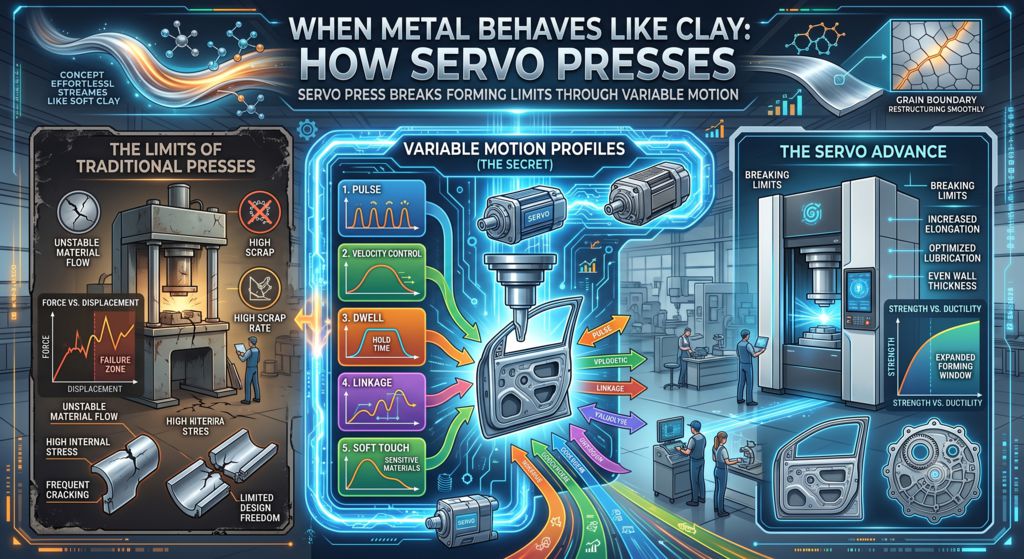
The Flaw of Traditional Mechanical Presses
To understand why servo presses are such a big deal, we first need to look at how traditional flywheel presses work.
A standard mechanical press is tied to a fixed crank motion. Imagine riding a bicycle with a fixed gear: as long as the pedals turn, your feet move in a rigid, repeating circle. You can’t stop halfway through a pedal stroke, slow down right before you hit a hill, or pause at the bottom to rest.
In stamping, this means the press ram always moves at its absolute fastest speed near the middle of its stroke—which happens to be the exact moment the top die slams into the raw metal sheet!
Impact heat spikes instantly, the metal suffers a violent shock, and the material doesn’t have time to stretch naturally. If you are forming a shallow, simple part, it works fine. But if you are trying to bend tough, modern lightweight steels or deep-drawn shapes, that sudden violent impact often rips the metal apart.
The Magic of “Variable Motion” (Curve Programmability)
A servo press throws away the flywheel, clutch, and brake. Instead, its drive mechanism is connected directly to specialized high-torque servo motors.
Because servo motors can accelerate, decelerate, stop, reverse, and hold position with microscopic precision at any point in time, the press ram is no longer locked into a rigid circle. Operators can design custom motion curves tailored to the exact personality of the metal they are forming.
Here are three game-changing motion profiles that turn tough metal into malleable clay:
1. The “Soft Touch” (Impact Reduction)
Instead of slamming into the raw sheet metal at full speed, a servo press can be programmed to approach the workpiece quickly, slow down to a gentle whisper right before making contact, and then press smoothly into the material.
This eliminates the violent shock load. The material isn’t startled into cracking; instead, its crystal structure has time to yield and flow naturally into the die cavity without tearing.
2. The “Dwell & Hold” (Taming Springback)
One of the most annoying problems in metal forming is springback. You bend a piece of high-strength steel to a 90-degree angle, but the moment the press lifts up, the metal slightly unbends itself to 92 degrees like a stiff spring.
With a traditional press, you can’t pause at the bottom of the stroke. With a servo press, you can program a “dwell time.” The press drives down, hits the bottom of the stroke, and holds intense pressure for a fraction of a second. This brief pause allows the internal stress in the metal to relax, permanently locking in the desired shape and virtually eliminating springback.
3. The Pulsing Motion (Pendulum Mode)
For extremely deep containers or complex geometries, a servo press can perform a “pulsing” or “step” motion. The ram pushes down slightly, backs off a fraction of a millimeter to let lubricants flow back under the tool, and then pushes down again.
This micro-pulsing action drastically reduces friction and heat build-up, allowing deep-drawn parts to be stamped in a single continuous operation without cracking the bottom out of the part.
Why Is This a Game-Changer for Modern Manufacturing?
The ability to control ram speed dynamically isn’t just a cool trick for engineers—it solves massive real-world problems on the factory floor:
- Stamping High-Strength Steels and Aluminum: Modern cars use ultra-high-strength steel for safety cages and aluminum for lightweight body panels.
Both materials are notoriously difficult to form on traditional presses. Servo presses make these lightweight, eco-friendly materials easy to stamp accurately. - Combining Multiple Operations into One: Because a servo press can pause or slow down at specific points, you can perform secondary operations—like piercing holes, tapping threads, or inserting rivets—inside the die while the press is forming the part. This eliminates the need for extra machines down the line.
- Massive Energy Savings: Traditional presses keep massive flywheels spinning continuously 24/7, consuming energy even when no parts are being made. Servo presses draw full power only during the actual forming stroke, cutting energy bills significantly.
- Doubling Tool Life: By removing the violent impact shock at the start of every stroke, cutting punches and forming dies suffer far less wear and tear. Tool life frequently doubles or triples on servo setups.
The Takeaway: From Brute Force to Precise Control
Manufacturing is undergoing a quiet shift away from sheer mechanical muscle toward intelligent, digital control.
By replacing the rigid flywheel with the precision of servo control, manufacturers have unlocked a completely new way to talk to metal. Metal is no longer an stubborn obstacle to be smashed into shape; with variable motion, it becomes a cooperative material that can be guided, stretched, and molded like clay.
Whether you are designing automotive structural parts, high-end electronics enclosures, or aerospace panels, adopting servo press technology means fewer cracked parts, longer tool life, and endless possibilities for complex design.
Get more info, please visit our CNC Turning Parts or Products.
Contact us for your customized metal parts.
Has your shop made the switch from mechanical flywheels to servo presses? What motion profile saved your most challenging stamping job? Let’s share your experiences in the comments below!