The Thermal Ghost in the Machine: Why 10,000 RPM Spindles Grow—and How to Stop Them
Imagine standing next to a modern high-speed CNC milling machine. The safety glass is spotless, the coolant is spraying in a fine, misting arc, and inside, the spindle is humming at a blistering 10,000 RPM—or even higher. To the naked eye, everything looks rock-solid, motionless, and mathematically precise.
You run a program to carve a high-precision medical housing or an aerospace valve. The first part comes off the table and measures dead-center on your blueprint tolerances. You feel like a master of precision.
Four hours later, without changing a single line of code, you pull out another part from the exact same batch. You measure the depth of a critical pocket with a digital indicator.
Suddenly, you’re off by 15 microns.
Your tool didn’t wear out. Your workpiece didn’t slip in the vise. So what happened?
You’ve just crossed paths with the “thermal ghost” of high-speed machining: spindle thermal growth caused by internal friction and motor heat. Let’s take an easy, math-free look at why high-speed spindles physically swell when they run, and how precision shops tame this invisible growth.
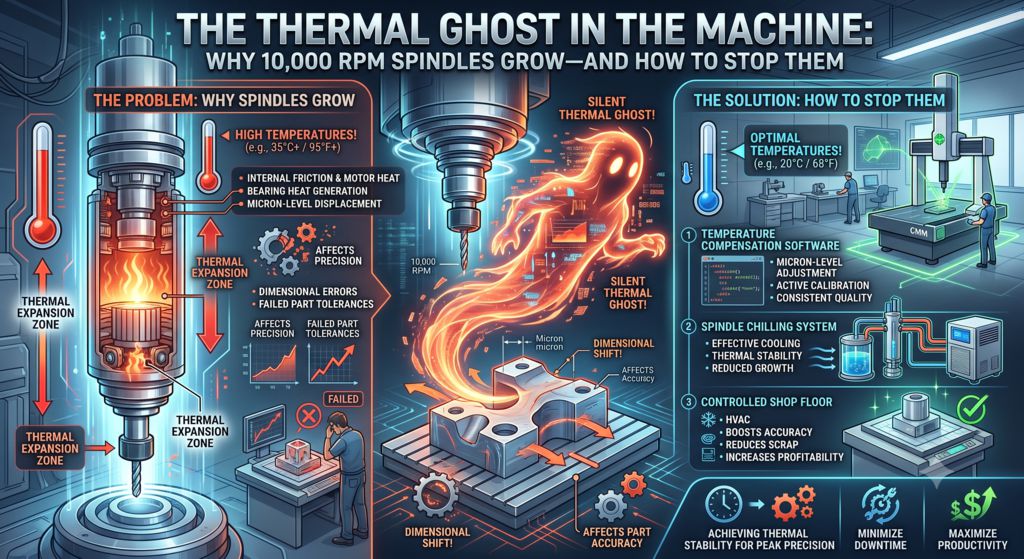
The Recipe for Internal Heat: Friction and Electromagnetism
To understand why a 10,000+ RPM spindle grows, we have to look deep inside its metal housing. A modern CNC spindle isn’t just a simple rod attached to a belt; it is a complex, high-performance electromechanical ecosystem.
When you spin a heavy steel shaft at 10,000 revolutions per minute, heat is generated simultaneously from two major internal sources:
1. The Bearings (Mechanical Friction)
To keep a spindle shaft spinning smoothly without vibrating itself to pieces, it relies on ultra-precision ceramic or steel ball bearings.
Even with high-tech synthetic grease or oil-air lubrication systems, spinning thousands of tiny ceramic spheres at extreme speeds creates inevitable mechanical friction. That friction generates a steady, continuous stream of heat right at the core of the spindle assembly.
2. The Built-in Motor (Electromagnetic Heat)
Most modern high-speed machines use “direct-drive” or “built-in” motor spindles. Instead of using external belts or gears, the electric motor’s stator and rotor are wrapped directly around the spindle shaft inside the housing.
As electricity surges through the motor windings to drive the tool through tough metal, the copper coils naturally generate electromagnetic heat—acting like a small internal furnace.
The Micron-Level Expansion: Why Metal Acts Like a Sponge
We tend to think of steel and cast iron as rigid, unyielding materials. But under a microscope, metal acts more like a stiff sponge that expands when warmed and contracts when cooled.
When the internal bearings and motor heat up during a long production run, that heat radiates outward into the solid steel spindle shaft and its surrounding housing. As the atoms inside the metal absorb thermal energy, they vibrate faster and push slightly away from each other.
Because the spindle is anchored tightly at the top to the machine’s vertical column, it has only one direction to expand: straight down toward your workpiece.
    [ Machine Column (Fixed Anchor) ]
                   |
                   |  <-- Spindle expands DOWNWARD as it heats up
                   v
         +-------------------+
         |   Spindle Motor   |  <-- (Generates Heat)
         |  +-------------+  |
         |  |   Bearing   |  |  <-- (Generates Friction)
         +--+-------------+--+
                   |
                   |  <-- Tool tip shifts closer to workpiece
                   v
             [ Workpiece ]
A human hair is roughly 70 microns thick. A high-speed spindle running continuously can easily grow by 10 to 30 microns or more as its internal temperature rises!
If your depth tolerance on a critical feature is only 5 microns, that thermal growth means your tool tip is gradually creeping deeper into the part, turning expensive raw material into scrap metal.
Why Doesn’t the CNC Controller See It Growing?
A common question machinists ask is: “My CNC machine has high-precision glass scales and encoders on the Z-axis—why doesn’t the computer automatically stop the tool from cutting too deep?”
The answer comes down to what those sensors are actually measuring.
The machine’s Z-axis encoder tracks the movement of the slides and ball screws that carry the spindle housing up and down. As far as the controller is concerned, the slide hasn’t moved a single micron. The computer has no idea that the steel shaft inside the housing has physically stretched downward like a warm piece of taffy.
How Modern Machine Shops Fight Thermal Swell
You can’t eliminate the laws of physics, but you can outsmart them. High-precision manufacturing facilities use a combination of clever mechanical engineering and smart software to keep thermal growth under control:
1. Active Liquid Cooling Jackets
High-performance spindles are wrapped in a liquid cooling jacket. An external industrial chiller continuously circulates temperature-controlled oil or water around the spindle body, pulling heat away from the motor and bearings before it can soak into the structural steel.
2. Thermal Stabilization Warm-Up Programs
A cold machine is an unpredictable machine. Experienced operators never start cutting high-tolerance parts the moment they flip the power switch on a cold morning. They run a 20-to-30-minute warm-up program that gradually ramps up the RPM.
This brings the spindle up to its stable “operating temperature.” Once the metal reaches thermal equilibrium, it stops growing and stays consistent.
3. Sensor-Based Software Compensation
Modern high-end CNC machines feature built-in thermal sensors embedded near the spindle bearings. As the sensors detect a temperature spike, the machine’s control software uses a real-time mathematical model to automatically retract the Z-axis by a few microns, dynamically counteracting the expansion as it happens.
The Takeaway: Precision Requires Respecting Heat
Spinning a CNC spindle at 10,000+ RPM opens up incredible possibilities for fast, high-efficiency manufacturing. But true precision isn’t just about how fast your spindle can turn or how sharp your cutting tools are.
It is about respecting the invisible physical forces at play. By understanding that friction and motor heat will cause high-speed spindles to swell, you can warm up your equipment properly, utilize active cooling, and ensure every part comes off the line with flawless, micron-level accuracy.
Get more info, please visit our CNC Turning Parts or Products.
Contact us for your customized metal parts.
Has spindle thermal growth ever ruined a critical job in your shop? What warm-up routines or cooling methods do you rely on to keep your tolerances tight? Let us know in the comments below!