For decades, the aerospace industry was the ultimate poster child for hyper-globalization. A single commercial jetliner taking off today is a marvel of international coordination. Its wings might be forged in Europe, its fuselage assembled in North America, its landing gear machined in Asia, and its thousands of microscopic sensors sourced from dozens of specialized tech clusters across the globe.
The goal was simple: chase maximum efficiency and lowest cost by spreading the supply chain across a highly interconnected, peaceful world.
But over the past few years, the old assumptions of seamless global logistics have violently cracked. Geopolitical tensions, sudden regional conflicts, sweeping export controls, and the lingering scars of pandemic-era shipping collapses have forced aerospace giants to face a harsh reality.
Relying on an fragile, over-extended global supply chain is no longer just a financial risk—it is a threat to national sovereignty and corporate survival.
To build resilience, the aviation and space sectors are aggressively pivoting toward a massive new trend: Supply Chain Localization. Aerospace companies are bringing the production of critical components back home or moving them to politically stable, friendly nations ("friend-shoring").
However, in aerospace engineering, you cannot simply pick up a manufacturing process from one country, drop it into a facility in another country, and press "Start." Moving production mandates an incredibly complex, legally strict, and high-stakes hurdle: Localization Re-Validation.
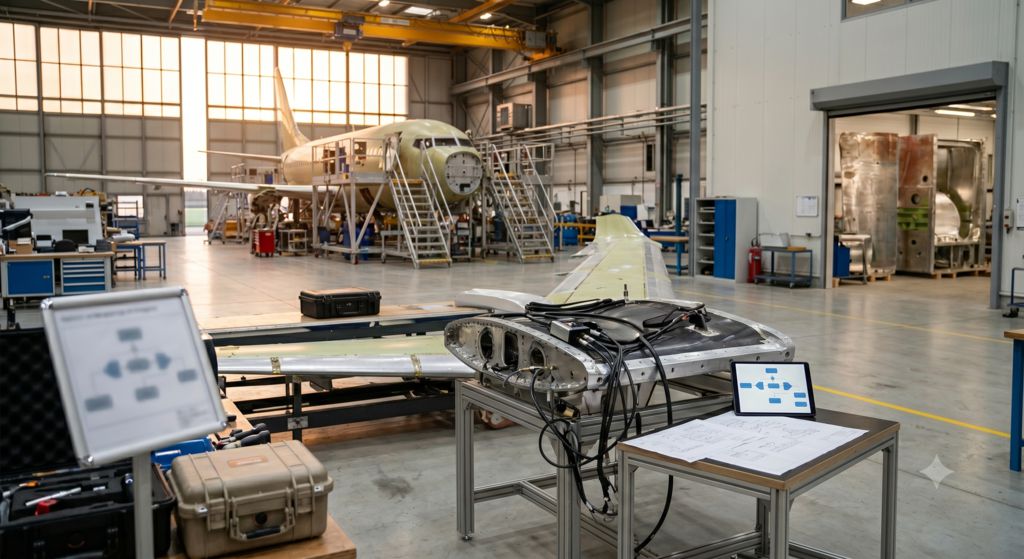
1. Why Aerospace Re-Validation is a Thermodynamic Mountain
In general manufacturing, duplicating a production line in a new location is relatively straightforward. If you are making plastic consumer goods or consumer electronics, as long as the new facility uses the same blueprints and injection molding machines, the parts will likely pass quality control.
Aerospace components completely defy this casual logic. In aviation and space exploration, materials operate at the absolute limits of physical endurance. Components are subjected to crushing atmospheric pressures, violent vibrations, and blistering thermal cycles. Because a single microscopic material defect can cause a catastrophic failure mid-flight, aerospace parts are governed by strict "Process-Dependent Quality."
This means that the quality of a part is inextricably tied to the exact environment, machine, and location where it was born. When you move an aerospace manufacturing process to a local facility, you face an invisible mountain of variables that can subtly alter the final product at an atomic level:
- The Micro-Climate Effect: Subtle differences in ambient shop-floor humidity and barometric pressure between an old factory in Western Europe and a new local facility in East Asia can completely change how advanced cutting fluids dissipate heat, leading to unexpected tool wear or micro-cracking.
- The Power Grid Fingerprint: Microscopic fluctuations in local electrical grid stability can alter the precise behavior of high-powered laser welding systems or multi-axis CNC spindles, introducing invisible variations into the finished metal.
- The Local Material Matrix: Even if a local supplier provides the exact same grade of titanium or aluminum alloy on paper, the regional melting and forging techniques used to create the raw ingot introduce unique trace element signatures that alter the metal's work-hardening behavior during CNC milling.
2. The Re-Validation Gauntlet: Demystifying the First Article Inspection (FAI)
To prove that a localized manufacturing process yields a part that is 100% identical in performance and safety to the original global version, manufacturers must go through a grueling, multi-layered regulatory gauntlet.
The heart of this process is the First Article Inspection (FAI), governed by the international AS9102 standard. When a local machine shop produces its very first component on a newly localized line, that specific part is treated like a scientific specimen. It undergoes a relentless battery of validation protocols:
A. Absolute Geometric Verification
The local part is scanned using advanced coordinate measuring machines (CMMs) and 3D laser scanners to map millions of data points. This ensures that the physical part matches the master digital twin down to a fraction of a single micron.
B. Non-Destructive Testing (NDT) and Microstructural Audits
Because visual inspections cannot detect internal molecular flaws, localized parts undergo Nadcap-approved NDT procedures. Technicians utilize X-ray computed tomography, ultrasonic scanning, and fluorescent penetrant inspections to look deep inside the metal lattice. They are searching for micro-porosity, internal voids, or abnormal grain boundary growth that could act as a nesting ground for future fatigue cracks.
C. Process Capability Sign-off
Regulators don’t just want to see that you made one perfect part; they need proof that your local setup can make ten thousand perfect parts consistently. Machine shops must execute statistically verified trial runs, documenting that the localized machine toolpaths, cooling pressures, and fixture stability remain perfectly predictable over extended production cycles.
3. The Digital Thread: The Secret Weapon for Local Compliance
Historically, re-validating an aerospace part for a new location took several months, sometimes years, because it required generating mountains of physical paper binders filled with material mill sheets, operator certifications, and quality charts.
In the era of modern smart manufacturing, forward-thinking aerospace firms are utilizing the Digital Thread to drastically accelerate localization re-validation.
The digital thread is an unbroken, digitized data loop that captures every single variable of a part's lifecycle. When an aerospace OEM decides to localize a component, they don't just send 2D blueprints to the local facility. They transfer a complete, end-to-end Digital Product Passport.
This electronic data bundle includes the precise original CAM toolpath geometries, real-time spindle load profiles, historical sensory data from the original machines, and exact heat-treatment recipes. By uploading this digital DNA into identical, IoT-enabled machines at the local facility, local engineers can instantly calibrate their equipment to mimic the original manufacturing fingerprint, cutting re-validation timelines down by up to 60%.
The Bottom Line
The global push toward aerospace localization is not a passing temporary trend; it is the blueprint for the future of industrial resilience. As the world navigates an era of intense geopolitical friction and economic fragmentation, the ability to build advanced aviation and space infrastructure within secure, localized boundaries is becoming a vital element of national competitiveness.
But true resilience cannot be rushed. Localization re-validation is the uncompromising gatekeeper that ensures our pursuit of supply chain security never compromises human safety.
By treating re-validation not as a bureaucratic box to check, but as a rigorous thermodynamic and digital science—weaponizing the digital thread, advanced material forensics, and strict AS9102 protocols—modern manufacturing is successfully achieving the ultimate goal: building skies that are globally connected, yet locally secure, one flawless validation at a time.
With our CNC turning centers, we machine complex parts with consistent precision and speed from small prototype batches to full production volume. For nearly 36 years, we’ve staked our reputation on the quality of our parts and timely delivery.
Get more info, please visit our CNC Turning Parts or Products.
Contact us for your customized metal parts.