In the world of high-performance engineering, materials are routinely asked to perform under brutal conditions. But there is a specific echelon of industries—such as aerospace jet propulsion, deep-sea oil extraction, and nuclear power generation—where the word "brutal" takes on a whole new meaning.
Imagine an environment where mechanical components are subjected to crushing forces while simultaneously being blasted by corrosive gases at temperatures exceeding 700°C. Under these conditions, standard industrial steels or aluminum alloys lose their strength almost instantly. They soften, warp, and deform like plastic putty.
To survive this fiery gauntlet, engineers rely on a specialized class of elite metals known as nickel-based superalloys. Standing confidently at the top of this material hierarchy is Inconel 718.
Renowned for its legendary ability to maintain its mechanical hardness and structural integrity at temperatures that would melt or compromise other metals, Inconel 718 is the backbone of modern extreme-service engineering.
Here is a look inside the microscopic science that gives this superalloy its incredible high-temperature powers.
1. The Phenomenon of Hot Hardness: Why Inconel 718 Defies the Heat
To appreciate what makes Inconel 718 so remarkable, we have to look at a fundamental concept in metallurgy known as hot hardness (or red hardness).
For most traditional metals, hardness and temperature share an inverse relationship: as the temperature goes up, the material’s hardness drops significantly.
This happens because the thermal energy causes the metal's internal crystal structure to vibrate violently, making it easy for the atomic layers to slip past one another under mechanical stress.
Inconel 718 completely disrupts this predictable decline. Through a masterful combination of nickel, chromium, and iron, blended with precise amounts of niobium and molybdenum, this superalloy maintains a nearly flat hardness curve across a massive thermal spectrum. Even when heated to a glowing red 650°C to 700°C, Inconel 718 retains the vast majority of its room-temperature yield strength and fatigue resistance. It refuses to soften, creep, or yield to the environment.
2. The Microscopic Microstructure: The Double-Gamma Prime Defense
Inconel 718’s high-temperature hardness isn't an accidental stroke of luck; it is a masterpiece of atomic choreography achieved through a process called precipitation hardening (or age hardening).
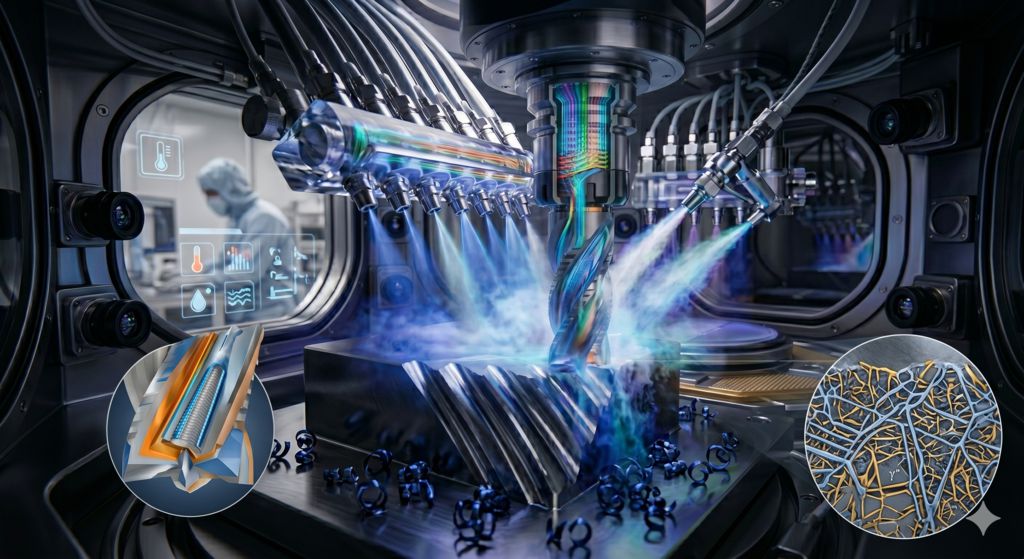
If you were to zoom in on Inconel 718 using an electron microscope, you wouldn't see a smooth, uniform metallic matrix. Instead, you would find a complex microscopic battlefield. The base nickel-iron matrix (known to metallurgists as the gamma phase) is densely packed with thousands of tiny, engineered microscopic precipitates.
In Inconel 718, these precipitates form two distinct reinforcing phases:
Gamma Prime ($\gamma'$)
Gamma Double-Prime ($\gamma''$)
Think of these precipitates as microscopic speed bumps or anchors embedded throughout the metal's atomic lattice. When a heavy external force tries to deform the component, it tries to push rows of atoms past one another. However, these atomic layers instantly slam into the rigid gamma prime and gamma double-prime speed bumps.
Because these microscopic precipitates are chemically locked into place and highly resistant to thermal breakdown, they prevent atomic slippage even when the metal is bombarded by intense thermal energy. This unique atomic lock is the secret weapon behind Inconel 718's unbeatable hot hardness.
3. The Double-Edged Sword: The Machine Shop Nightmare
While Inconel 718’s incredible hot hardness makes it an absolute hero for aerospace designers building jet engine turbine blades, it makes the alloy a notorious villain on the machine shop floor.
Cutting, drilling, and milling Inconel 718 is widely considered one of the most difficult challenges a CNC machinist can face. The very properties that make it excel inside a roaring jet engine work together to destroy cutting tools.
Relentless Work Hardening
Because Inconel 718 is engineered to resist deformation, the moment a CNC cutting tool makes contact with the metal, the localized stress causes the material's surface layer to instantly harden.
If the machinist uses an incorrect toolpath or allows the tool to rub against the material for even a microsecond, the next pass of the tool will try to cut through a freshly created layer of ultra-hard metal, resulting in instant tool chipping or breakage.
Extreme Heat Generation
Like titanium, Inconel 718 possesses relatively low thermal conductivity. When a solid carbide end mill tries to cut the superalloy, the intense friction generates immense heat.
Because the superalloy acts as a thermal insulator, that heat cannot dissipate into the workpiece or the metal chips. Instead, the heat pools directly at the razor-thin cutting edge of the tool, subjecting the tooling material to a punishing thermal shock that accelerates tool wear.
4. Taming the Beast: Advanced Machining Strategies
To successfully shape Inconel 718 without destroying thousands of dollars in tooling, modern manufacturers have had to reinvent their approach to machining:
Ceramic Tooling: For high-speed roughing operations, traditional tungsten carbide tools simply cannot survive the extreme heat. Instead, advanced shops utilize specialized ceramic cutting tools. Ceramics thrive in hot zones; they can handle operating temperatures that would instantly melt carbide, allowing machinists to slice through Inconel 718 at speeds up to ten times faster than traditional methods.
Aggressive, Continuous Feeds: To combat the intense work-hardening behavior of the material, CNC programmers ensure that the cutting tool maintains a heavy, consistent feed rate. The tool must continuously plunge deep beneath the previously work-hardened surface layer, cleanly shearing away raw material rather than rubbing against the hardened skin.
The Bottom Line
Inconel 718 is a testament to what is possible when human ingenuity masters atomic-scale engineering. By locking down the metallic crystal lattice with a dense network of thermally stable precipitates, material scientists created an alloy capable of operating safely within the literal jaws of fire.
As humanity pushes toward more efficient commercial jet engines, safer nuclear reactors, and deeper space exploration missions, our reliance on Inconel 718’s unique high-temperature hardness will only intensify.
It remains an irreplaceable cornerstone of modern industrial advancement—a superalloy engineered to stand perfectly strong when everything else is ready to melt away.
Get more info, please visit our CNC Turning Parts or Products. Contact us for your customized metal parts.