You’ve spent hours programming a flawless toolpath. Your multi-axis CNC machine has executed the program with sub-micron precision, and your cutting tools are razor-sharp.
But the moment the vacuum chuck releases the completed aluminum aerospace bulkhead or the thin-walled automotive housing, something devastating happens.
The part visibly bows, twists, or warps right before your eyes.
When you put a digital micrometer to the component, it is completely out of tolerance. The part is ruined, and it’s headed straight for the scrap bin.
What went wrong? You didn't make a programming mistake, and your machine didn't lose calibration.
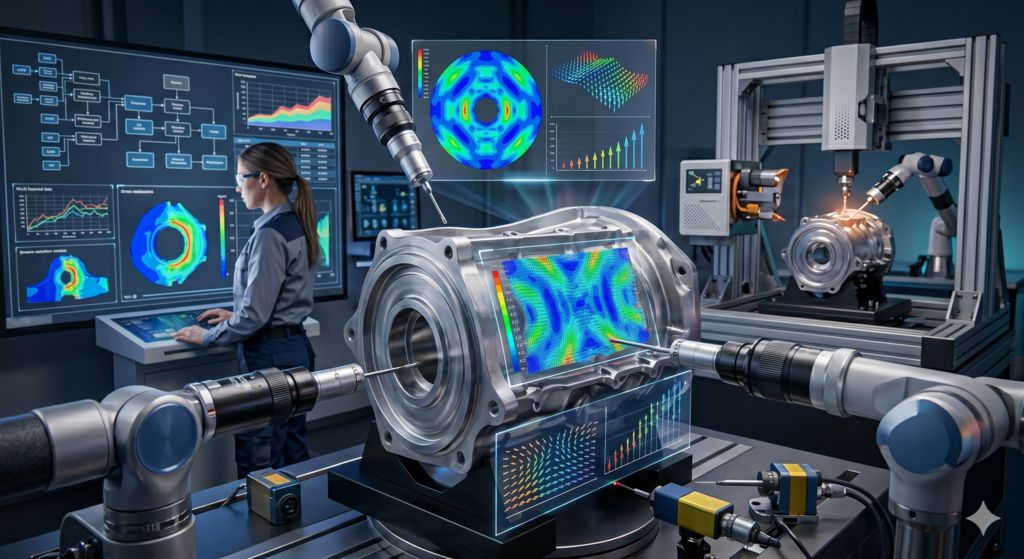
Your workpiece has fallen victim to a silent, internal saboteur: Machining-Induced Residual Stress. Here is a deep dive into how the invisible forces trapped inside metals cause physical distortion, and how modern machine shops are fighting back to maintain absolute dimensional accuracy.
Typography is the art and technique
Typography is the art and technique of arranging type to make written language legible, readable and appealing when displayed. The arrangement of type involves selecting typefaces, point size, line length, line-spacing (leading), letter-spacing (tracking), and adjusting the space within letters pairs (kerning).1. The Invisible Tug-of-War Inside Your Metal
To understand why a perfectly machined part warps, we have to look beneath its polished surface at the molecular level.
Every block of raw metal—whether it is forged, rolled, or cast—already carries a baseline of internal energy. When a cutting tool engages with this material, it doesn't just cleanly slice away chips. The violent action of the tool tip deforms the metal, subjecting the workpiece to a brutal combination of mechanical stretching and intense friction-induced heat.
This process introduces a massive layer of new internal tension, known as Residual Stress. Think of these stresses as millions of microscopic rubber bands stretched out inside the metal, constantly pulling and pushing against one another.
As long as the part is securely clamped down inside the CNC machine, the rigid fixtures force the component to stay perfectly flat. But the moment you unclamp the part, those internal microscopic rubber bands are free to snap back. To relieve that trapped energy and reach a relaxed state, the metal physically shifts, resulting in visible distortion or warping.
2. The Two Catalysts of Warpage: Mechanical vs. Thermal Stress
During any milling or turning operation, residual stress is injected into the workpiece through two distinct physical mechanisms. Understanding the difference between them is the key to controlling the final distortion.
A. Mechanical Stretching (Tensile vs. Compressive Surface Stress)
As a cutting tool pushes through metal, the chip is sheared off, but the metal layer directly beneath the tool tip is severely compressed and dragged forward. This mechanical plowing action stretches the surface layer plastically.
When the tool moves past, the deeper, untouched bulk metal tries to pull that stretched surface back into its original shape. This creates a state of high compressive residual stress on the outer skin of the part. If you machine away a large amount of material from only one side of a plate, this surface compression will force the plate to bow outward like a rainbow.
B. Thermal Spikes (The Heat Effect)
The intense friction between the tool edge and the workpiece generates localized temperatures that can instantly skyrocket past several hundred degrees. This extreme heat causes the outer layer of the metal to rapidly expand. However, the cold, rigid metal deeper inside the part acts like a wall, preventing this expansion.
As the hot surface layer cools back down, it shrinks aggressively. Because it was restricted during expansion, it winds up trapped in a permanent state of high tensile residual stress—meaning the surface atoms are continuously pulling away from each other. This tensile pull causes the part to curl inward.
3. The High-Risk Zone: Thin-Walled Structural Components
While residual stress affects all machined parts, it is a catastrophic threat to thin-walled components, which are highly prevalent in the aerospace, satellite, and electric vehicle industries.
To make aircraft lighter and more fuel-efficient, engineers design massive structural frames with incredibly thin webs and pockets—often thinner than a credit card. When you start with a thick, solid block of aluminum and machine away 95% of its weight to create these thin walls, you are fundamentally disrupting the material's internal stress equilibrium.
Because a thin wall has virtually no structural rigidity of its own, it cannot withstand even a minor internal tug-of-war. The microscopic stresses effortlessly overpower the thin cross-section, causing the walls to buckle, scallop, or twist completely out of shape.
4. Tactical Shop-Floor Strategies to Defeat Distortion
You cannot stop physics from creating residual stress, but you can use smart manufacturing strategies to manage, balance, and neutralize those forces before they warp your final product.
Symmetrical Material Removal (Balancing the Scale)
The golden rule of machining stress-prone parts is balance. If you need to mill a plate down to a specific thickness, never rough-machine the entire depth from a single side. Doing so releases all the stress on one side while keeping it locked on the other, ensuring instant warpage. Instead, flip the part repeatedly, taking equal, alternating cuts from both sides to keep the internal forces perfectly balanced.
Optimizing Tool Geometry and High-Speed Paths
Dull tools are the primary cause of severe mechanical residual stress. When a tool edge loses its sharpness, it stops shearing cleanly and begins to aggressively plow and rub against the metal, injecting massive compressive stress into the skin. Machinists must utilize sharp, polished inserts with positive rake angles.
Furthermore, employing advanced High-Speed Machining (HSM) paths—like trochoidal milling—keeps the tool engagement light and consistent, ensuring that the friction heat is carried away inside the flying chips rather than sinking into the workpiece.
Thermal Stress Relieving and Cryogenic Aging
For critical components with zero tolerance for warpage, physical post-processing is mandatory. After rough machining (where the bulk of the destructive stress is introduced), parts are placed into specialized industrial furnaces for Thermal Stress Relieving. The controlled heat allows the strained atomic lattice to vibrate, loosen, and relax.
Alternatively, some facilities utilize Cryogenic Aging, cycling the parts between extreme sub-zero temperatures and warm baths to shake the internal atomic stresses loose before the final, precision-finishing toolpass is executed.
The Bottom Line
Machining is far more than a simple exercise in cutting geometric shapes out of a solid block. It is a complex thermodynamic and mechanical manipulation of matter.
Distortion caused by residual stress is an invisible enemy, but it is entirely predictable. By recognizing that every cut changes the internal force balance of your workpiece, and by deploying adaptive strategies like symmetrical milling, razor-sharp tooling, and thermal stress relief, modern machine shops can tame the invisible war within the metal—ensuring that the beautiful, high-precision part on your CAD screen matches the flawless component that leaves your shipping dock.
Get more info, please visit our CNC Turning Parts or Products. Contact us for your customized metal parts.