Walk into any high-end machine shop today, and you’ll find some of the most advanced mechanical engineering on the planet. Massive CNC machines hum with power, cutting exotic titanium and nickel alloys to the precision of a micron. Yet, despite all this mechanical sophistication, traditional machining has a glaring flaw: it is fundamentally blind.
In a conventional setup, a CNC machine simply executes a pre-programmed script. It moves the tool at a fixed speed and a fixed depth of cut, completely oblivious to what is actually happening at the razor-thin interface where the tool meets the raw metal.
If a raw casting has an unexpected hard spot, or if a milling tool begins to dull halfway through a long night shift, the machine blindly plows forward until the tool violently snaps, scrapping a multi-thousand-dollar aerospace or automotive component.
But the manufacturing floor is undergoing a massive cognitive upgrade. By combining Smart Tooling embedded with IoT sensors with Real-Time Adaptive Control, the industrial world is turning passive iron into active brains. Here is how shops are successfully implementing these intelligent systems to maximize efficiency and eliminate unexpected tool failure.
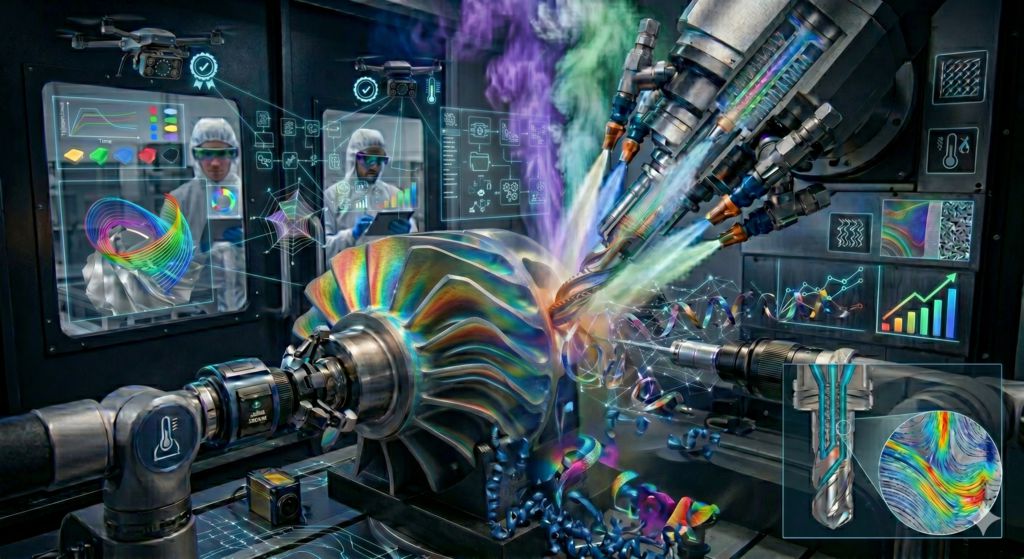
1. The Brains of the Spindle: What is Smart Tooling?
Historically, a cutting tool was a passive piece of solid carbide or steel. If you wanted to know if it was wearing out, a machinist had to stop the machine, open the enclosure door, and inspect the edge under a microscope.
Smart tooling completely shatters this old approach. Modern intelligent tools are embedded with microscopic, industrial-grade sensors—including accelerometers, strain gauges, thermocouple heat sensors, and acoustic emission ears—all packed tightly inside the tool holder or the shank of the tool itself.
Powered by tiny internal batteries or wireless induction loops, these smart tools continuously measure the physical forces of the cut. They track localized vibration frequencies, twisting forces (torque), and sudden thermal spikes. The tool then streams this data wirelessly via Bluetooth or high-frequency radio networks straight to the CNC machine’s central nervous system at a rate of thousands of data packets per second.
2. Adaptive Control: The Real-Time Co-Pilot
Streaming data is only half the battle. Knowing a tool is vibrating doesn’t help if the machine doesn’t know how to fix it. This is where Adaptive Control (AC) software comes into play.
Traditional CNC machines rely on a rigid “Fixed Feed Rate” model calculated by a CAM programmer weeks in advance. Adaptive control replaces this rigidity with a dynamic, real-time feedback loop. The software constantly compares the live data streaming from the smart tool against a pre-programmed baseline of optimal cutting forces.
If the smart tool enters a section of a metal casting where the raw material is unexpectedly thick or hard, the sensors detect an instant spike in cutting force. Instead of allowing the tool to overload and snap, the adaptive control software overrides the active G-code within milliseconds. It automatically dials back the feed rate to protect the tool tip.
Conversely, when the tool exits that hard zone and enters an area with less material, the software recognizes that the cutting force has dropped below the optimal threshold. It instantly accelerates the feed rate to maximum efficiency, cutting through soft zones faster and safely slashing overall cycle times.
3. The Practical Blueprint: Implementing Smart Systems on the Floor
While the concept of an self-optimizing machine sounds like science fiction, forward-thinking machine shops are successfully executing practical, real-world rollouts of this technology through a multi-stage approach.
A. Upgrading Legacy Hardware with Retrofit Kits
You don’t need to purchase a brand-new, multi-million-dollar machining center to leverage adaptive control. Many manufacturers successfully implement this technology by retrofitting existing CNC lines. This involves installing smart, sensor-laden tool holder sleeves into the existing spindle and routing the data to an external industrial PC running adaptive software that interfaces directly with the machine’s main control board.
B. Establishing the “Normal” Baseline
When a shop deploys a smart tool for a new component, they run a baseline calibration pass. A highly skilled machinist monitors a manual cut under optimal conditions while the software records the “healthy” fingerprint of the operation—the baseline vibration, acoustics, and mechanical resistance. This profile becomes the digital benchmark that the adaptive software will aggressively protect during automated lights-out production.
C. Predictive Tool-Life Tracking
One of the most immediate financial rollouts of smart tooling is eliminating the guesswork of tool replacement. Traditional shops replace tools based on conservative timers (e.g., swapping a drill bit every two hours of runtime). This means many perfectly good tools are thrown away early, while others dull prematurely and break.
Smart tools track micro-acoustic emissions—the distinct, microscopic sound waves that metals emit right as micro-cracks begin to form on a tool edge. The system flags the operator exactly when the tool has reached its true structural limit, maximizing tool utilization down to the final usable micron.
The Bottom Line
The transition to smart tooling and adaptive control represents the true maturation of Industry 4.0 on the factory floor. It shifts manufacturing away from an era of defensive, conservative programming and moves it into an era of aggressive, data-driven optimization.
By giving machine spindles the biological equivalent of sight, hearing, and touch, manufacturers are successfully conquering the volatile physics of metal cutting. Tools last longer, machine cycle times drop significantly, and the nightmare of catastrophic tool breakage during unattended night shifts is effectively neutralized.
The machine tools of tomorrow are no longer blindly cutting code; they are actively feeling the metal, adapting to the cut, and rewriting the rules of industrial precision in real time.
Get more info, please visit our CNC Turning Parts or Products.
Contact us for your customized metal parts.