In the modern manufacturing landscape, precision is a standard expectation. We are used to CNC machines carving intricate surface geometries or drilling standard bolt holes with flawless accuracy. But there is a specialized subset of manufacturing that leaves even veteran machinists staring through the machine enclosure glass with intense concentration.
Imagine needing to drill a hole straight through a solid titanium aerospace shaft that is only ten millimeters wide but over a meter long.
This is the world of High-Aspect-Ratio Machining and Deep Hole Drilling (DHD). In industrial engineering, a hole is generally classified as “deep” when its depth exceeds ten times its diameter. In extreme applications—like landing gear cylinders, oil exploration drill strings, and nuclear reactor cooling cores—machinists routinely tackle aspect ratios of eighty-to-one or even greater.
At these extreme depths, a hole stops being a simple geometric feature and becomes a highly volatile thermodynamic battleground. Here is a look inside the extreme challenges of drilling into the deep, and the technologies keeping the cuts perfectly straight.
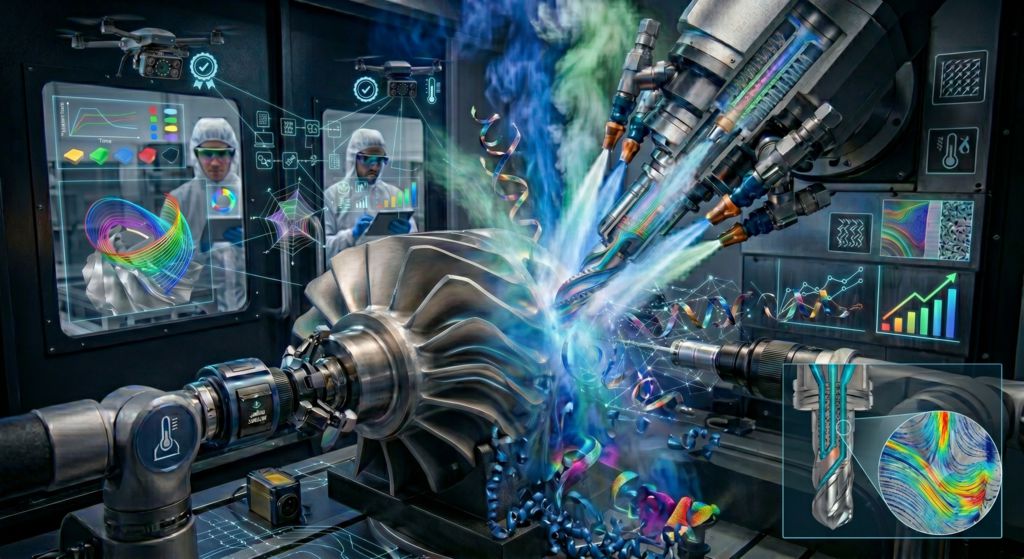
1. The Invisible Abyss: Why Deep Holes Defy Standard Drilling
If you attempt to drill a very deep hole using a standard twist drill bit that you might find in a hardware store, your tool will catastrophically fail before it reaches even a quarter of the required depth. Standard drilling methods cannot survive the physics of a deep hole for three primary reasons:
A. The Chip Evacuation Crisis
When a tool cuts metal, it continuously generates solid metal chips. In a shallow hole, the spiraled flutes of the drill bit easily lift the chips out. But inside an ultra-deep hole, the chips have a long, claustrophobic highway to climb to escape. If the chips cannot get out fast enough, they pack together tightly, a phenomenon called chip crowding. The packed chips bind against the rotating tool, causing it to instantly snap inside the workpiece, destroying a high-value asset.
B. Severe Thermal Trapping
As the drill tip plunges deeper into the metal, it is effectively sealed inside a dark, insulated chamber. The immense friction heat generated at the cutting edge has no air to cool it down, and it cannot easily dissipate through the thick surrounding metal. Without intervention, temperatures at the drill tip will rapidly soar past 1000°C, instantly melting the tool’s cutting edge and warping the interior dimensions of the hole.
C. Tool Deflection and “Walking”
A long, slender drill bit is fundamentally flexible, behaving more like a stiff wire than a rigid rod. As the machine pushes this long tool forward, any minor microscopic imperfection or hard spot in the raw metal will push the drill tip off-course. Once the tip veers slightly off-center, the error multiplies exponentially as it goes deeper, causing the drill to “walk” and exit the far end of the part completely crooked.
2. Weapon of Choice: The BTA and Gun Drilling Systems
To conquer the abyss, manufacturers throw away conventional drill designs and deploy highly engineered, specialized deep-hole systems. The two absolute kings of this domain are Gun Drilling and BTA (Boring and Trepanning Association) Machining.
The Art of Gun Drilling
Originally invented in the 19th century to manufacture perfectly straight rifle barrels, gun drilling is the premier choice for deep holes with small diameters. A gun drill is a single-fluted tool with a solid carbide head and a hollow V-shaped shank.
The magic of the gun drill lies in its internal plumbing. High-pressure cutting fluid is continuously pumped through the center of the drill body directly out of the cutting tip at immense pressures. This supersonic fluid jet serves a spectacular dual purpose: it instantly quenches the intense thermal trap and forcefully blasts the freshly cut metal chips backward out through the exterior V-shaped flute, ensuring the tool never recuts its own waste.
The BTA System: Single-Tube Internal Extraction
For larger holes (typically over twenty millimeters in diameter), shops scale up to BTA machining. The BTA system completely reverses the plumbing logic of the gun drill.
In a BTA setup, the cutting fluid is pumped around the outside of the long drill tube. The fluid rushes down into the cutting zone under immense pressure and is forced to escape by traveling backward through the hollow center of the drill tube, carrying the metal chips along with it. Because the chips are sucked up inside the enclosed tube, they never make contact with the freshly finished walls of the deep hole, leaving behind an exceptionally smooth, mirror-like surface finish.
3. Micro-Control: Keeping the Spindle Straight
Even with advanced BTA or gun drilling hardware, ensuring a hole stays dead-straight across a meter of tough alloy requires absolute operational discipline and smart motion control.
- Counter-Rotation (The Double-Spin Trick): To achieve near-perfect concentricity, modern deep hole machines do something fascinating: they spin both the tool and the workpiece simultaneously in opposite directions. This counter-rotation naturally averages out any minor gravitational sagging or structural imperfections in the drill tube, forcing the cutting tip to follow a mathematically straight path down the dead center of the part.
- Rigid Guide Bushings: A deep-hole tool cannot start a cut on its own; without support, it will whip and vibrate wildly. Machines utilize ultra-precise, zero-tolerance guide bushings that clamp tightly against the raw face of the workpiece. The bushing acts as a rigid mechanical tracks, guiding the flexible drill tip securely until it penetrates deep enough into the metal to be supported by its own freshly bored hole.
- Intelligent Torque Monitoring: Modern IoT-enabled deep-hole machines continuously analyze the torque load on the spindle motor. If a cluster of chips starts to pack together or a tool edge experiences minor micro-chipping deep inside the hole, the machine detects the subtle micro-second spike in mechanical resistance and instantly shuts down the cycle before the tool can violently snap.
The Bottom Line
Extreme shape and high-aspect-ratio deep hole drilling represent the absolute edge of mechanical endurance in manufacturing. It is a discipline where you are continuously operating blind, manipulating materials at extreme depths where human eyes and standard laser sensors cannot reach.
By respecting the harsh thermodynamics of trapped heat, mastering the mechanics of high-pressure fluid dynamics for chip evacuation, and deploying smart counter-rotational motion controls, deep hole specialists transform an incredibly volatile process into a predictable, ultra-precise science.
These deep, hidden channels are the unsung heroes of modern infrastructure—ensuring that when an aircraft drops its landing gear or an energy team drills for vital resources, the internal bones of our world stand perfectly strong, straight, and true.
Get more info, please visit our CNC Turning Parts or Products.
Contact us for your customized metal parts.