In today’s world, many industries need parts with complex shapes and tight tolerances. Traditional 3-axis machines sometimes just can’t keep up. That’s where 5-axis machining comes in — offering a powerful way to handle complicated designs faster and with better quality.
What is 5-Axis Machining?
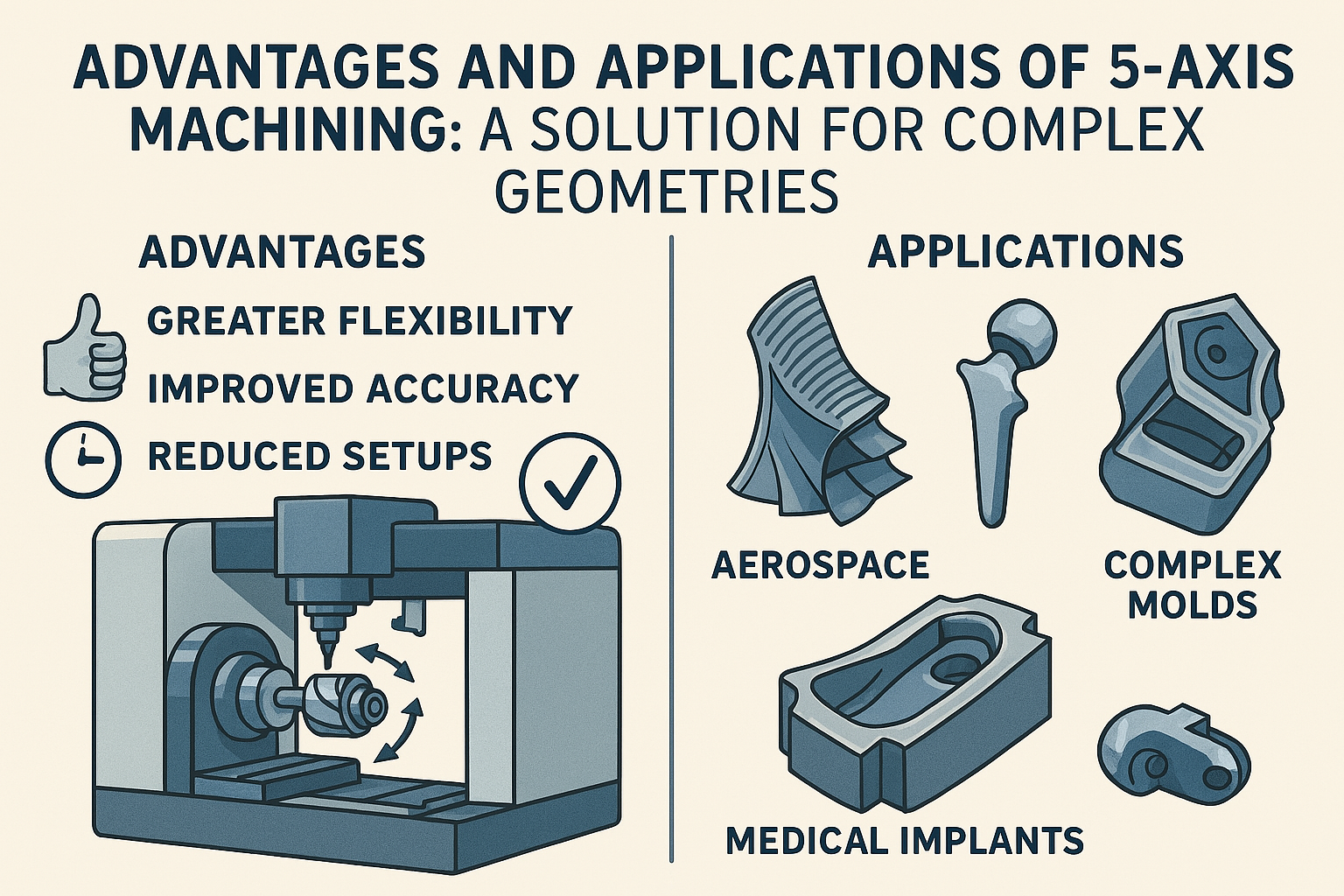
A standard 3-axis machine moves a cutting tool along the X, Y, and Z axes. A 5-axis machine adds two more rotational movements, allowing the tool to tilt and rotate.
That means it can approach the workpiece from almost any direction.
Simply put, 5-axis machines can move in five different ways at the same time, giving them much more flexibility and control.
Advantages of 5-Axis Machining
1. Complex Shapes Made Easier
5-axis machines can cut parts with curved or angled surfaces that would be impossible or very difficult on a 3-axis machine.
They reduce the need to reposition the part multiple times, which saves time and improves accuracy.
2. Better Surface Finish
Because the tool can stay closer to the part and approach from better angles, it produces smoother surfaces.
This is especially important for aerospace or medical parts, where quality is critical.
3. Higher Precision
Fewer setups mean fewer chances for positioning errors.
The machine can reach all sides of a part in a single run, keeping everything precisely aligned.
4. Shorter Production Time
Less repositioning means faster cycle times.
5-axis machines also allow for more efficient cutting paths, speeding up production.
5. Reduced Tool Wear
By approaching the workpiece at better angles, the tool cuts more efficiently, which helps extend tool life.
Applications of 5-Axis Machining
5-axis machining is used in many industries, especially where parts are complicated or highly demanding:
Aerospace: turbine blades, structural parts, and housings with curved surfaces
Medical: implants, surgical tools, and custom medical devices
Automotive: engine components, mold making, and prototype parts
Energy: precision components for turbines or pumps
General mold and die: complex injection molds with 3D surfaces
Basically, any part that has undercuts, complex angles, or sculpted surfaces is a good fit for 5-axis machining.
Summary
5-axis machining gives manufacturers a powerful way to solve the challenges of making complex shapes with high precision and good surface quality. It reduces production steps, saves time, and helps deliver better parts.
As products become more advanced and geometries more complicated, 5-axis machining will continue to be a key solution for modern manufacturing.
Please get more information, please visit our CNC Turning Parts or Products.
Contact us for your customized metal parts.