The Cost of a Tiny Deviation: Why Tool Center Height Is the Silent Killer in Precision Turning
Imagine setting up a CNC lathe for a high-precision turning job. You’ve picked the perfect insert, dialed in your speeds and feeds, verified the CAM program, and ensured the raw material is securely clamped in the chuck. Everything looks flawless. You hit the green button, expecting a pristine, mirror-finished component that hits your tolerances right dead-center.
Instead, when you pull the part out, you notice a tiny, stubborn “pip” of metal sticking out of the face. Or worse, your cutting edge chips after just five parts, leaving behind a rough, torn surface finish.
You check your program—no errors. You check your material—no hard spots. What went wrong?
You have likely been struck by one of the most common yet chronically overlooked saboteurs in turning: Tool Center Height Deviation.
In the world of precision lathe work, getting your tool tip aligned perfectly with the rotational center of the spindle isn’t just a good practice—it is the difference between a profitable job and a scrap heap. Let’s take an easy, math-free look at why tool center height matters so much, what happens when it’s off, and how you can fix it.
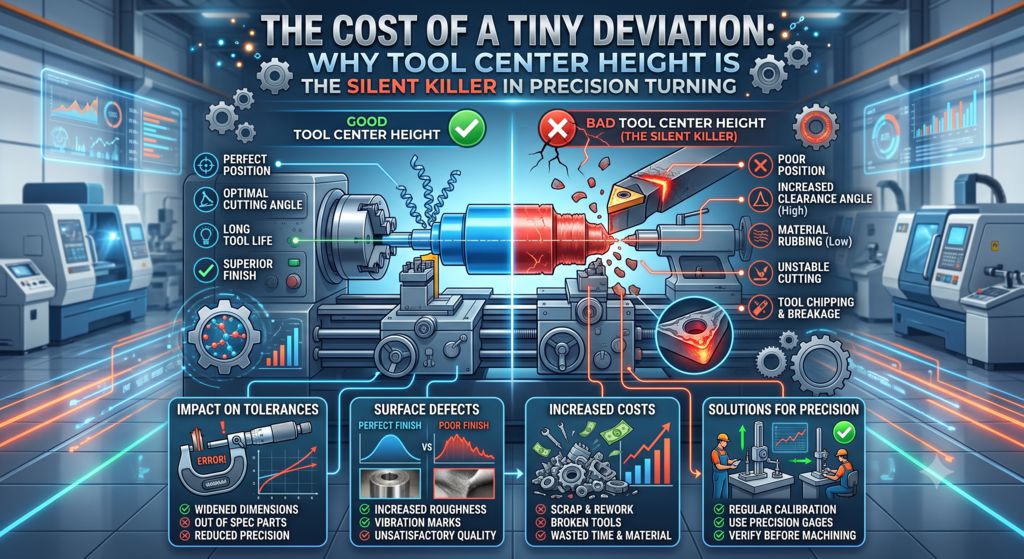
What Is Tool Center Height?
To understand center height, picture looking straight down the length of your lathe’s spindle from the tailstock side.
The spinning raw metal bar creates an imaginary horizontal line right through its exact geometric center—this is the spindle centerline.
Tool Center Height simply means aligning the absolute tip of your cutting insert so that it sits on that exact same horizontal plane.
- On-Center: The tool tip aligns perfectly with the center of the spinning part.
- Above-Center: The tool tip sits slightly too high, above the spindle centerline.
- Below-Center: The tool tip sits slightly too low, below the spindle centerline.
While a deviation of a few hundredths of a millimeter might sound microscopic, to a high-speed cutting insert, it fundamentally alters how the tool interacts with the spinning metal.
The Nightmare: What Happens When Center Height Is Off?
Whether your tool tip sits too high or too low, the consequences on your shop floor are immediate and painful.
1. The “Above-Center” Trap: Rubbing and Pips
When your tool tip is set above center, the sharp cutting edge loses its clearance angle.
Instead of slicing cleanly into the metal like a sharp knife, the underside (flank) of the tool rubs aggressively against the workpiece. This friction generates massive amounts of heat, destroys your surface finish, and causes the tool to wear out at lightning speed.
Furthermore, when facing a part (cutting across the front face toward the center), an above-center tool can never reach the true center of the rotating bar. It rides over the center, leaving behind a small, sharp nipple or “pip” of uncut metal right in the middle of your part.
2. The “Below-Center” Trap: Chipping and Snap-Offs
When your tool tip sits below center, the opposite problem occurs. The tool is effectively pushed down into a position where the cutting forces try to drag it underneath the part.
This increases the chip load on the delicate tip of the insert. Because carbide cutting tools are extremely hard but brittle, this extra downward pressure often leads to micro-chipping along the cutting edge.
Even worse, if you are performing a parting-off (cutoff) operation below center, the material will eventually become so thin that it snaps off prematurely before the tool finishes the cut, leaving a sharp burr on your finished component.
The Tiny Feature Effect: Why Small Diameters Hurt Most
Here is the sneaky truth about tool center height: the smaller the diameter of your part, the more destructive a center height error becomes.
If you are turning a massive 200mm steel cylinder, a tiny center height error represents only a fraction of a percent of the total diameter. The tool will cut relatively smoothly across most of the surface.
However, as the tool approaches the center of the part—or if you are machining micro-components on a Swiss-type lathe—that same tiny height error becomes massive in comparison to the remaining material diameter. At the absolute center, any deviation, no matter how small, ruins the cutting geometry completely.
How to Get Your Tools Perfectly On-Center
Achieving flawless center height doesn’t require complex physics; it just takes good habits and the right shop floor techniques:
- Use the Face Test (The Classic Method): Face off a piece of scrap material at a light depth of cut. If a small pip remains at the center, your tool is above center (or slightly below, if the pip snaps off). Adjust your shims or tool holder until the face is completely smooth from edge to center.
- Invest in Precision Optical/Laser Setters: Modern CNC lathes often feature optical tool setters or laser probes. These devices measure the physical tip of the tool automatically, taking human error out of the equation.
- Check Your Turret Alignment: Sometimes, the tool holder isn’t the problem—the machine’s turret is. If your machine suffered a minor bump or crash in the past, the entire turret disk might be rotated slightly off-center. Regularly checking turret alignment ensures all your tool stations sit where they belong.
- Watch Out for Wear on Tool Holders: Over years of use, tool holders can develop tiny burrs, rust, or wear pockets on their seating surfaces. A worn tool pocket will cause even brand-new inserts to sit crooked or below center.
The Takeaway: Precision Starts at the Center
In high-precision CNC turning, success is rarely decided by grand, sweeping changes. It is decided in the micro-world of proper setups.
Tool center height deviation is a quiet, silent killer because it doesn’t always break a tool instantly—instead, it gradually steals your tool life, ruins your surface finishes, and causes mysterious dimensional errors that leave operators scratching their heads.
The next time you set up a lathe job, take an extra minute to verify your tool center height. By keeping your inserts right on the centerline, you’ll eliminate pips, extend tool life, and ensure every part leaves the machine looking flawless.
Have you ever been baffled by a mysterious pip on a faced part or short tool life during a turning job? How does your shop verify tool center height? Let us know in the comments below!
Get more info, please visit our CNC Turning Parts or Products.
Contact us for your customized metal parts.