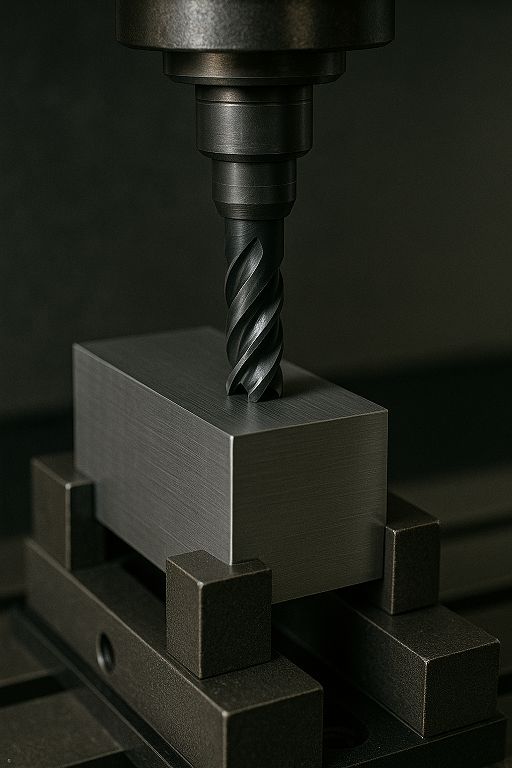
Understanding the Sources of Vibration
Machining vibration—also known as chatter—arises when cutting forces excite natural frequencies in the machine-tool-workpiece system. Common causes include:
Insufficient tool rigidity or overextended tool holders
Weak fixturing or improper clamping of the workpiece
Unbalanced spindles or misaligned tooling systems
Excessive cutting depth or inappropriate cutting parameters
If left uncontrolled, vibration can reduce tool life, increase dimensional error, and severely affect the surface finish of precision components.
1. Improve Tool Rigidity for Stable Cutting
The first step in minimizing vibration is ensuring high tool rigidity. A stiff cutting setup reduces deflection and prevents resonance during machining.
Best practices:
Use the shortest possible tool overhang.
Choose larger tool diameters to increase stiffness.
Select high-quality tool holders with anti-vibration design.
Regularly inspect and replace worn or loose collets and adapters.
Strong tool rigidity minimizes deflection, leading to improved dimensional accuracy and longer tool life.
2. Optimize Fixturing to Eliminate Movement
Proper fixturing ensures that the workpiece remains stable under varying cutting loads.
Even small vibrations in clamping can propagate through the system and cause chatter.
Recommendations:
Use solid, evenly distributed clamping points to prevent distortion.
Employ soft jaws, vacuum chucks, or modular fixtures for complex shapes.
Avoid over-tightening clamps that induce stress or deformation.
Verify that the fixture itself has sufficient mass and rigidity.
A well-designed fixturing system maintains tight contact between the workpiece and machine table, ensuring stable, repeatable machining conditions.
3. Maintain Machine Stability and Structural Integrity
Machine stability is the foundation of vibration-free machining. Poorly maintained or unbalanced machines are more prone to dynamic instability.
Steps to enhance machine stability:
Ensure the machine is installed on a level, vibration-dampened foundation.
Regularly check spindle balance and bearing condition.
Perform routine maintenance on slideways, ball screws, and guide systems.
Avoid operating near the machine’s natural resonance frequencies.
Maintaining machine stability not only reduces vibration but also improves surface finish and extends overall equipment life.
4. Control Cutting Depth and Feed Rate
Excessive cutting depth can dramatically increase cutting forces, leading to tool deflection and chatter. Adjusting cutting depth and feed rate helps balance material removal rate with process stability.
Optimization guidelines:
Use smaller cutting depth and multiple passes for high-precision surfaces.
Gradually adjust feed and speed to identify the most stable cutting zone.
Avoid combinations of parameters that excite harmonic vibration.
Balanced cutting parameters reduce cutting forces and enhance both machining stability and surface finish quality.
5. Monitor and Tune for Surface Finish Quality
A good surface finish is a clear indicator of proper vibration control. Continuous monitoring of machining noise, tool wear, and finish texture can help detect early signs of instability.
To improve surface finish:
Use vibration sensors or acoustic monitoring systems.
Fine-tune spindle speed to move away from resonance frequencies.
Perform final finishing passes at lower speeds with stable tool engagement.
Monitoring and tuning help achieve a mirror-like surface finish while maintaining consistent accuracy.
Summary
Minimizing vibration in precision machining requires a systematic approach that strengthens tool rigidity, improves fixturing, ensures machine stability, and controls cutting depth for smoother performance.
Effective vibration control not only enhances surface finish but also improves accuracy, tool life, and process reliability.
In today’s high-precision manufacturing environment, mastering vibration reduction techniques is essential for achieving stable machining results and maintaining a competitive edge.
Get more info, please visit our CNC Turning Parts or Products. Contact us for your customized metal parts.