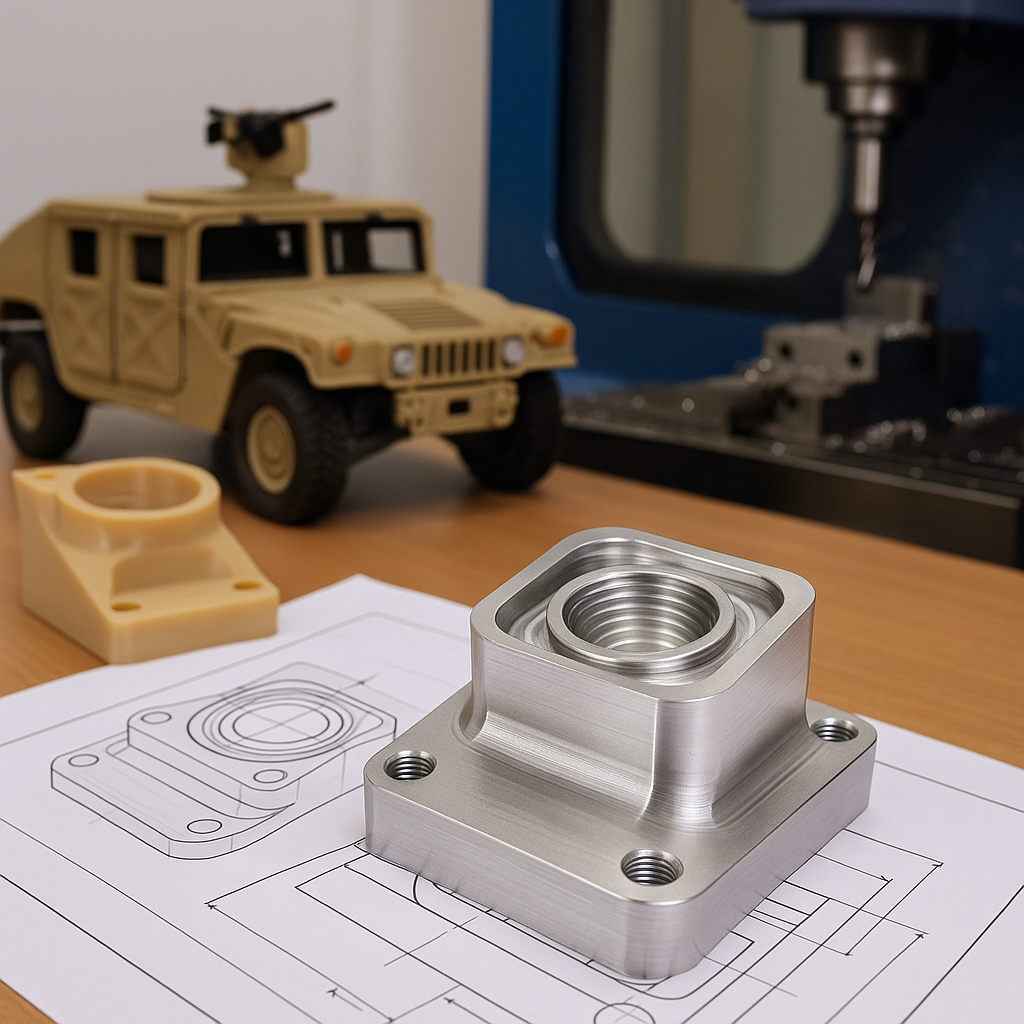
The Role of Prototyping in Defense Metalworking
Prototyping is a critical stage in defense applications, where rapid testing and design validation are essential.
Metalworking innovations such as multi-axis CNC machining and metal 3D printing allow engineers to quickly produce prototypes with complex geometries and tight tolerances.
These prototypes enable defense developers to evaluate performance, identify potential flaws, and refine designs before committing to large-scale production.
Key benefits of advanced prototyping in defense include:
Speed: Reduced development timelines through rapid machining and additive processes.
Flexibility: Ability to test multiple design iterations quickly.
Material accuracy: Prototypes made from aerospace-grade alloys, titanium, and stainless steel for realistic performance testing.
Transitioning to Mass Production
Once designs are finalized, the challenge shifts to scaling production while maintaining quality and cost efficiency.
Advanced metalworking processes enable a smooth transition:
CNC Machining at Scale: Multi-axis machining centers provide consistency and repeatability for large production runs.
Hybrid Manufacturing: Combining additive manufacturing for near-net-shape parts with CNC machining for finishing ensures efficiency and precision.
Automation and Robotics: Robotic loading, automated tool changers, and digital monitoring systems increase throughput and reduce human error.
Modular Production Cells: Flexible setups allow manufacturers to adapt quickly to changing defense requirements.
Meeting Defense Industry Requirements
Defense applications impose unique challenges that require cutting-edge metalworking capabilities:
Extreme durability: Components must withstand vibration, heat, and corrosive environments.
Tight tolerances: Even minor deviations can compromise mission-critical systems.
Material expertise: Advanced alloys such as Inconel, titanium, and hardened steels are essential for performance.
Compliance and traceability: Adherence to MIL-SPEC, AS9100, and other global defense standards ensures accountability and reliability.
Examples of Defense Applications
Aerospace systems: Precision turbine blades, structural frames, and missile housings.
Ground vehicles: Armored plating, drive components, and weapon mounts.
Naval platforms: Propulsion shafts, submarine fittings, and corrosion-resistant housings.
Weapon systems: Barrels, receivers, and targeting system enclosures.
These applications illustrate how innovations in metalworking directly support defense readiness and performance.
Summary
From prototyping to mass production, metalworking innovations are driving the future of defense manufacturing.
By leveraging CNC machining, additive processes, automation, and hybrid technologies, defense contractors can deliver components that meet the industry’s highest demands for precision, durability, and scalability.
As global defense challenges continue to evolve, advanced metalworking will remain at the heart of ensuring mission success and technological superiority.
Get more info, please visit our CNC Turning Parts or Products. Contact us for your customized metal parts.