For decades, the manufacturing landscape has been divided into two opposing philosophical camps. On one side stood Subtractive Manufacturing—the traditional workhorse where a solid block of metal is meticulously carved, drilled, and milled away by high-speed CNC machines to reveal a final part.
On the other side emerged Additive Manufacturing (3D metal printing)—the revolutionary newcomer that builds complex geometries layer by layer from loose metal powder.
For years, these two technologies were viewed as bitter rivals. Machinists claimed 3D printing was too slow and lacked precision, while additive engineers argued that traditional milling wasted too much material and couldn’t create intricate internal structures.
But as modern engineering demands lighter, stronger, and more complex components, forward-thinking manufacturers have realized that the future doesn’t belong to one technology or the other. It belongs to both.
By marrying 3D metal printing with precision CNC milling inside a single machine, the industry has birthed a game-changing paradigm: Hybrid Manufacturing.
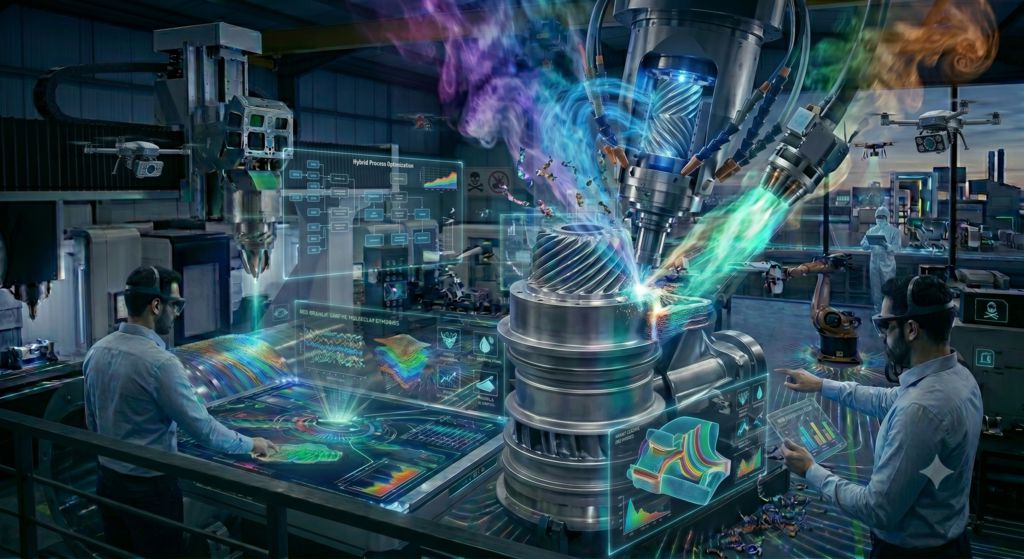
1. The DNA of a Hybrid System: How It Works
A hybrid manufacturing center is the Swiss Army knife of the modern shop floor. Instead of printing a part in one room, hauling it across the factory, and setup-clamping it into a separate CNC machine, a hybrid system combines both capabilities within the exact same workspace.
The process typically relies on an additive technology known as Directed Energy Deposition (DED) or Laser Metal Deposition. A robotic nozzle feeds metal powder or wire into the path of a high-powered laser, melting the material and depositing it layer by layer onto a substrate.
Once the additive nozzle finishes printing a specific feature, it automatically retracts into a tool changer. Instantly, a high-speed milling spindle drops down. While the part is still fresh, the machine switches to subtractive mode, utilizing precision end mills to shave the printed surfaces down to mirror-like finishes and sub-micron tolerances.
The machine seamlessly alternates between building up and carving away until the part is complete.
2. Why the Alliance Works: The Synergy of Both Worlds
By combining addition and subtraction, hybrid processing effortlessly solves the fatal flaws inherent to each individual technology.
Solving the 3D Printing Surface Defect
As incredible as metal 3D printing is, it has a notorious Achilles’ heel: poor surface integrity. Raw 3D-printed parts look grainy, rough, and microscopic powder particles often remain semi-fused to the exterior skin.
If you need a perfectly smooth bearing surface or a flawless airtight seal, a raw printed part is completely useless.
In a hybrid process, the CNC spindle cleans up these surfaces immediately after they are printed. This ensures that features buried deep inside a component can be finished to high-precision tolerances before the upper layers are printed on top of them, completely bypassing the “line-of-sight” limitations of traditional post-processing.
Slashing Material Waste and Lead Times
Traditional subtractive manufacturing is incredibly wasteful when dealing with high-value metals like titanium or nickel superalloys.
For instance, in aerospace manufacturing, it is common to start with a massive 100-kilogram solid block of titanium and machine it down until only a 5-kilogram finished bracket remains—wasting 95% of the material as scrap chips.
With a hybrid system, you can start with a simple, cheap, standard metal plate. The machine uses the 3D printer nozzle to grow complex, near-net-shape features directly onto that base plate, and then uses the milling tool to finish just the critical surfaces. Material waste drops close to zero, and machining times are slashed from days to hours.
3. The Microstructure Bonus: Managing Heat and Stress
Beyond the obvious geometric and financial advantages, alternating between adding and subtracting metal yields a massive benefit at the atomic level: exceptional residual stress control.
As explored in our previous manufacturing articles, 3D metal printing injects intense thermal stress into a part. Because lasers melt metal at extreme temperatures, the rapid cooling creates structural imbalances, leading to warping or micro-cracks.
In a hybrid setup, the cold mechanical action of the milling tool acts as a stabilizing force. As the cutting tool removes material, it redistributes the localized thermal energy.
Furthermore, the intermediate machining passes can work-harden specific layers or allow for controlled cooling cycles, leaving behind a highly uniform crystalline microstructure that boasts superior fatigue resistance compared to parts built via raw 3D printing alone.
4. Real-World Power: Where Hybrid Reigns Supreme
The unique capabilities of hybrid manufacturing are unlocking entirely new engineering possibilities across high-stakes industries:
- Repairing High-Value Assets: Imagine a multi-thousand-dollar gas turbine blade or an injection molding die that has suffered a severe wear scratch.
Historically, the part had to be scrapped. A hybrid machine can scan the damaged zone, use the laser nozzle to deposit fresh metal directly into the scratch, and then switch to the milling spindle to blend the repair perfectly back to the original specifications, restoring the asset to like-new condition. - Conformal Cooling Channels: Injection molds require internal water lines to cool plastic parts quickly. Traditional drills can only make straight holes.
A hybrid machine can print a few layers of a mold, switch to milling to carve a perfectly curved, organic cooling channel that wraps around the contours of the part, and then resume printing to seal the channel inside the solid metal block.
The Bottom Line
The manufacturing world is moving away from rigid, single-technology silos. The realization that additive and subtractive manufacturing are complementary, rather than contradictory, has opened up a new era of industrial agility.
Hybrid manufacturing proves that when we stop fighting over which technology is better and start engineering ways to combine their strengths, we unlock the ultimate production standard. It is a shape-shifting process that allows manufacturers to build the impossible, finish it to perfection, and do it faster and cleaner than ever before.
The industrial revolution is no longer just about making things—it’s about seamlessly blending the digital code of creation with the physical art of precision.
Get more info, please visit our CNC Turning Parts or Products.
Contact us for your customized metal parts.