For decades, the standard machine shop relied on the reliable, geometric rules of 3-axis machining. A cutting tool moved left to right along the X-axis, front to back along the Y-axis, and up and down along the Z-axis. It was a linear, predictable world.
If you needed to machine a complex shape, you had to manually unclamp the workpiece, rotate it to a new angle, re-clamp it, and run a separate program.
But as aerospace engineers design organic, sweeping turbine blades, automobile manufacturers engineer aerodynamic chassis molds, and medical companies develop custom titanium bone implants, the linear world of 3-axis cutting hits a hard physical wall.
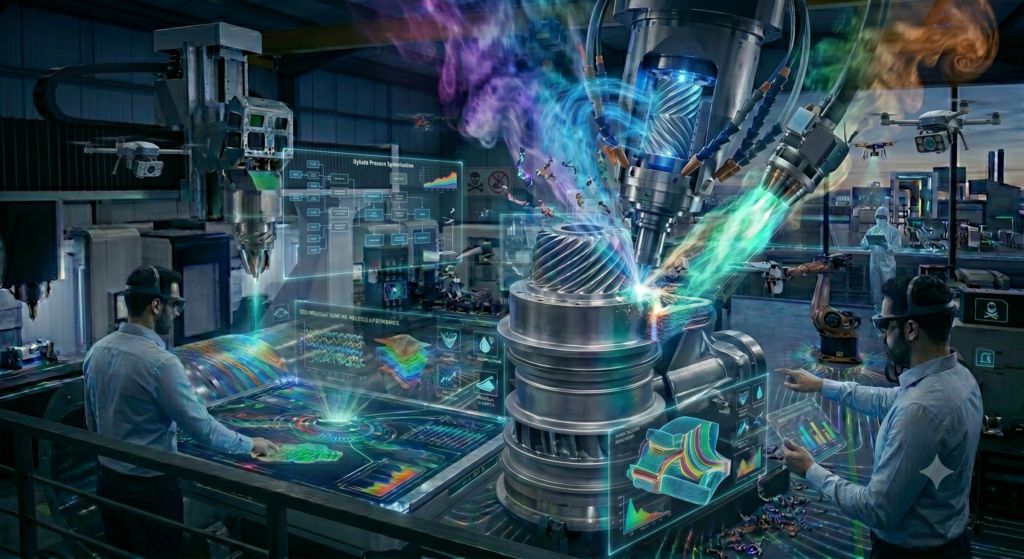
To sculpt these complex, free-form surfaces, modern manufacturing relies on 5-Axis Simultaneous Machining. By adding two rotational axes to the traditional three linear movements, a 5-axis CNC machine executes a mesmerizing, continuous dance.
However, unlocking the full potential of this technology requires more than just a advanced machine; it demands absolute mastery over CAM toolpath optimization. Here is how modern engineers are orchestrating the perfect cutting path.
1. The Anatomy of 5-Axis Movement: What are the Extra Axes?
To understand 5-axis machining, imagine holding a pencil perfectly vertical above a table. In a 3-axis system, you can move that pencil anywhere across the table and change its height, but the pencil must always point straight down.
In a 5-axis simultaneous system, the pencil gains the ability to tilt and roll. In addition to moving along the X, Y, and Z planes, the machine introduces two rotational axes, typically designated as A, B, or C:
- The A-Axis: Rotates around the X-axis.
- The B-Axis: Rotates around the Y-axis.
- The C-Axis: Rotates around the Z-axis.
In a simultaneous 5-axis configuration, all five axes move in perfect harmony at the exact same millisecond. As the spindle moves across a curved surface, the tool dynamically tilts, continuously adjusting its angle to follow the contours of the part without ever stopping.
2. The Crucial Objective: Maintaining the Ideal Cutting Angle
Why go through the massive computational trouble of tilting a tool dynamically? The primary reason comes down to an fundamental rule of cutting tool physics: avoiding the dead center.
When a standard ball-nose end mill spins, the velocity of the cutting edge changes depending on where it makes contact with the metal. At the outer diameter of the tool, the cutting edge is moving at its maximum speed, cleanly shearing away metal. However, at the absolute tip (the dead center bottom) of the ball-nose tool, the rotational speed drops to exactly zero.
If a 3-axis machine tries to finish a flat or shallow curved surface, the dead center tip of the tool rubs and plows against the metal rather than cutting it. This creates immense friction, injects damaging heat into the part, and leaves behind a poor surface finish.
In a 5-axis simultaneous setup, the optimization software tilts the tool—typically by a precise angle of 15 to 20 degrees relative to the surface normal.
By tilting the tool, the machine forces the sweet spot of the tool’s outer cutting edge to do all the work, completely lifting the dead center tip away from the metal. This ensures a flawless, mirror-like surface finish and extends tool life dramatically.
3. The Art of Toolpath Optimization: Smoothing the Motion
Simply having a computer generate a 5-axis path isn’t enough. Raw, unoptimized code often results in jerky movements, sudden spindle reversals, and surface gouging. True toolpath optimization focuses on three critical parameters:
A. Controlling the Tool Axis Orientation (Vector Smoothing)
As a tool moves across a complex, free-form surface, the CAM software calculates a series of points and tells the machine what angle the tool should be at each point. If the software isn’t optimized, the tool might tilt violently between two closely spaced points.
This jerky rotational movement forces the machine to slow down, causing tool marks on the part. Optimization algorithms smooth out these vector transitions, ensuring the tool tilts in a fluid, continuous motion.
B. Feed Rate Optimization (Adaptive Velocity)
When a machine tool tilts its heavy rotational axes, the physical speed at the cutting tip can fluctuate wildly. Advanced CAM optimization software calculates the exact real-time workload of the machine.
If the tool is entering a tight internal corner, the software automatically trims the feed rate to prevent tool deflection. Conversely, as the tool exits onto an open, sweeping curve, it accelerates dynamically to maximize efficiency.
C. Collision Avoidance (The Digital Guardian)
In 5-axis machining, the tool holder and the machine spindle move incredibly close to the workpiece and the heavy fixtures. A single programming error can cause a catastrophic multi-thousand-dollar crash.
Optimized toolpaths utilize advanced look-ahead algorithms that continuously scan the digital twin of the workspace. If a collision risk is detected, the software automatically tilts the tool away from the obstruction while maintaining a continuous cut.
4. The Economic Payoff: Shorter Lead Times and One-Setup Precision
While programming optimized 5-axis toolpaths requires a highly skilled manufacturing engineer and advanced software investments, the business advantages are undeniable.
The most powerful benefit is Single-Setup Manufacturing (often called “Done-in-One”). Instead of moving a complex component across four different machines, a 5-axis system can access almost every side of the part in a single clamping.
This eliminates the manual stack-up errors that happen every time a human operator re-clamps a part, ensuring that geometric tolerances between different faces are perfectly accurate.
Furthermore, because tilting the tool allows for shorter, more rigid cutting tools to be used instead of long, flimsy extensions, shops can cut at significantly higher speeds without the fear of chatter or tool breakage, slashing production lead times from days to a matter of minutes.
The Bottom Line
5-axis simultaneous machining represents the absolute pinnacle of mechanical orchestration on the modern shop floor. It transforms CNC machining from a rigid process of stepping through coordinates into a fluid art form, where software and hardware join forces to sculpt metal with organic grace.
As industries push the boundaries of shape and performance, the shops that succeed will not be the ones with the biggest motors, but the ones with the smartest code.
By mastering complex surface path optimization—ensuring fluid vector transitions, constant cutting velocities, and optimal tool-to-workpiece angles—manufacturers turn the chaotic forces of cutting into a beautifully synchronized dance of maximum efficiency and flawless precision.
With our CNC turning centers, we machine complex parts with consistent precision and speed from small prototype batches to full production volume. For nearly 36 years, we’ve staked our reputation on the quality of our parts and timely delivery.
Get more info, please visit our CNC Turning Parts or Products.
Contact us for your customized metal parts.