If you look at the structural bones of a modern commercial airliner, a next-generation electric vehicle (EV), or a high-performance satellite, you’ll notice a distinct engineering trend. Heavy, solid cast-iron blocks are gone. In their place are incredibly intricate, lightweight thin-walled structural components.
By pocketing out massive amounts of raw metal until only thin ribs and walls remain, engineers can slash the weight of a component by up to 90% while maintaining exceptional structural strength. It is the holy grail of light-weighting.
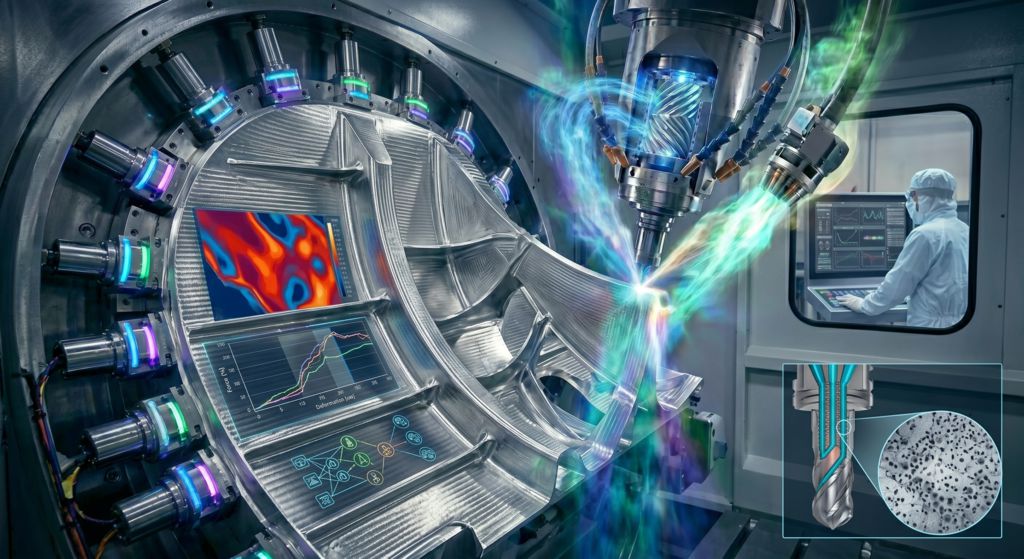
But on the manufacturing floor, these parts are notoriously temperamental. When you reduce the thickness of a metal wall down to just a millimeter or two, the component loses its structural rigidity during the manufacturing process. It becomes a flexible ribbon of metal.
The moment the cutting tools engage, or the clamps are released, the part acts like a spring—warping, twisting, and bowing completely out of specification.
For precision machine shops, conquering thin-walled machining requires moving past basic cutting parameters and entering the advanced world of deformation control and dynamic stress management.
1. The Underlying Enemy: Why Thin Walls Twist
To control thin-walled deformation, we have to look at the invisible forces locked inside the material. Every block of raw aluminum or titanium arrives at a machine shop with a baseline of internal energy trapped inside its molecular lattice, known as bulk residual stress. These stresses are left behind by original casting, forging, or rolling processes.
When a CNC machine begins milling away the metal to create a pocket, it doesn’t just create a hole; it destroys the internal balance of those trapped forces.
As the thick sections of metal are stripped away, the remaining thin walls no longer have the mass or stiffness required to hold those bulk residual stresses in check. The internal forces pull and push against the thin cross-section. The moment the part is released from its industrial fixtures, the metal shifts to find a new equilibrium, resulting in immediate warping and distortion.
2. The Mechanics of the Cut: Plowing vs. Shearing
Beyond the internal stresses born within the raw material, the cutting process itself actively injects new machining-induced residual stresses into the thin skin of the wall. This happens through two primary mechanisms at the tool tip:
A. Thermal Expansion (Tensile Friction)
When a cutting tool dulls or rubs against a thin wall, it generates intense friction, causing a sudden localized temperature spike. The outer skin of the thin wall expands rapidly from the heat, while the cooler root of the wall resists the movement. As the surface layer cools down and shrinks, it gets trapped in a state of high tensile residual stress, causing the wall to curl inward toward the cut.
B. Mechanical Plowing (Compressive Stress)
If a tool path forces the cutter to push heavily against the wall rather than cleanly slicing the metal chips away, it creates a mechanical plowing effect. The tool physically drags and compresses the top layer of metal atoms. This cold-working action leaves behind severe compressive residual stress on the outer skin, forcing the thin wall to buckle outward.
3. The Toolbox for Deformation Control
Defeating thin-wall deformation requires a multi-layered manufacturing strategy that combines smart toolpath programming, advanced fixturing, and stress-relieving protocols.
Symmetrical Step-Down Toolpaths (The Layered Approach)
The absolute worst way to machine a thin wall is to mill one entire side down to its final thickness before touching the other side. This completely unbalances the stress profile, ensuring the wall deforms instantly.
Instead, optimized CAM programming utilizes symmetrical step-down paths or axial-enveloped milling. The tool cuts both sides of the wall simultaneously or alternates in small, shallow increments. By stepping down in matching layers on both sides, the internal stresses are released evenly, allowing the wall to remain perfectly vertical and stable throughout the cut.
High-Speed Machining (HSM) and High-Feed Paths
To minimize the amount of heat and physical force injected into a thin wall, modern shops deploy High-Speed Machining parameters. By running the spindle at ultra-high RPMs combined with light radial depths of cut, the physics of chip formation shifts.
The cutting forces drop dramatically, and the friction heat is instantly transferred into the flying metal chips before it can sink into the delicate wall structure.
Adaptive Fixturing: Sacrificial Support and Vacuum Arrays
Traditional heavy mechanical vises will crush a thin-walled part, introducing massive clamping stresses before the machine even turns on. To hold these flexible parts safely, manufacturers utilize custom vacuum chuck arrays that distribute holding forces perfectly across the entire surface of the plate.
For ultra-thin, complex geometries, shops will even utilize temporary sacrificial filling media—such as specialized industrial waxes or low-melting-point alloys. The fluid medium is poured into the completed pockets of the part, where it hardens to provide rigid structural support while the adjacent thin walls are being machined.
Once production concludes, the part is gently warmed, and the filler melts away harmlessly.
4. Post-Processing: Relaxing the Molecular Jungle
Even with flawless toolpaths and high-speed cutting, some degree of internal stress is unavoidable. For critical components bound for space or aircraft frames, post-machining stress management is non-negotiable.
Parts frequently undergo Thermal Stress Relieving between the rough-machining and final-precision finishing passes. Placing the component inside a controlled industrial furnace allows the strained atomic bonds within the thin walls to vibrate, relax, and rearrange themselves into a stress-free state.
By executing a final, micro-level finishing toolpass after this molecular relaxation, the machine cleans up any minor distortion caused by the furnace, leaving behind a dimensionally perfect, rock-solid structural component ready for the field.
The Bottom Line
Thin-walled structural components are the future of high-efficiency design, but they demand an entirely new level of manufacturing discipline. You cannot treat a one-millimeter aluminum web with the same brute-force logic used on a thick steel block.
Conquering thin-wall warpage is an exercise in thermodynamic and mechanical balance. By mastering the art of symmetrical material removal, minimizing tool friction through high-speed cutting paths, deploying adaptive vacuum fixturing, and respecting the role of thermal stress relief, modern machine shops transform a highly volatile manufacturing challenge into a predictable, high-precision science.
The result is infrastructure that isn’t just remarkably light, but internally stable enough to endure the toughest journeys imaginable.
Get more info, please visit our CNC Turning Parts or Products.
Contact us for your customized metal parts.