When a passenger aircraft rolls down the runway and lifts into the sky, it relies on thousands of mission-critical components operating in absolute harmony. Inside the jet engines, turbine blades spin under immense centrifugal forces; in the fuselage, structural ribs endure rapid pressure changes.
In aerospace engineering, a single component failure is not a minor inconvenience—it is a potential catastrophe.
Because the stakes are life and death, the aerospace industry does not operate on trust. It operates on verification.
To ensure every single part meets uncompromising standards, the global supply chain relies on a rigorous network of Aerospace Quality Certification Systems. Historically, this meant managing mountains of physical paperwork.
However, in the era of smart manufacturing, the industry is undergoing a massive digital transformation, pairing traditional certifications with Digital Traceability. Here is how modern aerospace manufacturing is building an unbreachable fortress of quality.
1. The Pillars of Aerospace Quality: Understanding AS9100 and Nadcap
Before a machine shop can cut a single piece of titanium for an aerospace client, it must prove its operational discipline through specialized certification frameworks. Unlike general manufacturing standards, aerospace-grade certifications mandate absolute control over every variable.
AS9100: The Gold Standard of Management
The bedrock of aerospace manufacturing is the AS9100 standard. Building upon general ISO quality structures, AS9100 adds stringent layers explicitly tailored for aviation, space, and defense. It demands that a facility establish rigorous protocols for risk management, product safety, configuration management, and counterfeit part prevention.
Under AS9100, any change to a manufacturing process—such as updating CNC software or replacing a cutting tool brand—must undergo an exhaustive validation process before production can resume.
Nadcap: Controlling the Special Processes
While AS9100 governs overall management, Nadcap (the National Aerospace and Defense Contractors Accreditation Program) dives deep into the physics of manufacturing. Nadcap focuses strictly on “special processes” where the final quality of the part cannot be easily verified by visual inspection alone.
This includes processes like heat treatment, chemical processing, non-destructive testing (NDT), and laser welding. Achieving Nadcap accreditation means proving to a panel of global aerospace experts that your furnaces, chemical baths, and laser systems operate with flawless, predictable consistency.
2. The Evolution of the Digital Thread: From Paper to Pixels
Historically, proving compliance with AS9100 and Nadcap required a literal paper trail. A single aerospace bracket would be accompanied by a thick binder containing physical raw material mill sheets, operator sign-offs, heat treatment charts, and coordinate measuring machine (CMM) inspection printouts.
This paper-heavy model introduced massive storage burdens, manual data entry errors, and significant delays during quality audits.
Enter the Digital Thread.
The digital thread is an unbroken, digitized loop of data that connects every single phase of a component’s lifecycle—from its initial CAD design and CAM toolpath optimization, through raw material sourcing and CNC machining, all the way to final quality inspection and field deployment. Instead of scattered paper binders, every piece of manufacturing data is automatically captured, time-stamped, and linked to a unique digital identifier for that specific part.
3. Inside Digital Traceability: How Modern Shops Track Production
Digital traceability transforms data from a passive historical record into an active, protective shield. On a modern, digitized aerospace shop floor, traceability is achieved through advanced industrial technologies:
Direct Part Marking (DPM) and Smart IDs
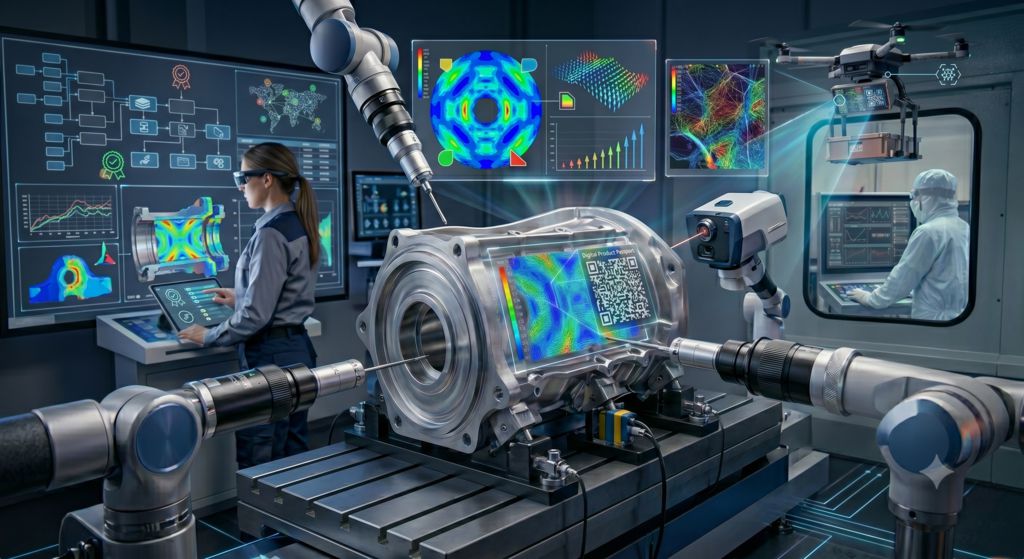
Every aerospace component is embedded with a permanent, laser-etched or dot-peened DataMatrix code or a specialized RFID tag. This identifier can survive extreme temperatures, chemical washes, and decades of operational wear. At every step of production, operators or automated robotic cells scan this code.
The system automatically records which machinist processed the part, which CNC machine spindle was used, the exact batch of cutting fluid applied, and the ambient temperature of the shop floor during the cut.
Real-Time Sensor Integration
During Nadcap-governed special processes like heat treatment, digital sensors stream temperature and atmospheric data directly into an Enterprise Resource Planning (ERP) or Manufacturing Execution System (MES). If a furnace experience a minor micro-fluasion in temperature for even a fraction of a second, the software flags it instantly.
The digital system automatically quarantines the affected parts before they can proceed down the line, preventing human error from slipping a potentially flawed component into an aircraft assembly.
4. Securing the Supply Chain: Blockchain and Digital Passports
As aerospace supply chains become increasingly globalized, maintaining digital traceability across multiple continents and subcontractors presents a major security challenge. To prevent data tampering and eliminate the risk of counterfeit materials entering the loop, the industry is deploying Industrial Blockchain Technology.
By recording traceability data onto a decentralized, cryptographic ledger, manufacturers create an unalterable history for every component. Once a raw material supplier logs the chemical purity of a titanium ingot onto the blockchain, that data cannot be modified or erased by anyone else down the supply chain.
When the final part is delivered to an aircraft assembly facility, it comes with a complete Digital Component Passport. Engineers can scan the part’s barcode and instantly trace its entire lineage back to the exact mine where the titanium ore was pulled from the earth, providing absolute verification of authenticity and quality compliance within seconds.
The Bottom Line
Aerospace quality certification is no longer just a set of rules hanging on a factory wall; it is a live, dynamic digital ecosystem. The marriage of rigorous standards like AS9100 and Nadcap with advanced digital traceability has fundamentally changed the economics of safety.
By replacing legacy paper trails with the digital thread, real-time sensor monitoring, and secure electronic passports, the aerospace industry is maximizing efficiency while driving defect rates closer to absolute zero.
In the high-stakes realm of flight, this digital fortress of data ensures that every piece of metal soaring through the clouds is backed by an unassailable record of precision, reliability, and engineering perfection.
Get more info, please visit our CNC Turning Parts or Products.
Contact us for your customized metal parts.