Can a CNC Machine Get Heatstroke? How Spindle Thermal Displacement Silently Ruins Precision Machining
Imagine it’s a scorching summer day. You step into the shop floor, load a fresh workpiece into your CNC machine, and start running a high-precision job. The first few parts come off the line looking immaculate—every dimension is spot-on down to the micron.
You feel great about the production run, grab a quick lunch, and let the machine do its magic.
When you return a few hours later to inspect the latest batch, you get a nasty shock. The parts are out of spec. The pockets are cut too deep, or the holes are slightly off-center. Yet, no one altered the CAM program, the cutting tool isn’t worn out, and the machine didn’t crash.
What went wrong? Your CNC machine just suffered from a case of spindle thermal growth—or in plain English, your machine got heatstroke.
Let’s take an easy, math-free look at why spindle thermal displacement happens, how it wreaks havoc on your precision parts, and what you can do to keep your machine cool, calm, and accurate.
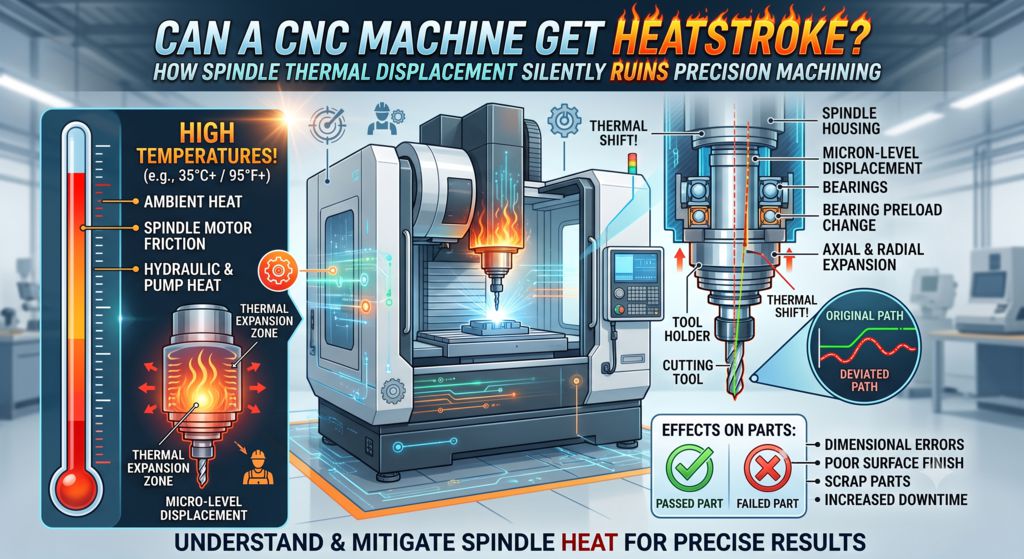
What Is Spindle Thermal Displacement?
To understand how a machine “gets heatstroke,” think about what happens inside the spindle head during a typical machining cycle.
The spindle is the beating heart of a CNC milling machine or lathe. Inside that metal housing, heavy-duty bearings are spinning at thousands—sometimes tens of thousands—of RPMs. At the same time, the electric motor driving the spindle is drawing significant power.
All that motion and energy creates friction, and friction creates heat.
As the spindle runs continuously, the internal temperature climbs. Just like a bridge expanding under the summer sun, the metal housing, bearings, and shaft inside the spindle begin to expand. Because the spindle is anchored to the machine’s column, it has only one direction to expand: downward toward your workpiece.
This unwanted movement caused by heat is what engineers call spindle thermal displacement or thermal growth.
The Destruction: How Thermal Growth Sneaks Up on Your Parts
In high-precision manufacturing, we fight for tolerances measured in microns (thousandths of a millimeter). A human hair is roughly 70 microns thick. A hot, hard-working spindle can easily expand by 20 to 50 microns or more as it warms up.
When your spindle expands downward, the cutting tool attached to it reaches deeper into the material than the control computer thinks it does.
Here is how this thermal expansion destroys your work in subtle ways:
1. The “Drifting Zero” Problem (Z-Axis Creep)
If you set your tool height offset (Z-zero) when the machine is cold, that reference point is valid only while the machine stays cold. As the spindle heats up and stretches downward, your tool cuts deeper and deeper. Pockets end up over-milled, step heights become uneven, and thin-walled parts can be completely ruined.
2. Multi-Tool Discrepancies
Imagine using a large facemill to rough out a part while the spindle is warm, and then switching to a small drill bit later when the spindle has cooled down during a pause. The height difference between the two tool operations will cause steps, misaligned holes, and inconsistent depth measurements across the same part.
3. Thermal Distortion Across Axes
Heat doesn’t just push the tool straight down (Z-axis). Heat from the spindle motor and internal bearings can radiate into the machine’s casting, causing the column or headstock to tilt slightly. This introduces subtle alignment errors along the X and Y axes, turning true circles into slight ovals or causing wall taper in deep pockets.
Why Doesn’t the CNC Machine Know It’s Growing?
Modern CNC machines use linear encoders and position sensors to track where the tool is. So why don’t they automatically stop thermal growth?
The reason is simple: standard position sensors measure the movement of the slides and axes, not the thermal expansion of the physical metal spindle shaft itself. The machine’s computer believes the Z-axis motor is holding position perfectly—unaware that the steel housing surrounding the tool holder has stretched downward due to heat.
How Smart Shops Beat the Heat
You can’t eliminate friction entirely, but top-tier machine shops use clever strategies to keep thermal growth from ruining their production runs:
1. The Morning “Warm-Up” Routine
A cold machine is an unpredictable machine. Before cutting high-precision parts, experienced machinists run a 20-to-30-minute warm-up program. This gently spins the spindle and moves the axes, bringing the machine up to its stable operating temperature before any tool touches metal. Once the machine reaches thermal equilibrium, it stops growing and stays stable.
2. Active Spindle Chillers
High-speed or heavy-duty CNC machines often feature built-in cooling jackets wrapped around the spindle housing. An industrial chiller continuously pumps temperature-controlled fluid around the spindle, pulling heat away at the source before the metal can expand.
3. Thermal Sensors and Software Compensation
Modern high-end machine tools come equipped with temperature sensors embedded directly inside the spindle and machine casting. The machine’s controller monitors these sensors in real time and uses smart algorithms to automatically adjust the tool position by a few microns, offsetting the heat expansion as it happens.
The Takeaway: Keep Your Spindle Cool for Consistent Precision
A CNC machine might be made of heavy steel and iron, but it is just as vulnerable to temperature changes as any living organism.
The next time your parts start mysteriously drifting out of tolerance during a long production run, don’t blame your CAM software or your cutting tools right away. Check if your machine is running a fever.
By warming up your equipment, utilizing proper cooling systems, and respecting the physics of heat, you can keep spindle thermal growth under control and ensure every part comes off the line perfectly.
Get more info, please visit our CNC Turning Parts or Products.
Contact us for your customized metal parts.
Have you ever lost a batch of parts to spindle thermal expansion? How does your shop handle machine warm-ups on cold mornings? Let’s share your experiences in the comments below!