The 20°C Rule: Why Your Measurements Change From Morning to Afternoon
If you have spent enough time in a machine shop, you have almost certainly encountered the ultimate manufacturing ghost story.
It goes like this: You arrive early in the morning, fire up the CNC machine, and cut a highly precise part. You pull out your calibrated micrometer, measure the diameter, and smile. It is absolutely perfect, sitting right dead-center of your tolerance zone. You set the part on your workbench and go to lunch.
When you come back in the late afternoon, the quality control inspector walks over, picks up that exact same part, measures it with the exact same micrometer, and shakes their head.
The part is out of tolerance. It grew.
You didn’t touch it. The machine didn’t magically recut it. So, how can a solid block of metal change its size just by sitting on a desk?
The answer lies in the invisible, shape-shifting nature of temperature. In the world of high-precision manufacturing, a few degrees of heat can be the difference between a perfect aerospace component and a piece of expensive scrap metal. Let’s dive into why parts seem to magically change size throughout the day, and why precision shops obsess over keeping their rooms at exactly 20°C (68°F).
The Culprit: Metal Breathes with the Temperature
To understand the morning-versus-afternoon mystery, we have to stop looking at metal as a dead, frozen object.
At a microscopic level, materials like aluminum, steel, and brass are highly active. When a piece of metal warms up, its atoms vibrate faster and push slightly away from each other. The entire piece of metal expands like a slow-motion sponge soaking up water. When the air cools back down, the atoms relax, and the metal shrinks.
In our daily lives, this thermal expansion is completely unnoticeable. But on a precision shop floor, we are measuring things in microns (one-thousandth of a millimeter).
Aluminum is notoriously sensitive to heat. Just the simple act of holding an aluminum part tightly in your warm hands for two minutes will cause it to physically expand enough to fail a tight tolerance check.
The Morning vs. Afternoon Trap
Let’s look at why your measurements are lying to you throughout a typical workday in a shop without strict climate control.
The Morning Chill
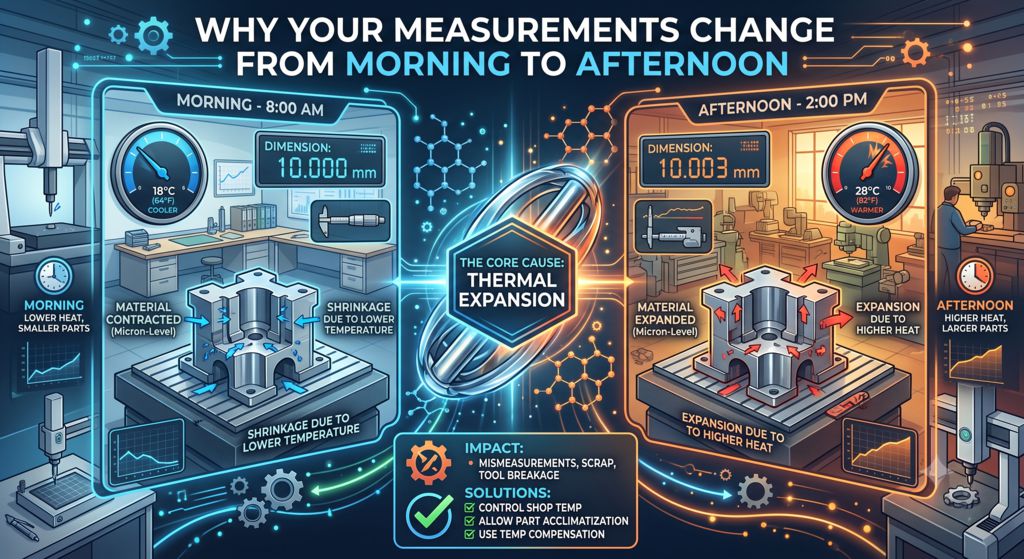
When you open the shop at 7:00 AM, the building is cool from the overnight air. The heavy cast-iron CNC machines are cold, the metal raw material is cold, and your measuring tools are cold. When you machine a part and measure it, everything is in a shrunken, tightly packed state. It measures perfectly.
The Afternoon Bake
By 3:00 PM, everything has changed. The sun has been beating down on the factory roof for hours. The CNC machines have been running non-stop, generating massive amounts of friction and pumping heat into the room.
Now, the ambient air is several degrees warmer.
- The Part: The part sitting on your bench has soaked up the afternoon heat and expanded.
- The Tools: Your micrometer or caliper has also warmed up and changed its shape slightly.
- The Machine: The metal frame of the CNC machine has absorbed heat and literally grown taller and wider, shifting the position of the cutting tools.
When the afternoon inspector measures the morning part, they are measuring a swollen part with a swollen tool. The part hasn’t actually grown extra metal; it is just reacting to the room. If you put that same part in a refrigerator, it would shrink right back into tolerance.
Why Exactly 20°C (68°F)?
If temperature causes so much chaos, the obvious solution is to turn on the air conditioner and keep the room stable. But why does every high-end inspection lab and precision machine shop in the world use 20°C as the magic number?
1. The Global Handshake (ISO 1 Standard)
Imagine a company in freezing-cold Canada making a steel shaft, and a company in sweltering-hot Taiwan making the bearing that the shaft needs to slide into. If both companies measure their parts at their local room temperatures, the parts will never fit together when assembled.
To solve this, the international manufacturing community created a globally agreed-upon baseline called the ISO 1 standard. It dictates that the official, true size of any physical object is its size at exactly 20°C.
If you are inspecting a part that must be accurate down to the micron, the only way to know if it is truly correct is to measure it when both the part and the measuring tool are resting exactly at 20°C.
2. The Human Comfort Factor
Scientists and engineers could have picked 0°C (freezing) as the global standard, but that would make working in a factory incredibly miserable. 20°C (about 68°F) was chosen because it strikes a perfect balance: it is warm enough for operators to work comfortably without wearing heavy winter coats, but cool enough to prevent the machines from overheating.
How Smart Shops Tame the Temperature
Achieving a constant 20°C in a room filled with heat-generating industrial equipment is incredibly difficult. You cannot just use a standard home air conditioner. Top-tier machining and inspection facilities use extreme measures to lock their environment down:
- Heavy-Duty HVAC Systems: These specialized systems don’t just blast cold air; they constantly mix and circulate the air to prevent “hot spots” near the ceiling and “cold spots” near the floor. They keep the temperature locked within a single degree of fluctuation, 24 hours a day, 365 days a year.
- Thermal Soaking: Precision shops never machine or measure metal the moment it arrives off a delivery truck. They let the raw materials and finished parts sit in the 20°C room for 12 to 24 hours to “thermally soak” and stabilize before anyone touches a micrometer.
- Humidity Control: As a bonus, keeping the room at a constant, cool temperature allows the HVAC system to strip moisture out of the air. This prevents the ultimate enemy of the machine shop: rust.
The Bottom Line
Precision manufacturing is not just about having the sharpest cutting tools or the most expensive CNC machines. It is about controlling the physical environment.
The next time your measurements seem to magically wander between your morning coffee and your afternoon break, don’t blame your tools. Check your thermometer. By respecting the laws of thermal expansion and bringing your shop as close to that magical 20°C mark as possible, you will eliminate the guesswork and ensure your parts are perfect—no matter what time of day it is.
Get more info, please visit our CNC Turning Parts or Products.
Contact us for your customized metal parts.