The aerospace industry demands the highest levels of precision, safety, and reliability in component manufacturing.
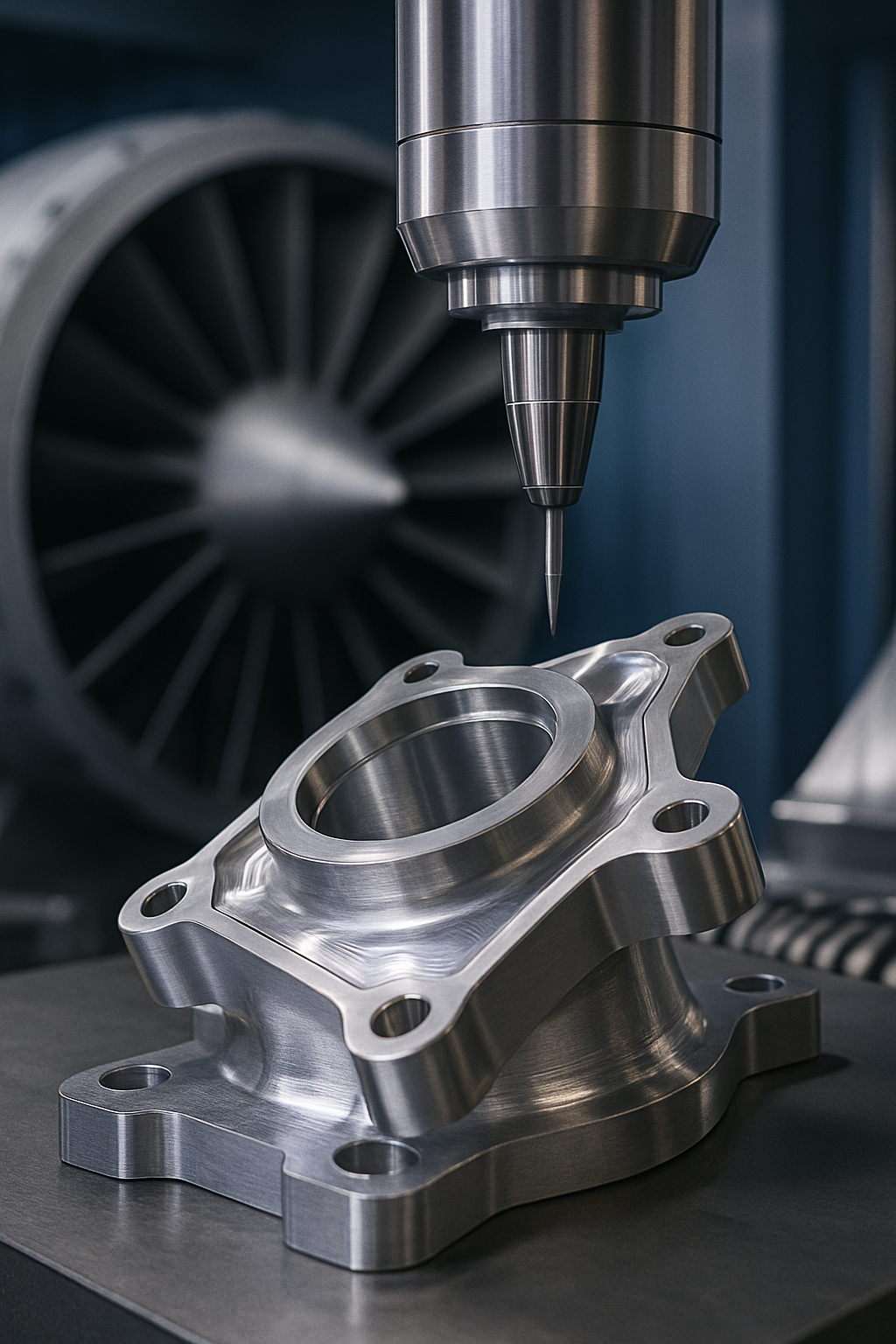
Aerospace parts machining is one of the most advanced sectors in precision engineering, where every component must meet stringent quality standards to perform under extreme conditions such as high temperatures, vibration, and pressure differences.
1. The Importance of Precision in Aerospace
Aircraft and spacecraft components are subjected to severe operating environments. Even the smallest dimensional error or surface defect can compromise safety. Machining tolerances often reach the micron level, ensuring that parts such as turbine blades, landing gear, and structural frames fit and function flawlessly.
2. Materials Used in Aerospace Machining
The aerospace sector relies on advanced materials to achieve performance goals:
Titanium Alloys: High strength-to-weight ratio and excellent resistance to heat and corrosion, ideal for turbine blades and structural components.
Aluminum Alloys: Lightweight and cost-effective, commonly used in fuselage and wing structures.
Nickel-Based Superalloys: Critical in jet engine components due to their ability to withstand extreme heat.
Composites with Metal Inserts: Increasingly used for lightweight structures, requiring hybrid machining solutions.
3. Key Machining Processes
Aerospace machining combines conventional and advanced methods to meet tight specifications:
CNC Milling and Turning: Provide precision shaping for complex geometries.
Grinding and Honing: Deliver ultra-smooth surfaces, crucial for fatigue resistance.
Electrical Discharge Machining (EDM): Used for intricate shapes in hard-to-machine alloys.
Additive Manufacturing Integration: Enables lightweight designs that are subsequently machined to meet final tolerances.
4. Challenges in Aerospace Machining
Material Hardness: Titanium and superalloys are difficult to machine, requiring specialized tools and cooling systems.
Tight Tolerances: Demands extensive quality control, including CMM (Coordinate Measuring Machine) inspection and non-destructive testing.
High Production Costs: Tool wear, long cycle times, and scrap reduction add to overall costs.
Regulatory Compliance: All parts must comply with rigorous standards such as AS9100 and FAA/EASA requirements.
5. Role of Automation and Digitalization
Industry 4.0 technologies are reshaping aerospace machining:
Robotics and Automation: Improve efficiency in repetitive operations.
IoT and Smart Monitoring: Enable predictive maintenance and tool life optimization.
Digital Twins and Simulation: Reduce prototyping time and improve design-to-production accuracy.
6. Applications of Aerospace Machining
Engines: Turbine blades, compressor discs, and casings.
Landing Gear: High-strength steel and titanium parts designed to withstand repeated stress.
Airframes: Precision aluminum and titanium structures.
Spacecraft: Lightweight and durable components resistant to extreme environments.
Summary
Aerospace parts machining represents the pinnacle of precision manufacturing, where safety and performance are paramount.
Through advanced materials, cutting-edge machining processes, and strict quality controls, manufacturers deliver components that keep aircraft and spacecraft operating reliably.
As aerospace technology evolves, machining will continue to adapt—integrating hybrid manufacturing, automation, and digitalization to meet the challenges of next-generation aviation and space exploration.
See our Facility and Inspection Equipment